Lord of Scoundrels by Loretta Chase

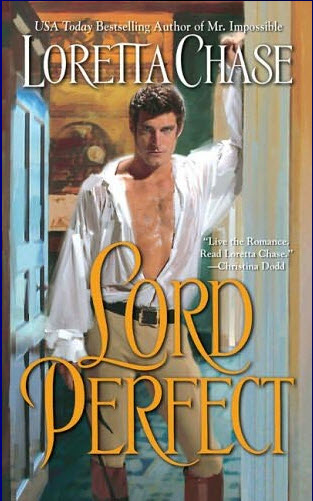
I am including this review for one reason only. Look at him:

I know it’s discomfiting, but do it for me. Note the manly open shirt, the manly sheen on his chest, the manly Coty cologne advertisement feathered hair and sideburns. The insolence. The seduction. The riding crop. The smolder. It’s not the book I’m reviewing, but Lord of Scoundrels is by the same author, and its cover is boring and staid. How could it not be in comparison to this wheel of Gouda? Not that Lord Perfect isn’t completely acceptable, it’s just that Lord of Scoundrels is a classic. It has a much deserved Amazon rating of 4 1/2 stars after 284 reviews. If I am embracing the historial romance genre, this book needs to be included as one of the ultimate romance novels: larger than life characters, operatic kisses in the rain, a battle of wills and, most of all, fun. It is thisclosetocamp, probablycloser, and the result is a delicious wet kiss of a book.

Our hero, full name Sebastian Ballister, Marquess of Dain, is 6’6″, black hair, black eyes, big nose, all man. Wealthy, arrogant, and clever, he meets his match in Jessica Trent, a pert, patient (she’ll need it), self-possessed spinster who has come to Paris to retrieve her gormless brother from the demi-monde Dain inhabits. He takes one look at Jessica and wants to lick her from head to toe. She takes one look at Dain and wants to rip all his clothes off. LET THE GAMES BEGIN! It’s beauty and the beast meets reformed rakes make the best husbands meets tortured hero, with a side of moustache twirling by minor characters trying to ruin everyone’s day. From Paris, the book moves to Dain’s ancestral home with machinations about a Russian icon and an illegitimate child, and an intense romance long on passion and blessedly short on maudlin.

Loretta Chase is, above all, an engaging and confident romance writer. She sets the scene deftly and excels at creating entertaining characters. If you like a touch of intrigue with your romance, she’s your gal. There will be chases, treasures and grand adventures. If you’re like me, you will revel in it despite the B story that does go on a bit. I find myself glossing over those parts hoping I don’t miss any major plot points. Truth be told, I can never tell if the subplot issue is with me (Why aren’t they kissing or bantering? When will they get back to the kissing and bantering? I DEMAND KISSING AND BANTERING!) or with the stories themselves, and I really don’t care.

Links to my other reviews can be found on my complete reading list of books sorted by author or Author Commentary & The Tallies Shameful.

The Turner Series: Unveiled, Unclaimed, Unraveled by Courtney Milan

It is a truth universally acknowledged that romance novels are not necessarily very well-written; however, if you are curious about them and want to know who is the best writer out there (of the more than two dozen I’ve tried) Courtney Milan is where you should start. Lisa Kleypas is actually my favourite writer, but I’ve already consumed her entire output and am looking out for other authors. Milan is a newer writer, very much better than most, and she makes interesting choices which neatly turn genre tropes, if not upside-down, at least on their side. This trilogy contains one book each for three popular romance storylines: the revenge plot, Unveiled, the reformed rake, Unclaimed , and the tortured hero, Unraveled . I read the books in reverse order, admittedly starting with the best one.

The Turner brothers grew up with an absent father and a deranged religious zealot mother. Their names are actually bible verses, so they each use a shortened nickname from their verse in daily life: Ash, Mark, and Smite, yes, Smite. Each man bears unique wounds of their traumatic experiences. The oldest, Ash (Unveiled), left his brothers behind to build a secure future for them. He was gone for several years, returned a wealthy man (in the manner of self-made men in romance novels, he is hardworking and magic at math, and that is all it takes to become rich), and as we join him at the beginning of his story, he is poised to steal a dukedom out from under a noble family based on his manipulations of primogeniture. Hoping to find his weakness, Margaret, the daughter of the house, stripped of her legitimacy by Ash’s actions, is posing as the current Duke’s nurse to spy on the Turners. Ash takes up residence with his brother, Mark, at the ducal estate, ostensibly to assess the family’s finances before the final act of transferring inheritance takes place. Normally, these vengeful men are dark, intense and intimidating. Ash is a giant mastiff that nuzzles you into acquiescence. While he is intense and “cheerfully ruthless”, he is also a profoundly nice man, plagued by insecurities and not a small amount of survivor’s guilt. Margaret has been treated as a pawn her entire life, reduced to who she can marry and dependent on the (sorely lacking) kindness of the men in her life to ensure her security and happiness. Ash objects to these notions and to the effect they have had on Margaret as a person. Many romance novel heroes become caretakers to the heroine, but almost none wage a campaign of relentless kindness and encouragement regardless of his personal goals. He wants her as a partner, but more than that he wants Margaret to see herself as a person in her own right, and with her own rights, in charge of her own happiness.

The hero of Unclaimed , Mark, is a 28-year-old virgin. Let me repeat that and emphasize that it is unprecedented in my experience: Mark is a 28-year-old VIRGIN, and not just a virgin, one who has become a celebrity after writing a tract on chastity, the first line of which is “Chastity is hard.” Mark is the youngest brother of the trio and while he is chaste, he is not innocent. His elder brothers protected him to the best of their ability, but his mother’s insanity resulted in choices and situations that no child should endure. With a virginal hero, the reformed rake role in this story falls to Jessica, a courtesan who has been hired to seduce and publicly humiliate Mark. She was “ruined” and disowned by her family at the age of 14 and has made her way in the world with a series of “protectors”. It is the most recent of these who has promised a payment equal to lifelong financial security to destroy Mark’s reputation, but here’s the thing: Mark isn’t really concerned about his reputation. He is honest in his chastity, but he dislikes the fame it brings and the resulting loss of control over his very simple message about the societal repercussions of sex outside of marriage. In most romance novels, there is an extreme disparity in sexual experience. The hero has had mistresses and lovers, and in their polite way, the writers make it clear that all of those women were available and unscathed. When the heroine has experience, it is extremely limited, she thought she was, or she actually was, in love and the result was her personal downfall. Even if she is older, she is chaste. In Unclaimed, Jessica has used the one thing she had to survive in the world alone. It has cost her emotionally, and even physically, but she is not viewed with the disparagement normally accorded a woman “no better than she should be”. Mark likes himself and he genuinely likes her, and he wants her to feel the same way. Her transformation from someone simply trying to survive into someone trying to build a real life for herself is believable and charming.

In Milan’s novels, not everything is country dances and house parties. Although I do not look for devotion to historical accuracy when I read these books, I mostly just enjoy the period costume descriptions and the home life details, Milan creates a true sense of the squalor and dangers lurking close to the surface in Victorian England. Unraveled in particular, dwells in the horrifying poverty of Bristol and the severe limitations and prejudices of the so-called justice system of the era – all of which brings us to Smite. Well now, Smite is my favourite. He is a brilliant, dark, pensive man, enmeshed in duty, and possessing of a wry sense of humour. Who could resist a man who says to his mistress, “I would not like you half so much, if you weren’t sarcastic,”? Not I, dear reader, not I. He is Milan’s tortured hero. He bore the brunt of his mother’s madness, he bears it still in PTSD, and in the roles he chooses in life. He works as a magistrate hoping to prevent the disregard of society that brought him and his brothers to such a vulnerable state. But he is still a man, so when he encounters a vibrant and canny young woman, Miranda Darling, posing as a witness at a trial, something happens that is again extremely unusual in a romance novel: he asks her to be his mistress and she accepts. For one month of sexual intimacy, Miranda will receive the princely sum of 1,000 pounds and a house. Miranda has just barely survived on her wits and has fashioned protection for herself by association with the local crime lord, so this business arrangement is an escape, but one which will be complicated by the tenacity of the underworld’s grip on her. She can earn lifelong financial independence in exchange for something/someone she also desires, and it gives Smite gets one month to dwell in the land of the living before returning to his self-imposed exile. What works about this tortured hero is not that he is broken and needs to be fixed by some innocent, inexperienced chit, as would normally be the case, rather Smite is in tact and what he and Miranda both require, and find in each other, is a kindred spirit who can meet each other’s needs and their own together.

Milan’s men have attitudes inconsistent with the era. They have no judgement of past indiscretions at a time when being seen alone with the wrong someone could ruin a woman’s reputation. The Turners treat the women as equals and want the women to see themselves in the same way. It is the latter element that makes her books so wonderful. Mark thinks well of himself and wants the same for Jessica; he wants her to want more, to expect more and to be her own person. Ash wants Margaret to see herself as a complete person, in turn she helps him smooth over his own wounds. Smite and Miranda balance each other and provide the freedom to be who they want to be.

A complete summary of Courtney Milan’s catalogue, with recommendations, can be found here.

Links to my other reviews can be found on my complete reading list of books sorted by author or Author Commentary & The Tallies Shameful.
 

The Pennyroyal Green Series: What I Did for a Duke by Julie Anne Long

I’m still reading historical romance novels and I keep a list of them as though tracking such things makes it any less ignoble. I call it The Shameful Tally. I also track the heroes’ names (Alex and Sebastian being the most popular), and the books so awful that I gave up on them.

What I Did for a Duke is from Julie Anne Long’s “Pennyroyal Green” series about the Redmond and Eversea families. She has set herself up quite nicely for a large group of interconnected novels as is a standard practice in this genre. It gives the reader a chance to revisit their favourite characters and is something I particularly like; so much so that I must confess, I have even bought a book only because I knew I’d get to see “Sebastian and Evie” (Lisa Kleypas The Devil in Winter) again. I adore them. I will buy any book they are in. Publishers are smart and I am easily led. From this Julie Anne Long series, I’ve also read How the Marquess Was Won. That book was so good, so good, oh Sweet Fancy Moses that is romantic, wait, is this high school?, oh, now, it’s all fallen apart, RATS! By the way, if you think these titles are bad, Long has a book called I Kissed an Earl that is waiting for me on my Kindle. As if the cover art weren’t embarrassing enough, these titles add insult to ignominy.

I’ve sampled about 2 dozen writers and you’ve got to give a writer credit where it is due: If you can pull off an almost 20 year age difference and make it not only palatable but irrelevant, you are on the right track. What I Did for a Duke pairs 20 year old Genevieve Eversea with “almost forty” (a phrase often and lovingly repeated) Alex Moncrieffe, Duke of Falconbridge. He is a widower out for revenge against Genevieve’s brother, Ian, for attempting to bed the Duke’s fiancée. Over the course of a house party, Alex sets out to seduce and leave Genevieve, but, pleasantly enough, the revenge plot is called off when this young woman figures it out, and is far lovelier and more attractive than Alex had anticipated. She’s bright and banters well. He’s charming and kind of autocratic. Tra la la. They get married. YAY!

There is nothing new here which is good because I am not looking for anything new, just fresh. It’s nice to see a standard revenge plot dismantled, but the real reason that this book works is simple: Julie Anne Long is very funny and she writes great smolder. That’s all it takes really; in fact, if you can pull off the funny, you don’t necessarily need the smolder, and, yes, she is that funny. [There was more here, but I’ve redacted the original pointlessly scathing review details.]

Edited April 17, 2013: I now consider Julie Anne Long one of the best romance writers currently publishing. Lisa Kleypas really skewed the curve for a while there when I was starting out with this phase. I bought this book as well as almost everything else Long has published, and she is on my autobuy list.

Edited October 1, 2013: What a bitchy review. So bitchy, this is the second time I have edited something that only I will see. What I Did for a Duke is a CLASSIC and I couldn’t see it at the time. The hero, Alex, is in the pantheon of great heroes. There are some issues with the structure, but the fact  is that in addition to the overall charm, humour, and delicious smolder, there is a two or three chapter section in the middle of the book that is simply magnificent. It features the hero and heroine having the kind of conversation that people falling in love have. The dialogue is honest and beautifully written, but what truly elevates it is the silences. There are long pauses during which the characters think and the reader follows their emotions to their conclusion. It’s just superlative and because it, and the rest of the book, are true to the emotional lives of the characters, Long accomplishes what every romance writer sets out to do.

A complete summary of Julie Anne Long’s catalogue, with recommendations, can be found here. Links to my other reviews can be found on my complete reading list of books sorted by author or Author Commentary & The Tallies Shameful.
Monomania Table for One

True Story: I recently renewed my Driver’s License and, being unwilling to be seen reading one of these books in public, I took The Life of Pi with me to help wile away the time. I was floored by the quality of the writing. It was as if I have read so much genre-specific literature, I had forgotten how good prose can be. I wanted to jump out of my seat and show everyone exclaiming, “Look at these sentences! They are so well written!”, instead I sighed quietly to myself, “I never knew it could be like this!”. Then I went home and read two romance novels, and I haven’t touched The Life of Pi since.

One More Book

Since I have been reading historical romance novels exclusively for over 3 months now, Mr. Julien has taken a new tack to dissuade me from continuing to do so. First, he had teased me. Then, he had suggested I read something else for a change, to which I replied, “I am 44 years old and will read whatever the hell I want,”, and now he has suggested that I write one. My response to that was what it has always been, “Have you ever been to a book store? The last thing the world needs is another book,”. His reply, “When I go to a bookstore, I see all the books and think there is always room for one more.” A more succint description of the difference between our personalities could not be given.

The Taming of the Shrew by William Shakespeare

I wanted to read William Shakespeare’s the Taming of the Shrew for a few reasons. Most importantly, it was to see if I could still cope with the text and thus prove my degree in English Lit/Drama is still in here somewhere. But I also chose it for its famous sexism/misogyny, to see how it came across to my middle-aged feminist eyes. I knew the plot, so I’d have no trouble understanding what was going on (or so I thought). Moreover, I have seen two live productions of the play and one of them made an indelible impression on me. It was in 1987 at the Stratford Festival (Ontario) with Goldie Semple as Kate and Colm Feore as Petruchio. When reading the play this week , I could still remember some of their interplay and reactions. It was a truly magnificent production. (I’ve also seen a filmed version with John Cleese of all people, and he was the best thing in it and the one who made the language most accessible.)

For the uninitiated, and how is that even possible, The Taming of the Shrew is the story of Baptista, a man with 2 daughters, both alike in dignity, but dissimilar in temperament, in fair Padua where we lay our scene. Katherina/Kate is the eldest, difficult and irascible; his youngest, Bianca, is a fair and delicate creature beloved by all the men she meets. Baptista is unwilling to let Bianca marry until Kate is herself settled. The ensuing hijinks focus around each sister: Bianca has a number of suitors performing a number of ruses to secure her hand. Kate is “taken on” by Petruchio as a challenge, and a wife, to allow Bianca’s suitors a chance gain their own ends. Petruchio proceeds to comically break Kate’s spirit rendering her a sweet, compliant, and therefore “happy”, wife.

As I started to read, I recalled, possibly incorrectly, that the modern aprroach to the play is to have Kate and Petruchio fall in love at first sight to lessen the sting of the abuse she endures and the obedient wife tropes she eventually spouts. If they are evenly-matched, and Petruchio’s efforts are ultimately well-intentioned to bypass the protective wall Kate has built around herself, it somehow makes it less awful when she is deprived of sleep, and food, and rational treatment. He is capricious in his behaviour to everyone he meets, and I don’t know it that helps exactly, but at least Petruchio is consistent. And Kate is a bit of a pill. They are indeed evenly-matched, if romance is a cage match, and in this case it is.

There was an irrelevant framing device that can be either included or omitted from the play. Its only use to me was as a starting point to accustom myself to the language, a task that would have been simpler, if fewer of the names were Somethingio. As I forged ahead, I knew I was going to be okay when I laughed out loud at this line –

PETRUCHIO: And you, good sir! Pray, have you not a daughter
Call’d Katherina, fair and virtuous?
BAPTISTA: I have a daughter, sir, call’d Katherina.

Some of the idiomatic language was lost on me, but I don’t think it undercut the overall effect of the play and, should I continue reading Shakespeare, I suspect that long dormant parts of my vocabulary will rally to the fore. Being a Shakespeare comedy (and from what I remember based on the story structures of ancient Roman plays which were later also used by P.G. Wodehouse) everyone is pretending to be someone else and trading places. The Bianca plot was actually the most challenging with all of those Somethingios to-ing, and fro-ing and woo-ing simultaneously. Had I been watching the play, which is, after all, the point, it would have been a lot easier to follow.

The Bridgertons Series: The Duke and I by Julia Quinn

Let’s start with a visual, shall we? After all, it is a romance novel and book cover art can be so dull.

The Duke and I is the first novel in Julia Quinn’s Bridgerton family series. It features Daphne Bridgerton, a young woman in her second season “out”, and Simon, Duke of Hastings, the erstwhile best friend of her brother, Anthony. Simon has been away for 6 years waiting for his father, a complete bastard, to die. He has returned to London to inherit his title and in doing so both accept and reject, as far as he is able, his role in life. Simon attends a soiree at the home of (recurring character) Lady Danbury and runs into Daphne as she tries to quash her only suitor’s advances. Daphne has not had luck with beaux. Men only see her as a friend because, rather than a fashionable flibbertigibbet, she is lovely, grounded, and kind. Now, who would want that? Guess. Simon is attracted to her instantly, but realising she is his best friend’s sister, errs on the side of propriety and backs off. The Fates and Plot Points intervene and the two of them settle into a friendship based on London society’s perception of their affection for each other: He escorts her to balls to deflect the unwanted attentions of marriage-minded women and to simultaneously make Daphne seem more appealing to suitable men by association with him. It works, but of course they fall in love, and, of course, there are obstacles, specifically Simon’s reluctance to marry and carry on his family name. The moment he gives in to his feelings for Daphne, they are caught in a compromising situation and the dance toward the happy ending is set in motion as, of course, they must marry…

While it would seem that I read the best of the Bridgerton, series first, I really enjoyed The Duke and I. Julia Quinn is especially good at the banter I look for in these books and she also manages to create a sense of anticipation in a story with a pre-determined ending. That is no small feat. This novel also had the added advantage of characters having genuine conversations. It doesn’t seem like a lot to ask for, but often romance novel interactions consist of projecting personality factoids at each other and waiting to kiss. Quinn creates believable people; they are beautiful, rich and charming, but at least they seem real enough to let you care about them. Lastly, Quinn is by far the best author I have found for balancing the love and sex elements.

A Bridgerton series summary is included in my review of Gregory’s book On the Way to the Wedding.

Reviewer’s Note:

I’ve read 20 historical romance novels in the past month and I have to ask –

What is with all of the French kissing? As God as my witness, last weekend, I read a kissing description in which the hero licked the roof of the heroine’s mouth. Is that even possible? Was he Gene Simmons? Is that an image you want in your head reading one of these books? Let me answer that for you: No, it is not. Do you remember when you discovered kissing, or, better still, kissed someone you were so smitten with that it was heady, electric, devastatingly swoony, and so many other delightful things? Remember those kisses? These books need more of that. In romance novels, the men are experienced, but the woman are certainly unaccustomed to being kissed. So imagine yourself as an inexperienced and, no doubt, uninformed young woman. You are being kissed by this man, this beautiful man. How much tongue is involved? How quickly? Is he flossing your uvula? These writers use tongue calisthenics to show the intensity of the leads’ connection, but don’t necessarily capture that magical kiss feeling. The racier the novel, the more violent, thrusting (in a “primitive rhythm”), sweeping, possessive, and getting into every nook and cranny of her mouth his tongue gets. There must be a way to describe kissing that is romantic, passionate and erotic, and doesn’t slide into inept erotica.

A summary of Julia Quinn’s catalogue can be found here. Links to my other reviews can be found on my complete reading list of books sorted by author or Author Commentary & The Tallies Shameful.

Tempt Me at Twilight by Lisa Kleypas

The Dowager Julien likes to read Georgette Heyer books upon occasion, and I recently pointed out to her that doing so did not mean she lost all intellectual credibility: Just because you enjoy kissing books does not mean that you forget what The Anschluss was, or have to go back to the remedial class; however, IF IT DID, I am now so knee deep in historical romance novels that my university degree would be revoked. “My name’s Prolixity and I used to want to write a Master’s thesis on e.e. cummings and the Metaphysical poets, but now I read books with characters named Sebastian, Lord St. Vincent”.

I listed the books I’ve read so far before, but I forgot a couple. There have been rather a lot.

Come Love a Stranger – Kathleen Woodiwiss – Reformed Rake: VERY attractive reformed rake, a lot of pages of subterfuge and silliness to skip over.
The Duchess – Jude Deveraux – I skimmed this one. Deveraux is a Deverdon’t.

Really? Are you still reading after that terrible joke? I am unworthy of such beneficence.

Since last week, I have read:

The Devil in Winter – Lisa Kleypas – Reformed Rake, Self-Sacrificing Lamb – I read it Friday night. My first Kleypas, but not my last, not even my last this past weekend.
The Viscount Who Loved Me – Julia Quinn – Reformed Rake AND Bridgerton Brother #1 (Anthony) – I read it yesterday. The Bridgerton books make me giggle and smirk. A lot. Occasionally, I hoot. I am expecting to receive The Duke and I by Julia Quinn in the mail today – Reformed Rake and Bridgerton Sister #1/sibling #4 (Daphne).

I went to K-Mart and purchased Lisa Kleypas’ Tempt Me at Twilight on Saturday morning. I went specifically to buy this book. I had seen it a couple of days before, but did not like the random passage I read. Later, I was reading different random passages on Amazon and came across a paragraph so appealing that I wanted the whole book. Now, go back and look at that title. Just look at it. Could it be any cheesier? Let me answer that for you: No, it could not. Mercifully, the book does not also have a salacious cover, but it does have a ridiculous frontispiece involving soap opera people posing in pseudo-19th century dishabille and, as is always the case in these books, bearing absolutely no physical resemblance to the characters. I ripped that sucker out of the book as fast as possible. The title is embarrassing enough; I don’t need to give Mr. Julien any more ammunition than necessary.

Tempt Me at Twilight is the story of Harry Rutledge and Poppy Hathaway. She is the rich daughter of an eccentric family, but, then, aren’t we all? Poppy has been “out” in society for three years and has not found a husband despite being beautiful and well-educated. Her problem, it seems, is an unconventional family, and her inability to dissemble about her education and intelligence. I like this Lisa Kleypas person already. Harry is the American owner of a London hotel that hosts families of the ton during the London season as they look for a mate they, hopefully, feel a sincere tendre for. If you have read any Regency romance novels, all of those words will make sense to you. Furthering my appreciation for Ms. Kleypas, Harry is tall, dark, handsome, and slightly forbidding. All excellent qualities. When the men are fair-haired, I stick my fingers in my eyes and sing “la, la, la I can’t hear you”, and then I scream and hit myself in castigation… Harry is also brilliant and a self-made man which adds a nice touch. Poppy and Harry meet cute and he sees in her everything good and wonderful in the world, so he ruins her reputation (in a chaste 19th century way) to make sure they end up married, but not really together, after which highly-predictable hijinks ensue. Being a Reformed Rake and having the usual “loveless child” back story, it takes him a while, practically the whole book, amazingly enough, to be able to voice his love for her, although he is clearly besotted which he shows in nice (gentleness, love, patience) and not so nice (jealousy, being overbearing) ways. I do so adore smoldering, besotted rakes. As is often the case, and not my taste, there was some silly sub-plotting, but I guess some people enjoy a bit of intrigue in their romance novels. I’m basically ONLY about the man/woman stuff, so if they’re not interacting, I’m not interested. That’s what skipping pages is for. I do that with whatever romance novel I’m reading.

Lisa Kleypas’ writing is very good for the genre. She doesn’t have the wit of Julia Quinn, but that is not a bad thing, only different. Kleypas is a bit racier, so it’s really just a question of what you are looking for. I cared about the characters, I loved Poppy, and wanted a Harry Rutledge of my own, and I think that is all that matters. Sometimes you want to giggle and beam (Quinn), and sometimes you want a charming, misguided, besotted rake, in which case Kleypas is a good choice.

Addenda:

Prolixity really is an apt pseudonym, isn’t it? I spend almost as long writing these reviews as I do reading the books.

These women spend a lot of time with their hair down. It’s not the historical inaccuracy I object to. It’s the fact that their hair is very long and it never gets caught under anyone or in the way. My hair goes about a 1/4 to a 1/3 of the way down my back and it’s forever getting caught under things, usually other parts of me.

One of the leads, usually the man, always has a Sardonic Eyebrow of Seduction which they lift as a wry gesture. I would love to be able to do that! Wry is one of my favourite things in the whole wide world. It’s why William Powell is my secret husband. The Dowager Julien has a Baleful Eyebrow of Doom that was deployed almost exclusively as a threat when we were young. Sadly, I did not inherit her skill.

Thank you to everyone who made recommendations. Loretta Chase is next in line.

A complete summary of Lisa Kleypas’s catalogue, with recommendations, can be found here.

Links to my other reviews can be found on my complete reading list of books sorted by author or Author Commentary & The Tallies Shameful.


The Bridgertons Series: An Offer From a Gentleman by Julia Quinn

As my ignominious devouring of romance novels continues and I present another one for review, I must start by making sure everyone bothering to read this is on the same page: There are two basic types of heroes in these books a) Laconic Warrior (usually a Laird or Cowboy) and b) Reformed Rakes Make the Best Husbands (titled and/or rich charming rake) as detailed in my first review. I prefer the Rakes by a mile. The books below are what I have read recently; I’m not counting them in my CBR total, but this is what I have been up (sunk) to:

Ransom – Julie Garwood – Laconic Warrior – predictable Garwood (which is not a bad thing, she’s reliable)
Honour’s Splendour – Julie Garwood – Laconic Warrior predictable Garwood
Prince Charming – Julie Garwood – Laconic Warrior, sub par Garwood
The Bride – Julie Garwood – Laconic Warrior – predictable Garwood
Once and Always – Judith McNaught – Reformed Rakes Make the Best Husbands. Charming Cynical Bastard. Gorgeous Bastard. Asshole. Rapist.
Temptation and Surrender – Stephanie Laurens – Surprisingly graphic, thisclosetosmut, occasionally hot, but not romantic
An Ideal Bride – Stephanie Laurens – Surprisingly graphic: 20 page sex scenes, really? Nervous virgins do things like that? Really?
The Heir – Joanna Lindsey – Tepid, underwritten, and dull.

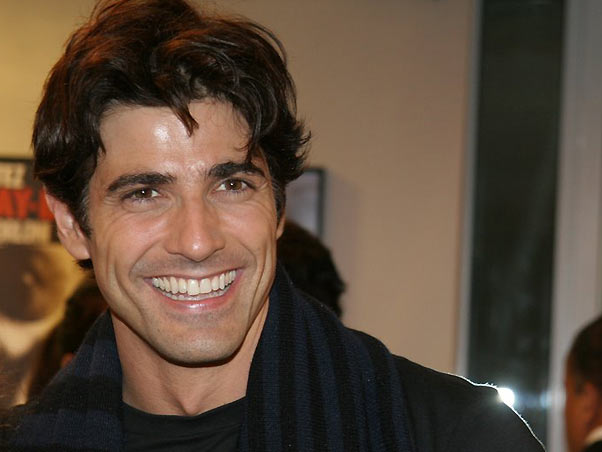
Oh, but then Amazon helped me discover Julia Quinn. She knows her way around a Reformed Rake, although, truthfully, they are more experienced charmers than genuinely rakish. I so don’t care. As is common with romance writers, Quinn created a series of books built around a family group, in this case the 8 Bridgerton children. Each is given their own book and, according to Amazon, the quality diminishes as one progresses through them. Last Friday, I picked up An Offer from a Gentleman (Bridgerton Family #3) about Benedict, and Romancing Mr. Bridgerton (Bridgerton Family #4) featuring Colin. I’d finished both of them by Saturday night. All of the family are described as having chestnut hair and wide mouths, and, although their eye colour varies, I choose to picture the men as all looking like a variation of this (but English and during the Regency):

I’ll give you a moment to collect yourself.

Now THESE are romance novels. Not the overwrought conflagration of sex scenes of Stephanie Laurens wherein everyone is on fire and ends up in the stars, or the tepid high school insufficiencies of Joanna Lindsey. Julia Quinn gets it right: There are no dramatic subplots just to fill pages; the writing is funny; the relationships are romantic; and there is playful banter. Oh, how I love the banter. The men are extremely attractive, and the women, well, the women are of the Wallflower/Why Didn’t Anyone Notice Me Sooner? variety. As a woman who never garnered much male attention, I relate to this type quite well because, in the real world, people don’t actually find it enchanting when you talk like a Gilmore Girl by way of Katharine Hepburn. Anyway, in An Offer from a Gentleman , Benedict (son #2) first meets Sophie Beckett (abused bastard daughter of the late Earl of Penwood) at a masked ball her stepmother has forbidden her to attend. She has to leave quickly and he doesn’t even find out her name.  Left with only the mystery woman’s glove, Benedict spends months looking for, and dreaming of, the woman he met. Mercifully, the description of those months lasts just a couple of pages. Meanwhile, Sophie is a little busier as she is cast out of her home and must find work as a servant. Their paths cross again two years later when Benedict saves her from being attacked and then, conveniently, falls ill and she stays with him. All of these books contain these contrivances and, again, I so don’t care. They fall for each other all over again, but she will not reveal they have met before, and he cannot marry a woman of her station/origins. In between the meeting and the marrying, the reader gets delightful interplay between the characters, genuinely romantic descriptions of how they feel about one another, and some well-written love scenes (although at least one more would have been nice). This book was exactly what I was looking for. I may even have taken a reading break to run into the living room to yell at Mr. Julien, “OH MY GOD! I LOVE THIS BOOK!”

I have ordered Julia Quinn’s Bridgerton books 1 and 2 (Daphne, then Anthony) used from Amazon. If I’m going to read this stuff, the least I can do is only pay 1 cent, plus shipping, for it. Next up after Quinn is Lisa Kleypas’ The Devil in Winter. I’ve decided not to review any more of these books, but I can tell you that the Devil excerpts I’ve read on Amazon held the promise a genuine rakehell at last. (2019 Update: HA! HA! HA!)

A summary of Julia Quinn’s catalogue can be found here. Links to my other reviews can be found on my complete reading list of books sorted by author or Author Commentary & The Tallies Shameful.


Sleepwalk with Me and Other Painfully True Stories by Mike Birbiglia

Who can resist a writer who describes falling in love as someone recognizing your “special secret skill”? Isn’t that lovely? It’s one of the most charming descriptions of love I’ve ever heard.

I purchased this book for my husband for Christmas after we watched one of Birbiglia’s specials. My sweetie hasn’t read it, but I found it extremely enjoyable and I felt it benefitted greatly from being able to hear Birbiglia’s wry and carefully monotone delivery in my head. He’s not exactly a comedian, but rather a raconteur of wonderfully-funny stories. There are not rimshots, just the ridiculous adventure he is relating and making observations on.

The book weaves stories from his life together and builds to a final section which I strongly suspect was drawn almost in its entirety from his lauded one man show Sleepwalk With Me. That is in no way a criticism.

The writing is of a quality typical for this kind of book. Above average, clever, but not earth shaking; in fact, that is my opinion of the book. It bobbed along nicely but wasn’t really entertaining enough for a huge recommendation. Buy it for times when you need something to read in 10 minute intervals.