Monthly Archives: February 2012

The Bridgertons Series: An Offer From a Gentleman by Julia Quinn

As my ignominious devouring of romance novels continues and I present another one for review, I must start by making sure everyone bothering to read this is on the same page: There are two basic types of heroes in these books a) Laconic Warrior (usually a Laird or Cowboy) and b) Reformed Rakes Make the Best Husbands (titled and/or rich charming rake) as detailed in my first review. I prefer the Rakes by a mile. The books below are what I have read recently; I’m not counting them in my CBR total, but this is what I have been up (sunk) to:

Ransom – Julie Garwood – Laconic Warrior – predictable Garwood (which is not a bad thing, she’s reliable)
Honour’s Splendour – Julie Garwood – Laconic Warrior predictable Garwood
Prince Charming – Julie Garwood – Laconic Warrior, sub par Garwood
The Bride – Julie Garwood – Laconic Warrior – predictable Garwood
Once and Always – Judith McNaught – Reformed Rakes Make the Best Husbands. Charming Cynical Bastard. Gorgeous Bastard. Asshole. Rapist.
Temptation and Surrender – Stephanie Laurens – Surprisingly graphic, thisclosetosmut, occasionally hot, but not romantic
An Ideal Bride – Stephanie Laurens – Surprisingly graphic: 20 page sex scenes, really? Nervous virgins do things like that? Really?
The Heir – Joanna Lindsey – Tepid, underwritten, and dull.

Oh, but then Amazon helped me discover Julia Quinn. She knows her way around a Reformed Rake, although, truthfully, they are more experienced charmers than genuinely rakish. I so don’t care. As is common with romance writers, Quinn created a series of books built around a family group, in this case the 8 Bridgerton children. Each is given their own book and, according to Amazon, the quality diminishes as one progresses through them. Last Friday, I picked up An Offer from a Gentleman (Bridgerton Family #3) about Benedict, and Romancing Mr. Bridgerton (Bridgerton Family #4) featuring Colin. I’d finished both of them by Saturday night. All of the family are described as having chestnut hair and wide mouths, and, although their eye colour varies, I choose to picture the men as all looking like a variation of this (but English and during the Regency):
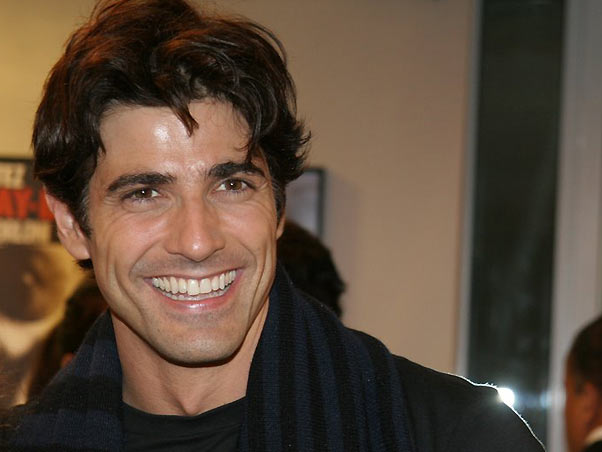
I’ll give you a moment to collect yourself.

Now THESE are romance novels. Not the overwrought conflagration of sex scenes of Stephanie Laurens wherein everyone is on fire and ends up in the stars, or the tepid high school insufficiencies of Joanna Lindsey. Julia Quinn gets it right: There are no dramatic subplots just to fill pages; the writing is funny; the relationships are romantic; and there is playful banter. Oh, how I love the banter. The men are extremely attractive, and the women, well, the women are of the Wallflower/Why Didn’t Anyone Notice Me Sooner? variety. As a woman who never garnered much male attention, I relate to this type quite well because, in the real world, people don’t actually find it enchanting when you talk like a Gilmore Girl by way of Katharine Hepburn. Anyway, in An Offer from a Gentleman , Benedict (son #2) first meets Sophie Beckett (abused bastard daughter of the late Earl of Penwood) at a masked ball her stepmother has forbidden her to attend. She has to leave quickly and he doesn’t even find out her name.  Left with only the mystery woman’s glove, Benedict spends months looking for, and dreaming of, the woman he met. Mercifully, the description of those months lasts just a couple of pages. Meanwhile, Sophie is a little busier as she is cast out of her home and must find work as a servant. Their paths cross again two years later when Benedict saves her from being attacked and then, conveniently, falls ill and she stays with him. All of these books contain these contrivances and, again, I so don’t care. They fall for each other all over again, but she will not reveal they have met before, and he cannot marry a woman of her station/origins. In between the meeting and the marrying, the reader gets delightful interplay between the characters, genuinely romantic descriptions of how they feel about one another, and some well-written love scenes (although at least one more would have been nice). This book was exactly what I was looking for. I may even have taken a reading break to run into the living room to yell at Mr. Julien, “OH MY GOD! I LOVE THIS BOOK!”

I have ordered Julia Quinn’s Bridgerton books 1 and 2 (Daphne, then Anthony) used from Amazon. If I’m going to read this stuff, the least I can do is only pay 1 cent, plus shipping, for it. Next up after Quinn is Lisa Kleypas’ The Devil in Winter. I’ve decided not to review any more of these books, but I can tell you that the Devil excerpts I’ve read on Amazon held the promise a genuine rakehell at last. (2019 Update: HA! HA! HA!)

A summary of Julia Quinn’s catalogue can be found here. Links to my other reviews can be found on my complete reading list of books sorted by author or Author Commentary & The Tallies Shameful.


Sleepwalk with Me and Other Painfully True Stories by Mike Birbiglia

Who can resist a writer who describes falling in love as someone recognizing your “special secret skill”? Isn’t that lovely? It’s one of the most charming descriptions of love I’ve ever heard.

I purchased this book for my husband for Christmas after we watched one of Birbiglia’s specials. My sweetie hasn’t read it, but I found it extremely enjoyable and I felt it benefitted greatly from being able to hear Birbiglia’s wry and carefully monotone delivery in my head. He’s not exactly a comedian, but rather a raconteur of wonderfully-funny stories. There are not rimshots, just the ridiculous adventure he is relating and making observations on.

The book weaves stories from his life together and builds to a final section which I strongly suspect was drawn almost in its entirety from his lauded one man show Sleepwalk With Me. That is in no way a criticism.

The writing is of a quality typical for this kind of book. Above average, clever, but not earth shaking; in fact, that is my opinion of the book. It bobbed along nicely but wasn’t really entertaining enough for a huge recommendation. Buy it for times when you need something to read in 10 minute intervals.

Almost Heaven by Judith McNaught

When last we met, I had just read a book (not to be confused with a work of literature) featuring an iron-thewed Highland Laird and his lady love, a Victim of Circumstance. Now, as I go through this phase, I’m all for a man can bench press Stonehenge and glower at me lovingly; however, while the whole Laird thing will do in a pinch, the Highlands are cold and damp, and I’d be constantly chilled to the bone, no matter how closely the hero “pulled me to his warmth”. Plus wool makes me itchy. What I need is a Reformed Rake to Make the Best Husband. He’s the charming, cynical bastard at the heart of most historical romance novels. It makes for better repartee and what’s the point of reading, if the man in question isn’t intelligent, magnetic and devastatingly seductive? Let me answer that for you: There is no point at all. Judith McNaught knows her way around a charming bastard: They require a lot of forgiveness and she makes sure he is worth it. The gentleman in question is so entirely delicious, and such a magnificent combination of everything swoonworthy, that I’d forgive him 17 times too. Almost Heaven is silly, the writing is overwrought yet strangely repetitive, and, oh my God, I LOVED EVERY SINGLE PAGE, even the ones I skipped to get back to the love story.

The Sacrificial Lamb of Almost Heaven, Elizabeth Cameron, is a Countess who will lose her beloved ancestral home should she marry against her vile and greedy uncle’s wishes. Because romance novel heroines are basically PG13 Disney princesses, she also has a worthless brother complicating things, and a household staff that dotes on her every move. Elizabeth is quite young, but I ignore that part. If I can ignore all the other strains on credulity, I can certainly pretend she is 5 years older. She is, of course, beautiful, but Elizabeth is also educated, independent and proud. Pride is considered a virtue in these books. I assume it’s their tenuous connection to the ultimate romance novel Pride and Prejudice. There are worse places to start. It also helps delay the denouement because everyone has to get over themselves for the happy ending to be achieved.

When the novel opens, Elizabeth is in disgrace because on the cusp on announcing her engagement to an appropriate young man, she met gambler Ian Thornton at a house party. He is gorgeous, charming, and, really, I can’t emphasize this enough, just smokin’ hot. (He is also rumoured to be the illegitimate grandson of the wealthy Duke of Stanhope. Guess how that turns out.) In flashback, they meet, fall in love instantly, he proposes, there is a misunderstanding owing to her naivety and his cynical bastardism, and her world implodes. Two years later (page 150 or so), she comes back into his life, they are still irresistibly drawn to each other, they establish a fragile peace, she has to leave, he FINALLY realises it’s ALL his fault, humbles himself, repairs her reputation, marries her, and there’s, like, two chapters of wedded bliss. Then it all goes to hell again because secrets are bad, jumping to conclusions is unfair, and sometimes people are idiots. But don’t worry, you already know how it turns out.

Links to my other reviews can be found on my complete reading list of books sorted by author or Author Commentary & The Tallies Shameful.

Saving Grace by Julie Garwood

About a week ago, I woke up and all I wanted to do was read a romance novel. I am not proud, but I am trying to own my shame. I blasted through the two books I had in the guest room closet and have moved on to both the library and the bookstore for more. If you have never read “historical romance fiction”, I can fill you in:

All the lead characters exist on a kind of mix’n’match continuum as follows:

The Men

A. Reformed Rakes Make the Best Husbands (gorgeous cynical bastard)
B. Laconic Warrior (gorgeous gruff protector)
C. Ordinary Guy (If you are looking for him, go find LaVyrle Spencer)

There’s also a whole cowboy thing, but the Old West is too dusty.

The Reformed Rake will have lean muscle mass and feline grace. He is a charming companion and an excellent dancer. His cynical bastardism may be a result of a feminine betrayal in his back story.

The Laconic Warrior will be heavily-muscled and rip doors of their hinges: Giant oak doors with giant iron hinges. There is an excellent chance he will also be a Highland Laird. He will sleep out of doors and bathe in the lake, even in the dead of winter. He will be intimidating and often frighten women, but not the heroine, no, she will take one look and see the handsome man no one else has been able to see underneath all the tartan and scowling.

These men are overwhelmed by the protective impulse they feel for the enchanting bit of fluff they’ve just met. These are Men of Action and are not distracted by such trifles as feelings.

The following elements will usually appear in some form:

1. Clenched jaw with visible muscle twitch to show anger
2. Clenched teeth as he clings to restraint in the face of the lust she has innocently aroused in him, and he is holding back lest he overwhelm or harm the woman with the strength of his passion
3. No matter where he lives, he will be tanned from head to toe. This bronzed glow will be surprising, and pleasing, to the heroine.

The Women

A. Victim of Circumstance (beautiful pawn)
B. Wallflower (otherwise ignored fabulous woman)

They are slim, but curvy goddesses as a rule. They always have more book learnin’ than is historically accurate, but I appreciate this token feminism. The Victim of Circumstance is either rich and exploited, or poor and exploited. The Wallflowers just need someone to finally notice them.

The following elements will appear in some form:

1. Cascading hair
2. A naturally tiny waist not really requiring a corset.
3. She holds herself like a queen, or
4. She is accident prone.
5. The Reformed Rake will require a lot of forgiveness.
6. The Laconic Warrior will require her to recognize he loves her before he is able to give in to this vulnerability and tell her.

Things You Have to Overlook

Blatantly anachronistic elements mostly with regard to social and sexual mores. If I wanted historical accuracy, I’d read Jane Austen. Incidentally, the things the hero and heroine do during their intimate moments has gotten much more adventurous since I started reading these books in the 1980s. I find it distracting. I blame the mainstreaming of porn.

No one can get out of that period clothing so quickly. Just once, I wish the heroine would be inwardly cursing all the damn layers that are taking so long to remove.

The age difference of at least 10 years, specifically the youth of the women.

Consistent Narrative Elements

Blazes of sensuality
Synonyms for heat
Oblique references to male body parts
Even more oblique references to female body parts
There is a lot of arching
Verbal sparring
Losing control
Sighing
Someone will be “vexed”
Something will be “sinewed”
Many things will be sensual
Being a pirate is cool

I think you should be up to speed now, but before I start, I must tell you that the book included a bonus chapter from another of the author’s novels. It was set in present day Boston and our hero (read: Kennedy) meets his prospective partner at a charity event when he THROWS UP ALL OVER HER as he has appendicitis. Then, because she is a doctor visiting from out-of-town, she performs the appendectomy. That’s right: she performs a random minor surgery at a local hospital at which she has no privileges. This is why I stick to historical romance novels.

Interjection December 2013: This was a pretty good summary of the tropes of the 1990s, but things have changed since then. The hero and heroine types have not changed but the women tend to be older and more experienced now.

And now to the business at hand:

God’s truth, I can’t even remember the heroine’s name. Let’s see if it comes back to me. The setting is England in 1206. Something exciting has happened with King John and his barons. Johana (!) is recently widowed after years of torment at the hands of her verbally and physically abusive husband, and the family priest. Childless despite her years of marriage (That’s right! She’s not a virgin and she never knew it could be like this), she is a valuable pawn as she has land holdings in Scotland that have been in dispute. Having avoided remarriage as long as she can, she ventures with her loving brother, Nicholas, to make a political match by marrying Laird Gabriel MacBain, a gruff and gorgeous warrior. By marrying her, he gains full title to his clan lands, and she is safely removed from the proximity of those who would exploit her for her wealth (I know). Although he now has the land, he is cash poor and that’s where the whisky subplot comes in. There is also some stuff about clan infighting and which plaid she is wearing.

As Johana settles into her new life with the imposing Laird, his love and gentleness, honestly, he really is a teddy bear, help her to heal and find her own identity and role as his partner. Along the way, she kills a group of wolves with her bow and arrow, she learns golf, and she gets over her fear of his wolf hound. I have to go back to the wolves for a second. She kills 4 wolves and her husband sets the bodies on fire rather than making a blanket out of the wolf pelts. I’d want a wolf pelt blanket myself.

I chose this book because I was familiar with the writer. It’s dangerous to take a chance on these novels because they often used to include an assault in which the heroine’s “body betrays her” and she gives in and enjoys it, OR, or the hero starts raping her, realises she is a virgin and then, AND ONLY THEN, feels guilty for the assault. You can see how I’d want to avoid that. The entire genre is very repetitious in plotting (obviously) and Garwood loves a nice, obvious subplot involving court intrigue. Generally, I skip ahead to get back to the romance. It’s really what I’m looking for and she does a good job with it. I’m actually not a big fan of the Laird/Highlander genre. I prefer the cynical bastards; they are generally witty, charming and fiercely intelligent, and I like that in a sexually-objectified man.

I’ve already started reading my next book Almost Heaven by Judith McNaught. I loved it when I was 20 and expect I will love it again now. It features a gambling roué named Ian Thornton, rumoured to be the illegitimate grandson of the Duke of Stanhope.

Links to my other reviews can be found on my complete reading list of books sorted by author or Author Commentary & The Tallies Shameful.