*OUTLANDER SPOILERS* BUT ONLY IF YOU HAVEN’T FINISHED VOYAGER *OUTLANDER SPOILERS*
Savage Beauty: Alexander McQueen – edited by Andrew Bolton
God bless my public library. I finally got around to seeing if maybe, just perhaps, they had some of the books I’ve kept on my Amazon wish list waiting for a gift card and look what I found! Savage Beauty: Alexander McQueen, edited by Andrew Bolton. It is the companion book to the 2011 McQueen exhibit at the Costume Institute at the Metropolitan Museum of Art.

Once a Duchess by Elizabeth Boyce
Short version: Don’t bother.
Long version: Damn Kindle with their free samples and $1.99 historical romance novels. I am nigh on powerless to resist. I’m not technically powerless, rather I make no effort to resist. Two decent opening chapters and I think “Oh, what the heck?”. They use my indolence against me. It’s how this happened.
Isabelle Fairfax is the former wife of the Marshal Lockwood, Duke of Monthwaite. She was wrongfully accused of infidelity by her particularly awful mother-in-law and ceremoniously divorced then cut off without a penny by both her former husband and her own family. Desperate, she is working as a cook at the local posting inn when her ex-husband stops there for a meal. Necessary repetition: Isabelle is working as a cook. Isabelle, a former duchess and current genteelly impoverished lady a. knows how to cook well enough to do so for groups of people and b. is doing MANUAL LABOUR. Later in the story, she volunteers to cook for 30 people at the Duke’s estate, but starting from scratch as no preparations to feed said 30 people have been made in a manor house with a huge staff anticipating a large group of guests. Isabelle draws on the memory of her French mother’s cookbooks to help her because if there was one thing the English were known for during the Napoleonic Wars, it was their love of all things French. To be fair to the author, being half-French is one of her mother-in-law’s many reasons for despising Isabelle.
Anyway… Marshall is still drawn to Isabelle, even in her mob-cap and cook’s apron, as he has not been to any woman before of since. He writes to Isabelle’s brother and ducally encourages him to take his sister back. Her brother does and decides that the solution to everyone’s problems is to get Isabelle married off immediately, sooner if possible. Hijinks ensue.
I did a lot of eye rolling and accusing the novel of having a lower than average IQ:
- There is a multi-tasking subplot provided by a dead pregnant horse (and her foal). Marshall is a botanist in the way of wealthy people with time on their hands. When he was 9, or maybe 15, he made a berry concoction to help the labouring horse, but it had the opposite effect. Every time I thought this sub-plot was out, the author pulled it back in.
- Marshall’s mum is a bitch of the first water. She goes unpunished. None of the villains are effectively punished even though there are some truly awful people in this book. Has Elizabeth Boyce never heard the following Oscar Wilde quote:”The good ended happily, and the bad unhappily, that is what Fiction means.” It’s a romance novel! Smite some fu*kers!
- TSTL (too stupid to live) is an expression in the romance vernacular describing a heroine who acts like an idiot. Once a Duchess has the distinction of being a novel in which BOTH the hero AND the heroine are TSTL. The events before the story starts qualify as Y&S (young and stupid), but both characters grow to maturity and full possession of their respective idiocies.
Much like my experience of reading the book and skipping through chapters, I can’t muster the energy to continue with this review. Could you please just go back and read the “Short Version” again?
Fashion: The Definitive History of Costume and Style

When they call something Fashion: The Definitive History of Costume and Style, it is a lot of pressure for a book, even one of the coffee table or tome variety. What they really mean is Fashion: An Excellent But Necessarily Brutally Edited Historical Overview of European Slash Western Clothing with the proviso So Not Nearly Enough About Bustles. This time, I wasn’t just looking at fashion plates or a picture book. This time, I was reading a picture book about fashion with “circles and arrows and a paragraph on the back of each one explaining what each one was” and descriptive notations like “cane”, historically relevant details, and extant examples, comme ça:
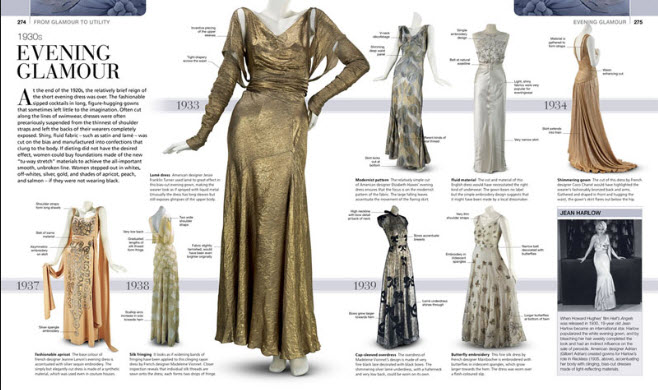
In the name of science, I made myself wade through the things I am less interested in, such as the Medieval and the 1970s, to get to the good stuff which in this case means 1850 to Edwardian. I discovered that I have gotten to the point where I recognise certain dresses and say things like, “this one lives at The Met” to myself while I’m reading. Honestly, the whole thing just increases my pretensions without any commensurate gain in actual knowledge.
DK Publishing makes excellent reference books. I have kept and pored over my copy of their Encyclopedia of the Dog for years, in spite of the fact that I do not have, nor do I anticipate getting, a dog. I borrowed Fashion: The Definitive History of Costume and Style from my local library to see if I wanted to buy it as well. It was interesting, but I don’t think I do. It provided a good historical overview, but without enough detail about the topics I really want to learn about such as dressing from the skin out, or focusing on time periods I find loveliest because I am, apparently, all about The Underthings and The Pretty. I keep looking through books about historical costume and wishing I could attend some sort of course or seminar to give me true insight into very specific fashion elements and eras. Seriously, I should look into that.
While at the library, I took out a book on the history of underwear. That should be interesting. Maybe.
The Pennyroyal Green Series: It Happened One Midnight by Julie Anne Long
This is the part I wrote before I read the book which is, as one might expect should one be paying attention to both me and such things, a historical romance novel and which, as one might expect of someone who often takes longer to write the reviews than read the book, has been copiously revised since.
It Happened One Midnight is a new release from someone on my autobuy list and as such makes me very, very happy. There are authors for whom I will pay full price and whose books I order in advance for Kindle. In order of quality with one being “magnificent” and 5 being “You show promise, Caroline,”, and no one being anything less than very good indeed, they are:
- The Monarch, Courtney Milan, who happens to have a book coming out on July 15th.
- Julie Anne Long – DING! DING! DING!
- Tessa Dare released a delightful book two weeks ago called Any Duchess Will Do
- Sarah MacLean whose next book comes out in November.
- Caroline Linden who has a new book out on July 30th.
This is the part I wrote while reading the book…
Julie Anne Long is the second best author in historical romance and while that may seem like damning with faint praise, the simple fact is that Courtney Milan is genre-defyingly good; HOWEVER, to give credit where it is due, Julie Anne Long is an extremely clever writer and is actually funnier than Milan. She creates entertaining conversation, well-rounded characters, and magnificent smolder. Her current series, which will be at least 10 books if I am adding correctly, is built around the fictional Sussex town of Pennyroyal Green and features the Eversea and Redmond families. This time it is Jonathon Redmond’s turn and, to be honest, I wasn’t that excited about his story. He hadn’t made much of an impression in previous appearances. I. Was. Wrong. I’m 25% of the way through It Happened One Midnight and it is laugh out loud funny.
Thomasina (which is apparently not pronounced Tamsin as I had been gulled into believing and I still think I’m right) “Tommy” de Ballesteros is the illegitimate daughter of a displaced Spanish princess or some such. I’m not really clear on that yet. She moves within Society, but is not precisely of it. She supports herself and does good works of the more than slightly dangerous variety. Confident, rich and rakish Jonathon Redmond is the youngest of four children and his controlling and obscenely wealthy father is about to cut him off without a penny. It’s something Isaiah Redmond does quite often: cuts children off, drives them away, and forbids their delightful, but inappropriate, wives entry to the family homes. Things of that nature. In this case, Jonathon has shown some prowess with investments, although he is between profits at present, and hoped his father would help him invest in a colour printing press, the first of its kind in England. Isaiah says, “No. I want you to get married in the next six months to an appropriate rich woman with a title or lose your inheritance. Your mother will put it about that you are available. I’m cutting off your allowance.” Now Jonathon needs an investor and/or a suitable wife. Tommy needs to create some security for herself and would very much appreciate it if people would stop assuming that she is a courtesan.
Back to reading, but first something for you to do while you are waiting. I have reviewed two of Long’s books and I recommend both of them very highly: A Notorious Countess Confesses and What I Did for a Duke which is a classic.
After devouring It Happened One Midnight –
Julie Anne Long’s best work features truly swoonworthy heroes and vibrant heroines. Jonathon and Tommy are great both together and individually. Long gives them time to grow and opportunities for the reader to see how they fit together.This was an engaging, winsome and satisfying read. The subplots involve poignant exploration of nineteenth century social issues and the nature of family. Long continues to be in great form and avoided the twee pitfalls of her last book, but not all of the editing issues which is a very minor quibble. I emphatically recommend It Happened One Midnight.
A complete summary of Julie Anne Long’s catalogue, with recommendations, can be found here.
Links to my other reviews can be found on my complete reading list of books sorted by author or Author Commentary & The Tallies Shameful which includes the aforementioned observations.
I’ve come around the horn.
It’s official, I took a romance out of the library that I have already read and (clearly) forgotten.
An Introduction to Pleasure: Mistress Matchmaker by Jess Michaels
Given a title like An Introduction to Pleasure: Mistress Matchmaker, you should not be surprised to learn that Jess Michaels’ book falls into the “romantica” historical romance category which means it’s reasonably tame erotica with a love story thrown in to keep things on the straight and narrow. It was free for Kindle, I read it quickly, and I wasn’t going to review it, but the heroine’s name beckoned:
LYSANDRA
Were I the kind of person to make egregious use of multiple exclamation points, that name would warrant just such a display. What’s more, I kept misreading “Lysandra” as “Lysistrata” thus adding piquancy my romantica experience. As for the hero, I track the men’s names on The (Shameful) Tally and I’d like to show you something:
Simon – 7: I’ve updated the totals many times. Simon always wins.
Michael – 5: Meh.; Alex/Alexander – 5: Seems fair.
Robert – 5: Seriously? And not a Bob or a Rob in the bunch.
Charles – 4: Including a rather charming Charlie.
Colin – 4: Tessa Dare has the best one, just ask Malin.
Harry – 4: Plus 2 Henries.
Sebastian – 4: Sebastian is the quintessential rake name.
William – 4: Will never Bill.
Gareth/Ian – 3, Jackson – 3: Yet I could not name one of the books off the top of my head.
Julian – 3: I prefer this spelling, Lucien – 3: THREE!
Marcus – 3: I would have thought there would be more.
Also: Gideon, Griffin, Jonas, Rafe, Tristan, Vere – 2; plus, a Cyrus, a Wulfric, and a SMITE!
Why did I bring this up? Because, somehow, this is the first ANDREW and I find that interesting. Mind you, his brother calls him “Drew” because “Andy” isn’t going to cut it on the Testosterone and a Y Chromosome Registry of Manly Names.
Andrew is Viscount Callis (not to worry though, he isn’t) whose beloved wife died three years ago and he is still grieving. Lysandra Keates is an impoverished lady with an ailing mother, abusive moustache-twirling relatives, and no reference to help her find work in household service. As a last resort, she approaches Vivien, a former courtesan, for help being matched with a “Protector”. Lysandra is wholly inexperienced (how quickly things change), so Vivien chooses Andrew because while he is not in the market for a mistress, she feels Lysandra can help him to, quite literally, come out of mourning.
It is lust at first sight.
Pointless time constraints being common in romance, their relationship duration is set for one month during which Andrew will act as Protector and Lysandra will learn the ways of Mistressin’. The woman used as payment of debt/or turning to a “life of sin” out of desperation is, for better or worse, a standard romance trope, and I should make it clear that the woman is always a willing sexual participant, and that her sojourn in the Land of Euphemistic Prostitution is usually brief. What sets romantica apart from a standard romance is the reversal of the First Comes Affection Then Comes Consummation structure, and focusing on the sexual elements over the emotional bonding elements, or by replacing them therewith as was the case here.
As expected, although it is neither particularly romantic, nor especially erotic, An Introduction to Pleasure: Mistress Matchmaker does have more than the average amount of detail and level of creativity in the love scenes. Jess Michaels gets a gold star on her romantica report card for putting a check in each activity box. She doesn’t get one for the sequencing of the sex scenes/love story though, and there are a lot of authors who make similar mistakes. In this case it’s romantica, but even in standard issue historical romance, the writers sometimes fumble in terms of timing. If one is following a checklist, and this story reads like one is, shouldn’t one put a little thought into progression as well? On the Lisa Kleypas Suddenly You scale of one to six raspberries, with six being a sequencing misstep on par with the scale’s namesake, “He’s doing that NOW?!” and one being a Georgette Heyer novel, I would give An Introduction to Pleasure four raspberries. I’d say the plot organization had a negative effect on the reading experience, but since I had profoundly low expectations that really wasn’t possible and it resulted in eye-rolling more than a let down. Other than that, the writing was perfectly serviceable, if unromantic(a), which is likely not the enthusiastic endorsement the writer was looking for.
Spindle Cove Series: Any Duchess Will Do by Tessa Dare
Desperate for grandchildren and a Dower House, Her Grace the Duchess of Halford has gone to the trouble of drugging her son, Griffin York, His Grace the Duke of Halford, and bringing him to Spindle Cove. Familiar to Tessa Dare readers as the setting of her current series, it’s a convenient location for duchess hunting, rife with eligible young ladies who don’t fit into Society for one reason or another. Her Grace insists that her son pick somebody, ANYBODY, and she will mold a Duchess out of the woman. Griff, vexed and still half-lit, picks the barmaid, Pauline Simms, to irk his mother, and because the little voice inside him whispers, “Her. I’ll take her.” Pauline is an astute, purposeful, and engaging woman with a challenging home life. Griff offers her an obscene amount of money to humour his mother and fail spectacularly at “duchess training”.
I’ve written before about the two basic heroes in historical romance novels: The Rake and The Protector. This may be the first novel I’ve ever read in which a character readers met as a Rake in an earlier story is reintroduced later in the midst of transforming himself into a Protector. When Tessa Dare’s readers first met Griff in A Week to Be Wicked, he was a dissipated, dissolute, hedonistic sybarite. He fit a lot into a couple of pages. His Grace wasn’t exactly hero material, but that was Dare’s challenge. You have to bring them low to build them up. Griff had been brought very low indeed before the story began and, I have to say, I don’t think I’ve seen an unapologetic rake so completely redeemed since Sebastian St. Vincent took a bullet for Evie Jenner in The Devil in Winter.
Any Duchess Will Do is a very good historical romance: clever, sweet, sexy, and, yes, romantic. Tessa Dare’s books are always a great deal of fun and often more than slightly implausible. My review of her recent novella, Beauty and the Blacksmith, included my thoughts on the willing suspension of disbelief in romance in general and with this writer in particular. Dare pulls the story off much more successfully in this case because, frankly, the hero is a Duke and rich as Croesus, and because Dare takes a romance trope and gives it enough of a twist to make it sufficiently crediblesque to maintain the illusion. For readers of the series, she has some savvy reincorporation, which was absolutely necessary to keep the willing suspension of disbelief going, although she was less successful in bringing back her most popular characters from A Week to Be Wicked and That Other Book I Didn’t Like as Much.
Reviewer’s Note: I sincerely hope that someone somewhere in the romance sub-culture is making a list of all the things Dare’s heroes compare their telltale masculine firmness to. She has a particular gift for wry metaphor in this area.
A complete summary of Tessa Dare’s catalogue, with recommendations, can be found here.
Links to my other reviews can be found on my complete reading list of books sorted by author or Author Commentary & The Tallies Shameful which includes the aforementioned observations.
The Immortals After Dark Series: The Warlord Wants Forever by Kresley Cole
If you whisper the title, it sounds even better.

Just when I thought my preferred reading material couldn’t possibly be more silly, my brain pointed out, “You’ve never really given paranormal romance a shot”. Kresley Cole is a very big name in the genre. She has a huge following. She has dozens of books. She has copious high ratings on Amazon. I have a Kindle. I have 99 cents. The Warlord Wants Forever was worth each and every one of them because Nikolai Wroth is a vampire and Myst the Coveted is, I am not making this up, a Valkyrie. They meet cute.
A prequel to Cole’s Immortals After Dark series, The Warlord Wants Forever is set in an unseen world populated by illusory creatures familiar from mythology and Things That Go Bump in the Night. There may also be shape-shifters. I’m not sure. Until last night, my main romance concern was historically-accurate frocks and then suddenly it was all fangs, blood, and violently intense love scenes that I’ve decided to christen “THUNDER SEX™”. There is some sort of internecine war between the Myth/Bump factions and Nikolai the hot vampire warlord gets “blooded” (imprinted) by the tempestuous Valkyrie, Myst the Coveted. It’s a mating system requiring, to put it delicately, initial release exclusivity, so when Myst escapes Nikolai before the THUNDER SEX™ consummation devoutly to be wished, he must chase his Valkyrie down to relieve his eternal blue balls. It takes him five years. Then he has to convince her to shack up with him, a lesser immortal being. There is a magical waist chain involved.
The novella was fun and the first time I’ve heard of a story that did involve a Valkyrie and didn’t involve Richard Wagner. The THUNDER SEX™ was hot and plentiful, if a trifle “red in tooth and claw” for my tastes. There is clearly a huge audience for paranormal romance and I could go on about what tastes or appetites this kind of fiction appeals to, but I think it all comes down, almost literally because of the vampires, to à chacun son goût. If I ever have qualms about the nature of The (Shameful) Tally’s contents, I now know it could be worse, if not quite so deliciously ridiculous.
After reading The Warlord Wants Forever, I tried another work from Cole’s Immortals After Dark series, Lothaire, about an ancient vampire finding love with a blue-collar mortal (which is apparently totally declassé and galling). It was even redder in tooth and claw than The Warlord Wants Forever and included a THUNDER SEX™ scene which can be imagined as biting a sausage longways for a protracted period of time. Sex? Sure. Blood. Useful. Sex and blood? I’m out thus ended my paranormal romance experiment.
… or I was until being given more Kresley Cole books by Malin and Alexis. I’M NOT MADE OF STONE! As a result, I have reviewed the following linked books from the series as well A Hunger Like No Other; No Rest for the Wicked; Wicked Deeds on a Winter’s Night; Dark Needs at Night’s Edge; Dark Desires After Dusk; Kiss of a Demon King; Deep Kiss of Winter; Pleasure of a Dark Prince; Demon from the Dark; Dreams of a Dark Warrior; Lothaire; MacRieve; Shadow’s Claim.
Indigo, Night Hawk, & Always and Forever by Beverly Jenkins
New author? NEW AUTHOR!
How did I find a new writer in amongst all the dross? I clicked “African-American” on the Amazon historical romance sidebar and abandoned Victorian England for nineteenth century North America. HELLO, BEVERLY JENKINS! She’s a great writer and justifiably highly rated on Amazon and Goodreads. I read three of her books in four days and I’ll get to the other two, but first I want to talk about Indigo, her highest-rated book. It is really good. Definitely a “recommend” and possibly a classic.
Northern Michigan, 1859. Born a slave and now a free woman, Hester Wyatt is a “conductor” on the Underground Railroad. As the book begins, she and her fellow conductors are helping a family that has just arrived from the South. The family will move on quickly to Canada, barely stopping to rest and replenish themselves, but their guide was seriously injured during the flight. Severely beaten, the man, known as “the Black Daniel”, cannot possibly be moved. He remains in a secret room in Hester’s basement to be cared for, even as he suspects that someone in Hester’s circle has betrayed him, and more importantly, their work.
Hester nurses the Black Daniel, Galen Vachon, back to health. Initially very difficult to deal with, he relaxes as he heals and they form a tenuous bond before he returns to his work. They each try to forget the other, but when Galen returns in the spring, it is with very serious intentions towards Hester. Objecting to the differences in their stations, Hester holds out against his charm offensive for as long as she can, but ultimately surrenders. Because of the setting, their happily ever after is vulnerable and the reader knows it will be challenged as the American Civil War begins.
Almost any other historical romance written in 1998 would feel dated. Indigo does not (mostly) and I think that is owed to both Jenkins skill as a writer and the seamless way she weaves genuine historical detail into the story. Every once in a while, there is a history lesson/succinct summary of what the reader needs to know about the political and cultural climate at the time. The fraught situation creates a sense of jeopardy that no other romance has ever possessed for me. Normally, I view the “historical” part of the romance as something that creates narrative distance: It’s another world and the clothing is pretty. Indigo is a love story in which the historical context is truly essential. The characters are not real, but the bravery and boldness required in their situation calls out to all of the people who fought against the injustice of a repugnant society.
Night Hawk (also a recommend) and Always and Forever reviews after the jump…
Night Hawk is set in Kansas and Wyoming in the 1870s. The Civil War is over and The Reconstruction is still in force. Jim Crow has not yet reared its ugly head, but endemic racism is always an issue.
Indigo’s Hester was dignified and humble, Night Hawk’s Maggie is a force of nature, bloodied but unbowed. After losing her beloved parents, Maggie has managed to scrape by, occasionally finding sanctuary, but often falling prey to unscrupulous people, and also to her own temper. Her latest mess is the accidental death of her boss while she was fighting off his sexual assault. She is of mixed race and poor which is enough to condemn her in the eyes of the dead man’s father and the community. The local lawman attempts to transport her to another town to await her reprieve in peace, but things go horribly awry and she is passed off to a US Marshall, Ian Vance, “The Preacher”. The book is largely a road trip undertaken by the two as Maggie tries to escape and Vance keeps trying, unsuccessfully, to find another person to deliver Maggie to for safekeeping so he can go home to his ranch.
Night Hawk was the first Beverly Jenkins books that I read. It’s clever and well-paced, not to mention laugh out loud funny. One thing I particularly enjoyed about all three of these books is that the couples married a. after much persistence from a scrumptious man who knows a good thing when he sees it and b. in the middle of the story, so that the balance of the book takes on a “you and me against the world” tone. If romance novels are about finding the right partner, it makes sense for that partnership to be used and tested. All men in romance novels are delicious: gorgeous, strong, and sometimes heroic, but in these books they are truly heroes, not just for plotting purposes, but in the context of their times. For the equally heroic women, Jenkins acknowledges something that I often think of with stories set in the past. In our world, beauty can be a gift and a ticket to a better life. For women living in a time when women, especially those of colour, had no power, beauty could be a liability. It certainly was for Maggie.
Always and Forever (SPOILERS)
It’s 1884 and the Civil War is long over, but the dismantling of the Reconstruction and the insidious expansion of Jim Crow laws has created an exodus of African-Americans to the plains and the West. Grace Atwood is contacted by her cousin and told that the men in his community in Kansas need wives. Grace, who owns and runs a bank in Chicago, has just been left at the altar and takes up the project to distract herself. She decides that despite the potential ease of train travel, the risk for mistreatment (being forced to ride in the livestock cars or summarily dumped beside the tracks) at the hands of Jim Crow means a wagon train is the most logical choice. She finds 35 women to join her and sets up the trip, but she needs a wagon master…
Enter Jackson Blake. A former (Jim Crow again) deputy US Marshall, he wants to get back to Texas to clear his name and to lay his ghosts to rest. He hires on with Grace as a way to get there. The book makes it clear that home/Texas is not only not a safe place for him to be, it is not a safe place for ANYONE of colour to be. It is a time of devastating violence and he should not be going back. Jackson’s internal battle between his need to make things right and common sense is one of the central conflicts in the story.
Despite Indigo’s pre-Civil War setting, Always and Forever was actually the most graphic and disturbing in terms of giving witness to the burden and potential horror for people of colour at the time. Indigo reports the experiences of many people, Always and Forever shows us: The hero is actually drawn (as in “hanged, drawn and quartered”) in preparation for lynching what is left of him. It was heartbreaking and extremely difficult to read.
I found the preparation for the wagon train fascinating. Not just organization and purchase of supplies, but the actual training, practice and extensive coordination the women undertake to get ready. That said, the plotting of this book was actually the weakest of the three. Grace and Jackson consummate their relationship and he decides that it was so amazing she must have been impregnated and therefore they must absolutely, positively get married rightright away. This results in a little more Come here! Go away! than was necessary.
Beverly Jenkins is a very good writer and I am so pleased to have discovered her. Despite the realities of the characters lives, I would not describe the books as dark, but rather as possessing a verisimilitude uncommon in my romance reading experience. There are trauma survivors and victims strewn throughout the genre. In these three novels, the difference is that the characters are at risk of being victimized again. The history lesson interjections are interesting even when they slow things down a bit, and I loved the feeling that Jenkins just really wanted you to know more about the remarkable real people living and working at the time. To her back catalogue!
 Mrs. Julien Presents