Category Archives: book review

The Beautiful Series: Beautiful Secret by Christina Lauren

I have reviewed the rest of the Beautiful series by writing duo Christina Lauren in an ongoing post, but since the tone of this latest entry was something different, I decided to review it by itself. To get caught up, this is the series thus far (9 books, 4 couples):

  1. Beautiful Bastard
  2. Beautiful Bitch
  3. Beautiful Stranger
  4. Beautiful Bombshell
  5. Beautiful Player
  6. Beautiful Beginning
  7. Beautiful Beloved
  8. Beautiful Secret  – see below
  9. Beautiful Boss 

Ruby is an engineering intern at a London firm. An American living abroad, she is a very ambitious and capable young woman working to augment her experience before applying to a prestigious Masters program. Her boss is one of those quietly harassing, sexist douchelords so many of us have encountered; however, once a week, she attends a team meeting in which dreamy dreamboat Niall Stella will be present and that helps considerably. When the douchelord can’t participate in a month-long work project in New York, Ruby is nominated to attend with Niall.

The beautiful Series is on the erotica end of the romance continuum. Each of the previous books in the series featured characters who quickly got busy, or stayed busy in the case of the novellas. Beautiful Secret is a bit of a right turn in that the consummation is delayed, although Niall and Ruby still have fun. Niall is recently divorced and, while not particularly upset about it, he is a tightly wound guy with very little romantic experience. His closed-off demeanor alternately entices and creates problems for Ruby. They suffer from communication problems – both of the over and under-share varieties – and need to adjust their expectations and behavior to get themselves moving in the right direction.

Beautiful Secret was pleasant and occasionally sweet, but it would be disingenuous of me to be too critical because, for better or worse, I have purchased and read every book in the series and will likely continue to do so. I did find the juxtaposition of Lauren’s usual raunchiness with a more traditional approach to the relationship a bit jarring, but this indicates more about my romance tastes and the point at which they intersect with erotica than about the novel itself.

Having taken 3.7 seconds to ponder it, I generally do not find the “uptight in public/wild man between the sheets” type terribly attractive. Niall is a really great guy, sincere and patient, but he has a long way to go and a lot to learn before he is ready for a relationship with Ruby. To his credit, he realises he needs to grow and give her the space and she is, of course, able to help him with his buttoned-up demeanour. Also around are Niall’s brother, Max, and friends Bennett and Will who appear in previous books in the series. For some strange reason, only one of the women, Chloe, also has a guest starring role. This was a disappointment as I like the other female characters better than her.

Christina Lauren has a series, Wild Seasons, in the new adult romance genre which I recommend over the Beautiful books. A complete list of Christina Lauren’s catalogue can be found here.

Links to my other reviews can be found on my complete reading list of books sorted by author or Author Commentary & The Tallies Shameful which includes the aforementioned observations.

 

Paris Nights Series: All for You by Laura Florand

Five years ago, Joss Castel* left Celie and everything he knew behind to join the French Foreign Legion. He wanted to be more for her, better, to lay the foundation of a life together outside the tenements they had grown up in. The only problem is that he did not tell Celie any of this. Joss held himself in a self-made friends-only space until they could start their a life in a new place. He was her closest friend and the person she adored. All Celie knew was that the man she loved abandoned her and didn’t come back for five years. In his quest to be more for Celie, Joss broke her heart. Now 28 years old to Celie’s 23, he’s back to lay his accomplishments at her feet. She still loves him, but that feeling is constantly at war with her need to brain Joss for his surprise departure and sudden return.

All for You showcases once again Laura Florand’s ability to write enjoyable, thoroughly escapist contemporary romance. While her books often feature down-to-earth billionaires, a trope I am not fond of (but which Florand manages to pull off), this outing has two people from the wrong side of the tracks who are determined to build better lives for themselves. Celie took a teenage apprenticeship with a local baker and through her hard work and desire to excel now works for one of Paris’s premiere chocolatiers. It’s into this shop that Joss bursts back into her life. Celie is overwhelmed and angry, but so happy to see him she doesn’t know what to do with herself.

Joss and Celie’s reunion and the timeline of the book is actually quite condensed. From beloved, to “Idiot”!,  back to beloved takes place over a short period, but includes enough flashbacks for context and some excellent, writhing, repressed smolder to keep things moving along. A might fortress is our Joss, so it’s a one-step-forward-two-steps-back romance until everyone comes to their senses and he learns that Celie wants the journey with him more than she wants the destination. Florand is generally very good with couples experiencing communication problems and, while it frustrated me and went on a bit, Joss really is a prisoner of his own reserve, Legion-trained stoicism, and good intentions. Despite this, while he may be a military man to his core now, he is free of the annoying romance writer’s crutch of PTSD.

Blissfully, my favourite couple from Florand’s L’Amour et Chocolat series novel, The Chocolate Touch, are on hand to provide guidance to the couple and doses of their own adorability. Still madly in love, Dom continues to be a giant lug and much fun is had teasing him for referring to Jaime as his “wife” despite lacking the official and legally binding piece of paper indicating this. Incorporating previous characters without letting them dominate is a challenge that many romance writers face and Florand does well with it. I wanted more of Dom and Jaime, of course, but then I always will.

All For You crosses over with the L’Amour et Chocolat series and will be crossing over with the La Vie en Roses series as well.

*Fun Aside: Josselin Castle

A complete summary of Laura Florand’s catalogue, including recommendations, can be found here.

Links to my other reviews can be found on my complete reading list of books sorted by author or Author Commentary & The Tallies Shameful which includes the aforementioned observations.
The Exile: An Outlander Graphic Novel by Diana Gabaldon, Illustrated by Hoang Nguyen

“Experience Jamie’s Side of the Story!”, the cover cries and who am I to turn down any Outlander material? I suppose that this graphic novel might be a good starting place for people curious about the book series who also like this format; moreover, Outlander is entirely from the heroine’s perspective and The Exile mostly from the hero’s which is something lacking until much later in novels and a welcome change.

If you haven’t read Outlander , and you really should, it’s AWESOME, here is a bastardized summary from my review: In 1946, Claire Randall is on a second honeymoon in the Scottish Highlands. She visits a local henge and through the magic of fiction is able to walk between the two halves of a broken stone slab and end up in the same place, but in 1743.  As an outsider, Claire is regarded with suspicion and is thus pulled into a protective relationship with the chief’s nephew, Jamie Fraser… and thus an epic historical adventure and love story begins, spanning decades, leaping centuries, and continents, with eight novels and still going.

The Exile shares the beginning of the story from Jamie’s perspective both before and after becoming involved with Claire. It also includes some back story on other significant characters and adds one that is either new or I have forgotten. Even with pictures (and like the book and TV series) I had trouble keeping all the craggy men straight. Overall, it was a quick read that left me flat.

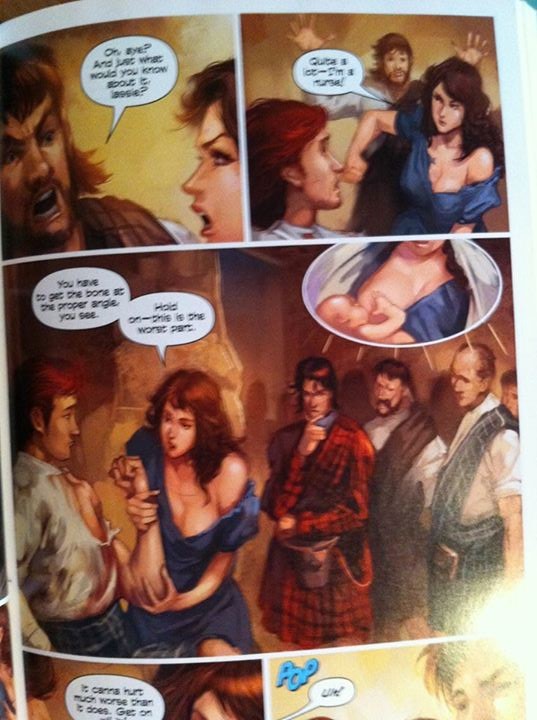
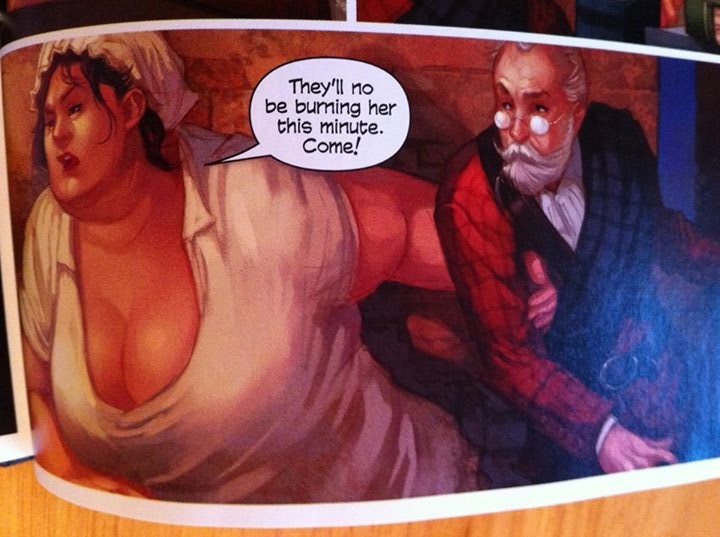
I’m no judge of the artwork, but it seemed competent in a simplified, shorthand way, i.e. the dress is long and she’s wearing a corset tied over it, so it must be historical. Really, this means that, in keeping with my perception of female depictions of women in graphic novels, all the ladies are running around in their underclothes or that which simulates same. There are a lot of boobs on display, such many boobs. Magically, heaving two-dimensional boobs in that distracting “my clothing can barely withstand the pressure” way of boobs in fiction. Squished and/or overflowing boobs, not only for Claire (apologies for the picture quality),

exile 1

exile 2but supporting characters as well,

exile 3

Clearly, The Exile is not made for what is considered the usual Outlander audience: women. If Claire had been given a frequently savoured comely backside, I could have understood it more as her arse is frequently appreciated in the books.

Graphic novels have simply never been part of my reading. I read some religious Archie comics that one time I spent 10 days at bible camp (never to return), but the whole world of comic books was not a part of my formative years and as such they leave me cold. The most interesting part of the book for me was the brief Afterward in which Gabaldon shares her correspondence with the illustrator about what Jamie and Claire look like. You can check out the book to see, but to get the idea just look up some combination of “Gabriel Aubry Jamie Fraser” and apparently you will be quite close. (Self-congratulatory aside: That’s pretty much what my Jamie looks like, too. My Claire is entirely different though.)

My reviews of the books in Diana Gabaldon’s Outlander series can be found here.

Links to my other reviews can be found on my complete reading list of books sorted by author or Author Commentary & The Tallies Shameful.

Dark Lover by JR Ward

JR Ward, you made me miss Kresley Cole. Go stand in the corner and THINK ABOUT WHAT YOU DID!

Paranormal romance is the portion of the genre with the most primal stories. There are strong tribal elements and the tropes tend towards traditional roles. Men are warriors, god-like iron-thewed lords capable of both shocking violence and macho tenderness. The women are fertility goddesses, sensual and beautiful, but with a core of steel. The mythological elements dovetail perfectly with common  wish-fulfillment fantasies. These stories are generally not my cup of tea, although I admit that the genre’s writer I am most familiar with, Kresley Cole, is capable of sexy escapism when she isn’t regurgitating misogynistic folderol. Paranormal romances can be campy fun when securely centered in their own world and everyone’s tongue is placed firmly in their cheek, but that doesn’t mean you get to be a lousy writer, or maybe it does because JR Ward’s Dark Lover is very badly written and, this is the cardinal sin, not particularly sexy, yet her Black Dagger Brotherhood books are incredibly popular and successful.

Wrath, erstwhile vampyr king, and his Black Dagger Brotherhood, including Rhage, Vishous, Phury, Tohrment, and Zsadist are in a battle to the undeath with the Lessers, meaning humans converted to vampyrs, as opposed to pure-blooded or mixed race vampyrs. (Note my jejeune “vampire” spelling homage to Ward’s maverick orthography.) Human Beth is about to make the transition to vampyr and needs assistance lest the transformation kill her. Owing a debt to her deceased vampyr father, Wrath takes on the task of assisting her through the process and out of her underpants. The factions fight, future heroes and heroines are introduced, and Ward lays the groundwork for the rest of the series.

In this world, men can only feed off women and female vampyrs offer the best nutrition, so they are often kept away from the outside world. This gives me pause because, one, what happens if a vampire is gay, and two, I don’t know about you, but I am leery of any culture in which women must be sequestered for their own “protection” and whose primary function appears to be to servicing the men’s needs. Vampyr Marissa has been meeting Wrath’s blood requirements for decades and knows when she finishes doing so she will be AND I QUOTE “considered used goods”. There’s more on this front: “He’s marked you…I can smell it…the warning’s all over you…That scent on your skin sends a powerful message to other males.” I was at a party with a man I was seeing who was acting so territorial that I finally asked him, “Wouldn’t it be easier just to pee in a circle around me?” This is that, that is what this is. The male vampyrs mark their territory/women with scent, like a dog or an ocelot, or whatever male animal that pees on things and seems the most manly.

Speaking of territoriality:

Zsadist: Not willing to share the female?
Wrath: You only like it if you pay for it.
Zsadist: So I’ll flip her a twenty. Assuming she lives through the sex.

Wrath clarifies Beth’s role and his relationship with her father, “and then (Zsadist) made a point to tuck in his shirt while looking her in the eye. As if he were apologizing.”… for planning to rape her so violently she died. [waiting for the full body shudders to pass]  Zsadist has his own book and that is going to have to [still shuddering] be one hell of a redemptive female.

Ward’s vampyrs have powers, as is the paranormal way of things, and they include the ability to materialize and dematerialize, super strength, and heightened senses, in particular strong scent associations.  The women are stunningly beautiful, and the men are huge, muscular, heavily tattooed and/or scarred, and wear a lot of leather. In other words, every bad boy fantasy rolled into one. At first, I took that to mean this:

ymca

or perhaps this,

term

but then my brain got smart and I went with this: momoa

Good job, my brain!

Note: In addition to all the leather, Wrath is nearly blind and sports wraparound sunglasses almost constantly, such as after a shower when he holds a meeting while wearing only a towel around his waist.

As is true of all romance or any other genre writing based on such a consistent and repeatable pattern, Dark Lover’s quality comes down to the writing and, truly, JR Ward has a gift, nay, a curse for metaphor:

“Jose loosened his hold, and Butch went down like a piano.”  Pianos stand quietly where you put them.

“Panic ran like gasoline through her veins.”  That must be a really small nozzle.

“The smell of her sex on him was like a whip against his self control.”  Wouldn’t that have an encouraging effect, i.e. “Daily weigh-ins are like a whip against my self control around chocolate.”

“She arched again, feeling like a dam had broken between her legs.”  [insert beaver joke here]

It’s not just the metaphorical language that sets the writing and story apart. I also learned that discovering your absent father has had you secretly followed and photographed your entire life is sweet and not completely freaky, and that police brutality is totally cool as long as the victim deserves it.

Then there was this,

“There was an IV pumping fluids and painkillers into his arm and a catheter bag…”  I was grateful that Ward clarified as I was too distracted by my concerns about Wrath’s vampyr urine management, to concentrate on the story.

and this,

“He let out a bellow of ecstasy.” I tend to bray in ecstasy myself, or give a ladylike yawp.

and, lastly, this:

“Oatmeal raisin,” he said, taking three. “My favourite.”

It was then I understood the unholy nature of these creatures and the true malevolence of Dark Lover and JR Ward’s vampyr world. No good can come of a book series in which oatmeal raisin cookies are anyone’s preference.

Links to my other reviews can be found on my complete reading list of books sorted by author or Author Commentary & The Tallies Shameful.

The Wedding Journey by Carla Kelly

The Wedding Journey is another lovely and highly recommendable Carla Kelly Regency romance about genuinely kind and likable people falling in love against the backdrop of war. I really enjoyed it at the same time as I realised that I have read too many of her novels too close together. All of Kelly’s best elements can be found here, as well as her one besetting sin minor shortcoming.

Profoundly shy, Doctor Jesse Randall has loved Nell Mason for years. She and her family have followed the drum at the behest of her gormless father and working in the hospital tent is Nell’s contribution to their income. In debt to a moustache-twirling bastard of a villain, Nell’s father plans to offer her up in  payment for gambling debts once Nell’s mother – and the protection she affords – is gone. When his long-suffering wife dies, Jesse steps in to marry Nell and prevent her sacrifice on the altar of matrimony, or at least offer a significantly better altar. It is a bittersweet gesture for him given his feelings. The moustache-twirling bastard “accidentally” leaves the medical personnel behind when his troop retreats, so newly wedded and even more recently abandoned, Jesse, Nell, and their small band of misfits make their way through rural Spain back to safety behind British lines. Along the way, they encounter rapscallions, batty aristocrats, and villagers just trying to survive living on an ever-shifting battle front. The moustache-twirling bastard has left damage in his wake that creates even more challenges for the group. Jesse and Nell find time, along with the urgent clarifying reality of their situation, to come together as a couple and in appreciation of each other.

There are two problems with The Wedding Journey. The first is mine as I feel like I have read versions of this book by Kelly already: A nice soldier is thrown together with an unassuming young woman and the two must make their way to a new location. There is nothing wrong with this trope. Nothing. Kelly writes gratifyingly sincere prose without being overly sweet and adds enough danger and harrowing detail to bring everything together well. It’s a great formula and I am not complaining. That would be like saying, “Lisa Kleypas, could you please do something about all those deliciously sardonic men?”, or “Julia Quinn, could you ease up on the wit?”.  Carla Kelly writes a specific kind of romance and she does so beautifully. I just need to stash her books lower on my To Be Read pile.

The second problem with The Wedding Journey, and let me just pause to replace “problem” with “quibble”, is that Carla Kelly might be too nice. She has a tendency to wrap things up very neatly.

“The good ended happily, and the bad unhappily. That is what Fiction means.”

Yes, thank you, Mr. Wilde, I am aware of that, but while I have no objection to moustache-twirling bastards receiving comeuppance, the redemption of others and some deus ex machina Kelly indulges in were over the line. She creates such a convincing and honest world for her characters that it actually works against the story when things are neatly resolved at the end of the book.

Oh, one last thing: I would have liked just a few more pages of epilogue with the characters once they were safe and sound, mostly because I liked them so much that I wanted to have time with them enjoying domestic bliss.

My summary of Carla Kelly’s catalogue can be found here. Links to my other reviews can be found on my complete reading list of books sorted by author or Author Commentary & The Tallies Shameful.


I’m Not Sure I Care Whether This Is Real

This is neither here, nor there, nor a romance novel, but it appears to exist and I am not knowing that alone. Also, it’s a hint for an upcoming review:

The Pennyroyal Green Series: It Started with a Scandal by Julie Anne Long

Having just finished a book in which the main characters were rarely in the same country, it was a pleasant change to read a book in which the hero and heroine are almost always in the same room, and by one of my favourite authors as well. Julie Anne Long’s new, potentially penultimate, Pennyroyal Green novel, It Started with a Scandal, includes small visits from previous stories’ characters and the return of one of her most charming men, the displaced French aristocrat and raffish rogue Lord Phillipe Lavay of I Kissed an Earl.

Assaulted by no less than six thugs, Lavay is recuperating in a somewhat sad little house in Pennyroyal Green. As a tenant, rather than the owner, the servants have become shiftless and indolent. (As a plebe, rather than the gentry, this is not a trope I enjoy.)  Enter a new housekeeper in the form of Elise Fountain. Abandoned by her family when she had a child out-of-wedlock, she worked at the local school for recalcitrant young ladies until her unseemliness became widely known. Moving onward and belowstairsward, this is her first position as a servant and her desperate circumstances provide enormous motivation to succeed. Lavay, leonine and grumpy, lays odds against her success, but doesn’t count on Elise’s determination or the conveniences of historical romance plotting.

As in all Long novels, each of the leads has to lay down their inhibitions and be willing to emotionally bare themselves for a chance at true happiness. Elise has spent years trying to tuck in her natural exuberance and verve in order to avoid either repeating her youthful mistake or making another one. Lavay has been working towards restoring his family’s status and wealth in French society but, while his behavior is strangely honourable, I don’t think that anyone feels the French Revolution was a bad idea. Lavay needs to come to terms with the loss of what he considers his proper life and Elise with the chance that she can still build a future beyond safety and simple survival.

I have read so very many romances at this point and I always look forward to a new Julie Anne Long book. It Started with a Scandal never quite grabbed me the way some of her other books have *cough*What I Did for a Duke*cough*. I found it a little too divorced from historical reality and a little too neat, even for a genre with carefully prescribed outcomes. The novel was still an entertaining read as Long is incapable of being anything less than a wonderfully clever writer, but not necessarily a potentially re-readable story. On to Lyon and Olivia’s book The Legend of Lyon Redmond coming in October which I have already ordered and may take a day off work to read in a wantonly luxurious gesture.

A complete summary of Julie Anne Long’s catalogue, with recommendations, can be found here.

Links to my other reviews can be found on my complete reading list of books sorted by author or Author Commentary & The Tallies Shameful.

Bar Sinister by Sheila Simonson

Short Version: Long on historical, short on romance.

This novel came to me through a recommendation on my list of books sorted by author with a comment from Jorry saying she/he thought someone was missing from my reading list: Sheila Simonson. Always willing to look into a suggestion, I found one of this new-to-me author’s books available on e-loan from my library.

Bar Sinister surely had the most authentic feeling historical elements of any romance I have read. (I say feeling because I am not a historian, just a pretentious reviewer.) I wasn’t expecting any [insert funky bassline here],  but I was disappointed that the two leads were rarely in the same room house town county country. It wasn’t even an epistolary romance, despite letters passing back and forth, and I found myself frustrated that the only time the hero and heroine spent any real time together was in the Epilogue when, spiff-spoff, they decided to marry.

Set during the Napoleonic Wars, Emily, widowed with a four-year-old son, has decided to become a baby farmer to generate income and to provide a larger family for her child. She takes in the baby boy and three-year old daughter of Captain Richard Falk.  Also widowed (widowered?), his Spanish wife has passed away and he has returned to England to place his children in care that is meant to be temporary, but may become permanent depending on his survival in the Wars. He drops the children and the baby’s wet-nurse off with Emily and returns to the Continent.

The portion of the novel in which Richard’s children, Tom and Amy, settle in was very difficult. Amy is a three-year-old which makes her of an age to understand that her Papa has disappeared, but not really why, and she doesn’t speak English, nor Emily Spanish. When the grown ups clue in that Amy thinks her father is dead (like her mother), Emily and Richard start writing letters which include adventure stories Richard incorporates into each missive. The arrangement goes on for years, with Richard making rare, brief appearances between postings and sending letters full of tales for the children.

Richard’s perilous existence is complicated by his parentage. An admitted by-blow, his biological family is divided between wanting him to disappear forever and come for visits. This element is crucial to the plot progression and provides much of the action. While it did create character development, it didn’t add much to the romance element. I wasn’t expecting a lot in that department, or even any smolder full stop, but the characters were too removed from each other to make the ending seem like much more than a marriage of convenience that concluded rather than started the story, despite their protestations of love.

Despite the lack of romance in Bar Sinister, Simonson is a very good writer and I enjoyed the historical immersion feeling of reading her prose. I picked up Lady Elizabeth’s Comet at my library since it is the novel specifically recommended by Jorry. The hero is a supporting character in Bar Sinister and such a charmer that I want to read his story, but it will have to wait as Julie Anne Long has released a new book and that gets priority for now.

Links to my other reviews can be found on my complete reading list of books sorted by author or Author Commentary & The Tallies Shameful.

Sweet Disorder by Rose Lerner

As a romance reader, I rely on recommendations since it’s a genre full of authors of wildly varying quality. Like any other group, there are a few greats that land on one’s autobuy list, then the excellent, very good, reliable, guilty pleasures, desperate measures, and so on. Finding good new-to-me authors always feels like a coup. My romance spirit guide, Malin, has pointed me in many the right direction, as have others. Writer Courtney Milan suggested this author on her blog and who am I to turn down the opportunity for a good book and a good turn bringing attention to a new author.

Sweet Disorder by Rose Lerner is set in Lively St. Lemeston and has the most interesting political intrigue of any historical romance I’ve read. It’s not spies or fighting Napoleon, but the prosaic reality of nineteenth century voting rights which create the impetus for the story. Widowed Phoebe is being courted by opposing political parties. She can’t vote (I know), but the man she marries will be able to. Given a sudden motivation for financial security that a husband is her best bet of providing, Phoebe declines, then agrees to politically motivated matchmaking. I have never read anything like that before, have you? Nick Dymond has been charged by his family with finding a suitable partner for Phoebe. The local baker seems a good choice, but he and Phoebe don’t really connect, nor does Nick’s opposition have more luck. Since I have mentioned his name twice now, I am sure you can guess who Phoebe ends up with.

Sweet Disorder had strong historical elements and vocabulary, and I really liked that it felt grounded in believable history. Phoebe is a zaftig heroine which is a bit of a departure and appreciated since many times in romance the heroine is either upset that her lush curves are not the fashion, or that she is slim and therefore doesn’t have much chest, the poor dears. I must admit though that I found myself skimming passages of the book, that the tone was a bit uneven, and I was surprised by the love scene choices. I tried another of Lerner’s books, True Pretenses, and did not finish it. I may try again with another of her novels given that the historical elements are so strong, and, after looking at these two novels, she embraces unconventional heroes and heroines.

Links to my other reviews can be found on my complete reading list of books sorted by author or Author Commentary & The Tallies Shameful.

The Bridgertons Series: It’s In His Kiss by Julia Quinn

My reviews of the best of Julia Quinn continue with It’s in His Kiss. The penultimate book in the Bridgerton series, if you don’t count the catch-up novella, it has one of my favourite heroines in romance, and the hero is not so bad either. The writing is, as always, deft and witty, and the banter is especially good, even for a Julia Quinn novel.

The youngest child of eight, Hyacinth Bridgerton was born one month after the untimely death of her father. Surrounded by a loving family, she is confident, intelligent, and, to quote those who love her, “diabolical”. No shrinking violet, but not a brat either, Hyacinth has learned to hold her own as the baby of the family and, just maybe, is therefore uncomfortable in situations in which she does not feel in control of her environment. This kind of situation arises in particular when she is faced with an appealing young man who can keep up, or perhaps even challenge her.

Charming, droll, and a bit of a rogue, Gareth St. Clair’s family life is almost the opposite of Hyacinth’s. As he points out, he has but one person in the world to love. Fortunately for him, it is his grandmother, and Quinn fan favourite, Lady Danbury. Terrifyingly direct and more than a bit managing, Lady Danbury is delighted to encourage Gareth’s interest in Hyacinth, especially as the women have in many ways the same personality. Despite but one relation he can rely on, Gareth does have a father and the elder St. Clair not so much twirls his moustache, but pushes every single one of his son’s buttons every time they meet. Gareth is his legitimate heir by law, but not by conception, and his father does what he can to make Gareth’s life miserable, including cutting him off and taking vindictive delight in emptying the family coffers.

Gareth’s ability and joy in stopping the force of nature in her tracks is a delight and, naturally, the main event, but beyond the love story, It’s in His Kiss  is a treasure hunt. When his paternal grandmother’s diary falls into his hands, Gareth asks Hyacinth to translate the Italian and she discovers that the unhappily married woman had stashed a set of jewels somewhere in Gareth’s family home – the one that he was kicked out of years before.They spend their time skulking around Mayfair late at night and falling in love.

The novel has some minor glitches, but the characters are so winning it’s hard to object. Bridgerton series followers have watched Hyacinth grow up and here her bravado and vim are in full flower; having Lady Danbury as a counterpoint is a smart character choice since Hyacinth mirrors her so well.  With an excellent match in Gareth, the reader can be confident that theirs will truly be a marriage of equals and that Gareth and Hyacinth genuinely delight in each other.

A summary of Julia Quinn’s catalogue can be found here. Links to my other reviews can be found on my complete reading list of books sorted by author or Author Commentary & The Tallies Shameful.