Tag Archives: romance

The Brothers Sinister Series: The Heiress Effect by Courtney Milan

If you want to try a historical romance, I recommend Courtney Milan’s books the most highly, but not this particular one. Nobody’s perfect and it does open splendidly…

Miss Jane Fairfield has a number of problems, but they can be boiled down to the fact that she a. is very wealthy and therefore marriageable and b. has a younger sister she needs to protect from a rather dim and unscrupulous uncle. In order to avoid marriage and protect her sister, but still give the impression she is trying to find a husband, Jane takes it upon herself to be available but undesirable. It is quite a balancing act. She must repel suitors, but not openly reject them. To accomplish this, she is meticulously awful: loud, ill-mannered, horrifically but seemingly unintentionally impolite, and hideously upholstered in garish clothing.

The Heiress Effect novel begins strongly. It is fremdschämen in chapter form.  Jane is doing her best to be inappropriate and seemingly oblivious to the mocking laughter behind her back. She attends a dinner party and meets Oliver Marshall, an ambitious young man of equally questionable background who simply refuses to participate in unkindness toward Jane, even when given the opportunity to gain his own political ends if he helps put the bright and brave upstart “in her place”.

My reaction to the novel is a disappointed, “Oh, dear”. Courtney Milan is the very best writer currently publishing in historical romance. The. Very. Best. But The Heiress Effect is a bit of a mess. A very well-written and compelling mess, but a mess with structural and character issues nonetheless. It feels like a fabulous novella that other story lines have been slotted into, or perhaps one that simply got away from the author. The extra plot lines were interesting, and the one for Jane’s sister could have been a lovely novella in and of itself, but they didn’t coalesce successfully. The lead characters were kept apart for too long and Jane behaved in a way that contradicted her earlier actions. I was actually gaping whathefu*kingly at my Kindle.

Such is my faith in Courtney Milan’s writing ability that I  went back and re-read portions of The Heiress Effect, hoping the problem was how quickly I had read it. I came to the same conclusions, but assume Milan could have resolved the problems, if she had more time. I suspect that the publishing schedule that many romance authors keep to of one book every six to nine months and her promised publication date was the real issue here.

Courtney Milan is fascinated by medical history and it always makes for interesting and galling story developments, in this case with themes of women’s rights and personal empowerment. Also, she deserves some sort of award for writing stories that take place in neither London nor Bath, the two default locations for all nineteenth century historical romance.

A complete summary of Courtney Milan’s catalogue, with recommendations, can be found here.

Links to my other reviews can be found on my complete reading list of books sorted by author or Author Commentary & The Tallies Shameful which includes the aforementioned observations.


The Pennyroyal Green Series: It Happened One Midnight by Julie Anne Long

This is the part I wrote before I read the book which is, as one might expect should one be paying attention to both me and such things, a historical romance novel and which, as one might expect of someone who often takes longer to write the reviews than read the book, has been copiously revised since.

It Happened One Midnight is a new release from someone on my autobuy list and as such makes me very, very happy.  There are authors for whom I will pay full price and whose books I order in advance for Kindle. In order of quality with one being “magnificent” and 5 being “You show promise, Caroline,”, and no one being anything less than very good indeed, they are:

  1. The Monarch, Courtney Milan, who happens to have a book coming out on July 15th.
  2. Julie Anne Long – DING! DING! DING!
  3. Tessa Dare released a delightful book two weeks ago called Any Duchess Will Do
  4. Sarah MacLean whose next book comes out in November.
  5. Caroline Linden who has a new book out on July 30th.

This is the part I wrote while reading the book…

Julie Anne Long is the second best author in historical romance and while that may seem like damning with faint praise, the simple fact is that Courtney Milan is genre-defyingly good; HOWEVER, to give credit where it is due, Julie Anne Long is an extremely clever writer and is actually funnier than Milan. She creates entertaining conversation, well-rounded characters, and magnificent smolder. Her current series, which will be at least 10 books if I am adding correctly, is built around the fictional Sussex town of Pennyroyal Green and features the Eversea and Redmond families. This time it is Jonathon Redmond’s turn and, to be honest, I wasn’t that excited about his story. He hadn’t made much of an impression in previous appearances. I. Was. Wrong. I’m 25% of the way through It Happened One Midnight and it is laugh out loud funny.

Thomasina (which is apparently not pronounced Tamsin as I had been gulled into believing and I still think I’m right) “Tommy” de Ballesteros is the illegitimate daughter of a displaced Spanish princess or some such. I’m not really clear on that yet. She moves within Society, but is not precisely of it. She supports herself and does good works of the more than slightly dangerous variety. Confident, rich and rakish Jonathon Redmond is the youngest of four children and his controlling and obscenely wealthy father is about to cut him off without a penny. It’s something Isaiah Redmond does quite often: cuts children off, drives them away, and forbids their delightful, but inappropriate, wives entry to the family homes. Things of that nature. In this case, Jonathon has shown some prowess with investments, although he is between profits at present, and hoped his father would help him invest in a colour printing press, the first of its kind in England. Isaiah says, “No. I want you to get married in the next six months to an appropriate rich woman with a title or lose your inheritance. Your mother will put it about that you are available. I’m cutting off your allowance.” Now Jonathon needs an investor and/or a suitable wife. Tommy needs to create some security for herself and would very much appreciate it if people would stop assuming that she is a courtesan.

Back to reading, but first something for you to do while you are waiting. I have reviewed two of Long’s books and I recommend both of them very highly: A Notorious Countess Confesses and What I Did for a Duke which is a classic.

After devouring It Happened One Midnight

Julie Anne Long’s best work features truly swoonworthy heroes and vibrant heroines. Jonathon and Tommy are great both together and individually.  Long gives them time to grow and opportunities for the reader to see how they fit together.This was an engaging, winsome and satisfying read. The subplots involve poignant exploration of nineteenth century social issues and the nature of family. Long continues to be in great form and avoided the twee pitfalls of her last book, but not all of the editing issues which is a very minor quibble.  I emphatically recommend It Happened One Midnight.

A complete summary of Julie Anne Long’s catalogue, with recommendations, can be found here.

Links to my other reviews can be found on my complete reading list of books sorted by author or Author Commentary & The Tallies Shameful which includes the aforementioned observations.

An Introduction to Pleasure: Mistress Matchmaker by Jess Michaels

Given a title like An Introduction to Pleasure: Mistress Matchmaker, you should not be surprised to learn that Jess Michaels’ book falls into the “romantica” historical romance category which means it’s reasonably tame erotica with a love story thrown in to keep things on the straight and narrow. It was free for Kindle, I read it quickly, and I wasn’t going to review it, but the heroine’s name beckoned:

LYSANDRA

Were I the kind of person to make egregious use of multiple exclamation points, that name would warrant just such a display. What’s more, I kept misreading “Lysandra” as “Lysistrata” thus adding piquancy my romantica experience.  As for the hero, I track the men’s names on The (Shameful) Tally and I’d like to show you something:

Simon – 7: I’ve updated the totals many times.  Simon always wins.
Michael – 5: Meh.; Alex/Alexander – 5: Seems fair.
Robert – 5: Seriously? And not a Bob or a Rob in the bunch.
Charles – 4: Including a rather charming Charlie.
Colin – 4: Tessa Dare has the best one, just ask Malin.
Harry – 4: Plus 2 Henries.
Sebastian – 4: Sebastian is the quintessential rake name.
William – 4: Will never Bill.
Gareth/Ian – 3, Jackson – 3: Yet I could not name one of the books off the top of my head.
Julian – 3: I prefer this spelling, Lucien – 3: THREE!
Marcus – 3: I would have thought there would be more.

Also: Gideon, GriffinJonas, Rafe, Tristan, Vere – 2; plus, a Cyrus, a Wulfric, and a SMITE!

Why did I bring this up? Because, somehow, this is the first ANDREW and I find that interesting. Mind you, his brother calls him “Drew” because “Andy” isn’t going to cut it on the Testosterone and a Y Chromosome Registry of Manly Names.

Andrew is Viscount Callis (not to worry though, he isn’t) whose beloved wife died three years ago and he is still grieving. Lysandra Keates is an impoverished lady with an ailing mother, abusive moustache-twirling relatives, and no reference to help her find work in household service. As a last resort, she approaches Vivien, a former courtesan, for help being matched with a “Protector”. Lysandra is wholly inexperienced (how quickly things change), so Vivien chooses Andrew because while he is not in the market for a mistress, she feels Lysandra can help him to, quite literally, come out of mourning.

It is lust at first sight.

Pointless time constraints being common in romance, their relationship duration is set for one month during which Andrew will act as Protector and Lysandra will learn the ways of Mistressin’. The woman used as payment of debt/or turning to a “life of sin” out of desperation is, for better or worse, a standard romance trope, and I should make it clear that the woman is always a willing sexual participant, and that her sojourn in the Land of Euphemistic Prostitution is usually brief. What sets romantica apart from a standard romance is the reversal of the First Comes Affection Then Comes Consummation structure, and focusing on the sexual elements over the emotional bonding elements, or by replacing them therewith as was the case here.

As expected, although it is neither particularly romantic, nor especially erotic, An Introduction to Pleasure: Mistress Matchmaker does have more than the average amount of detail and level of creativity in the love scenes. Jess Michaels gets a gold star on her romantica report card for putting a check in each activity box. She doesn’t get one for the sequencing of the sex scenes/love story though, and there are a lot of authors who make similar mistakes. In this case it’s romantica, but even in standard issue historical romance, the writers sometimes fumble in terms of timing. If one is following a checklist, and this story reads like one is, shouldn’t one put a little thought into progression as well? On the Lisa Kleypas Suddenly You scale of one to six raspberries, with six being a sequencing misstep on par with the scale’s namesake, “He’s doing that NOW?!” and one being a Georgette Heyer novel, I would give An Introduction to Pleasure four raspberries. I’d say the plot organization had a negative effect on the reading experience, but since I had profoundly low expectations that really wasn’t possible and it resulted in eye-rolling more than a let down. Other than that, the writing was perfectly serviceable, if unromantic(a), which is likely not the enthusiastic endorsement the writer was looking for.

Indigo, Night Hawk, & Always and Forever by Beverly Jenkins

New author? NEW AUTHOR!

How did I find a new writer in amongst all the dross? I clicked “African-American”  on the Amazon historical romance sidebar and abandoned Victorian England for nineteenth century North America. HELLO, BEVERLY JENKINS! She’s a great writer and justifiably highly rated on Amazon and Goodreads. I read three of her books in four days and I’ll get to the other two, but first I want to talk about Indigo, her highest-rated book. It is really good. Definitely a “recommend” and possibly a classic.

Northern Michigan, 1859. Born a slave and now a free woman, Hester Wyatt is a “conductor” on the Underground Railroad. As the book begins, she and her fellow conductors are helping a family that has just arrived from the South. The family will move on quickly to Canada, barely stopping to rest and replenish themselves, but their guide was seriously injured during the flight. Severely beaten, the man, known as “the Black Daniel”, cannot possibly be moved. He remains in a secret room in Hester’s basement to be cared for, even as he suspects that someone in Hester’s circle has betrayed him, and more importantly, their work.

Hester nurses the Black Daniel, Galen Vachon, back to health. Initially very difficult to deal with, he relaxes as he heals and they form a tenuous bond before he returns to his work. They each try to forget the other, but when Galen returns in the spring, it is with very serious intentions towards Hester. Objecting to the differences in their stations, Hester holds out against his charm offensive for as long as she can, but ultimately surrenders. Because of the setting, their happily ever after is vulnerable and the reader knows it will be challenged as the American Civil War begins.

Almost any other historical romance written in 1998 would feel dated. Indigo does not (mostly) and I think that is owed to both Jenkins skill as a writer and the seamless way she weaves genuine historical detail into the story. Every once in a while, there is a history lesson/succinct summary of what the reader needs to know about the political and cultural climate at the time. The fraught situation creates a sense of jeopardy that no other romance has ever possessed for me. Normally, I view the “historical” part of the romance as something that creates narrative distance: It’s another world and the clothing is pretty. Indigo is a love story in which the historical context is truly essential. The characters are not real, but the bravery and boldness required in their situation calls out to all of the people who fought against the injustice of a repugnant society.

Night Hawk (also a recommend) and Always and Forever reviews after the jump…

Night Hawk is set in Kansas and Wyoming in the 1870s. The Civil War is over and The Reconstruction is still in force. Jim Crow has not yet reared its ugly head, but endemic racism is always an issue.

Indigo’s Hester was dignified and humble, Night Hawk’s Maggie is a force of nature, bloodied but unbowed. After losing her beloved parents, Maggie has managed to scrape by, occasionally finding sanctuary, but often falling prey to unscrupulous people, and also to her own temper. Her latest mess is the accidental death of her boss while she was fighting off his sexual assault. She is of mixed race and poor which is enough to condemn her in the eyes of the dead man’s father and the community. The local lawman attempts to transport her to another town to await her reprieve in peace, but things go horribly awry and she is passed off to a US Marshall, Ian Vance, “The Preacher”. The book is largely a road trip undertaken by the two as Maggie tries to escape and Vance keeps trying, unsuccessfully, to find another person to deliver Maggie to for safekeeping so he can go home to his ranch.

Night Hawk was the first Beverly Jenkins books that I read. It’s clever and well-paced, not to mention laugh out loud funny. One thing I particularly enjoyed about all three of these books is that the couples married a. after much persistence from a scrumptious man who knows a good thing when he sees it and b. in the middle of the story, so that the balance of the book takes on a “you and me against the world” tone. If romance novels are about finding the right partner, it makes sense for that partnership to be used and tested. All men in romance novels are delicious: gorgeous, strong, and sometimes heroic, but in these books they are truly heroes, not just for plotting purposes, but in the context of their times. For the equally heroic women, Jenkins acknowledges something that I often think of with stories set in the past. In our world, beauty can be a gift and a ticket to a better life. For women living in a time when women, especially those of colour, had no power, beauty could be a liability. It certainly was for Maggie.

Always and Forever (SPOILERS)

It’s 1884 and the Civil War is long over, but the dismantling of the Reconstruction and the insidious expansion of Jim Crow laws has created an exodus of African-Americans to the plains and the West. Grace Atwood is contacted by her cousin and told that the men in his community in Kansas need wives. Grace, who owns and runs a bank in Chicago, has just been left at the altar and takes up the project to distract herself. She decides that despite the potential ease of train travel, the risk for mistreatment (being forced to ride in the livestock cars or summarily dumped beside the tracks) at the hands of Jim Crow means a wagon train is the most logical choice. She finds 35 women to join her and sets up the trip, but she needs a wagon master…

Enter Jackson Blake. A former (Jim Crow again) deputy US Marshall, he wants to get back to Texas to clear his name and to lay his ghosts to rest. He hires on with Grace as a way to get there. The book makes it clear that home/Texas is not only not a safe place for him to be, it is not a safe place for ANYONE of colour to be. It is a time of devastating violence and he should not be going back. Jackson’s internal battle between his need to make things right and common sense is one of the central conflicts in the story.

Despite Indigo’s pre-Civil War setting, Always and Forever was actually the most graphic and disturbing in terms of giving witness to the burden and potential horror for people of colour at the time. Indigo reports the experiences of many people, Always and Forever shows us: The hero is actually drawn (as in “hanged, drawn and quartered”) in preparation for lynching what is left of him. It was heartbreaking and extremely difficult to read.

I found the preparation for the wagon train fascinating. Not just organization and purchase of  supplies, but the actual training, practice and extensive coordination the women undertake to get ready. That said, the plotting of this book was actually the weakest of the three. Grace and Jackson consummate their relationship and he decides that it was so amazing she must have been impregnated and therefore they must absolutely, positively get married rightright away. This results in a little more Come here! Go away! than was necessary.

Beverly Jenkins is a very good writer and I am so pleased to have discovered her. Despite the realities of the characters lives, I would not describe the books as dark, but rather as possessing a verisimilitude uncommon in my romance reading experience. There are trauma survivors and victims strewn throughout the genre. In these three novels, the difference is that the characters are at risk of being victimized again. The history lesson interjections are interesting even when they slow things down a bit, and I loved the feeling that Jenkins just really wanted you to know more about the remarkable real people living and working at the time. To her back catalogue!
Spindle Cove Series: Beauty and the Blacksmith by Tessa Dare

I’m not going to lie: I love the cheesy title. It sets just the right tone.

Tessa Dare is one of five writers on my historical romance autobuy list and she earned her place there owing to sheer entertainment value. There are different ways for these books to be enjoyable, but Dare’s best books are of the “romp” variety. She is such fun! Oh, there will come a time when she will challenge your profound willingness to suspend your disbelief, but it will be (mostly) be worth it.

Dare’s current series is set in the small seaside town of Spindle Cove where young single women go to recuperate from illness, embarrassment, and/or hide from the world. Local resident Mrs. Highwood has three daughters: Charlotte, for whom I hope a story is in the offing; Minerva, a spectacled academic who has recently married a lord (A Week to Be Wicked); and her favourite daughter, the ethereally lovely Diana, on whom Mrs. Highwood has pinned all of her ambitions. It was Diana’s poor health that brought the family to Spindle Cove and while it worked as a restorative, it also left her at a loose end: Now that she is healthy and has a full life to look forward to, Diana has to decide what kind of life she wants.

Before I had even begun reading Beauty and the Blacksmith, my willing suspension of disbelief was being challenged. Diana couldn’t seriously end up with a blacksmith, could she? Is he the younger son of a lord in hiding? Did he watch Diana from the edge of ballrooms and follow her here? I was very curious to find out because of all the tropes of historical romance that I question, the marriage between someone from the gentry and someone “low born” is the one I regard with the most jaundiced pseudo-historical eye. Unless one of them is rich (him, always him), then all bets are off.

All bets are on. Aaron Dawes, while a strapping sweetheart of a man, is really a blacksmith. One who makes jewelry on the side and this could turn into a loftier career for him, but a blacksmith nonetheless. It fits in nicely with cowboy/fireman/fighter pilot on the Pyramid of Manly Professions, but it slaps the face of historical reality. Dare’s characters get away with all sort of suspension of disbelief-y shenanigans, but this was too much for me. The voice in my head kept saying, “But he’s a blacksmith, but he’s a blacksmith, BUT HE’S A BLACKSMITH,” with ever-increasing volume and HTML formatting. What that voice really meant is that something fell flat in making the pairing sufficiently believable. Diana and Aaron have been mooning over each other from a distance for two years, but how exactly did this mutual yen turn into a convention defying love? Dare included discussions of the ramifications of the relationship, but not enough attention was given to the actual falling in love part of the story.  Which is not to say I didn’t enjoy the novella, even disregarding the even more patently ridiculous things that happened later because of the “romp” factor,  I really did. It just wasn’t quite as fantastic as it could have been.

If you have an e-reader and 99 cents, Dare has a novella called The Scandalous, Dissolute, No-Good Mr. Wright which is charming. Her best novel, so far, is A Week to Be Wicked, and she has one called Any Duchess Will Do (read: The Duke and The Barmaid) coming out at the end of May. I have already “autobought” it.

A complete summary of Tessa Dare’s catalogue, with recommendations, can be found here.

Links to my other reviews can be found on my complete reading list of books sorted by author or Author Commentary & The Tallies Shameful which includes the aforementioned observations.

One Good Earl Deserves a Lover by Sarah MacLean

Girl meets boy. Girl asks boy to ruin her. Boy refuses. Boy gives in.

I’ve read about 140 romance novels in the past year, and attempted another two or three dozen. I feel depressingly confident in saying that I’ve read all the good ones. At least, all the good ones that I can get my hands on, as I am unwilling to pay $7.99 each to purchase an author’s out of print backlog as it spills into Amazon’s Kindle stock.  This means I do a lot of three things:

  1. Wait for the good authors to release new books.
  2. Take a chance on new authors on Amazon.
  3. Try random library books with titles like:                                                                                 If You Give a Girl a Viscount                                                                                                Sex and the Single Earl                                                                                                  Cloudy with a Chance of Marriage

Between the awful titles and covers, the publishers really do manage to convey what they think of their extremely profitable readership. This book has an awful title, too. I don’t blame the author. I’m sure she would have preferred something less excruciating.

One Good Earl Deserves a Lover is the second book in Sarah MacLean’s Regency Rule of Scoundrels series. Each book features one of four displaced lords who run a notorious, and therefore extremely fashionable and popular, gaming club called The Fallen Angel. The first book, A Rogue By Any Other Name, introduced the gentlemen, and told Bourne and Penelope’s story. That book was good, but the hero suffered from a prolonged case of Head Up Posterior. This book is much better, lovely in fact. It picks up exactly where the Epilogue of the last book left off. I love it when they do that!

Pippa Marbury is getting married in two weeks. She is a woman of insatiable intellectual curiosity and as such is extremely inquisitive about what to expect on her wedding night. Instead of doing the logical thing and throwing herself at her very nice, very boring fiance, she approaches a notorious rake to provide the “ruination” she seeks; however, Cross is not actually the roue he appears to be, so he naturally/correctly/wisely refuses Pippa’s request, but he doesn’t really want to. Hijinks ensue.

Cross (Jasper, Earl Something) is likeable, fiercely intelligent, and kind, a quietly tortured hero. He’s also a redhead which is extraordinarily unusual for heroes in the genre; what’s more, he’s tall and he gangles (H/T Douglas Adams). The men in these books are never short, but at 6’6″ Cross, dwarves Pippa. I’ve complained about the practicalities of height differences before. These are details that occur to me while reading romance novels and break my otherwise extraordinarily willing suspension of disbelief. What does absurdly tall Cross do when he wants to kiss Pippa? He picks her up, they both sit down, he kneels in front of her. Not in swooping romantic gestures, but simply as a practicality. It’s small details like this that make Sarah MacLean the writer she is and put her on my autobuy list. I’m so grateful for the effort to keep things logical.

Pippa is bespectacled and bookish. She’s odd. An intellectual at a time when such efforts would have been barred to her, she’s also rich and has disinterested parents, and thus free to follow her scientific interests. I don’t normally latch on to the heroines as much as the heroes, but I loved Pippa and related to her strongly.  Her insistent uniqueness was really endearing. Pippa knows she’s unusual, she always has been, and while she doesn’t necessarily like it, she embraces it as who she is. In my family, speaking in a clever and complicated way is seen as a game. As a result, I tend to sound like a Gilmore Girl by way of Katharine Hepburn. It’s not a good thing. It’s a thing I was mocked for as a child and a thing that I still constantly try to temper in my everyday life: Don’t be too clever, don’t use words people might not know, don’t be too enthusiastic, don’t talk too quickly, don’t use references. I loved Pippa for being herself in a way I don’t often feel I’m allowed to be. Defiantly so. Defiantly curious, defiantly intellectual, defiantly demanding what she wants and needs, and being rewarded for it with a lovely man who genuinely understands, cares for, and delights in her.

And now I can go read Malin’s review of this book and see if we agree. We usually do.

The Slightly Series: Slightly Dangerous by Mary Balogh

Mary Balogh is a reliable and consistent romance genre author. She’s been putting out books for years and years, and with the advent of e-books will be reissuing her back catalogue for quite some time to come. I do not begrudge any author the chance to cash in, except maybe that 50 Shades of Twilight woman. I generally read Balogh when nothing else is handy, but I would go so far as to say this particular book is a classic of the genre.

In my (scathing and bitchy) review of Jennifer Ashley’s Mackenzie series , I wrote that the common series structure has the last book be about “the most forbidding of the men; the one you can’t imagine rooting for, or whose arrogance and aloofness is nigh on insurmountable”. This is that book, but instead of digging deeper to find sexually-twisted tyrants all the way down a la Ashley, Mary Balogh shows us a deeply caring man, motivated only by love and duty. Wulfric (I know) Bedwyn, Duke of Bewcastle, is the eldest of six children and each have already had their story told;  I gave Slightly Married a try, but when I skipped ahead to page 200 to check on the [cough] action I met the sentence, “He gave her his seed,” and I was out.  I did read all of Slightly Scandalous, but, despite a wonderful rake, the heroine was off-putting.

As the family protector and a Duke, Wulfric is a very serious man weighed down by duty and propriety in a way that is everything repugnant about the antiquated notion of aristocracy; fortunately, he falls for a woman who punctures that and makes him human.  Christine is a free-spirited widow living in genteel poverty who encounters the Duke at a house party (because it’s the Regency and that’s how they do).  She is both drawn to and leery of the Duke and her objections to his character, as she perceives it, and the role of his Duchess are the basis of the book’s tension. He’s fighting it for all he is worth, too, but in the end, she deigns to rescue him and it is lovely.

An Amazon review described the book as “Notting Hill meets Pride and Prejudice” and I can’t do any better than that.  The story is not as funny as some, and is virtually chaste, but the two main characters are so well drawn and fight against their attraction so valiantly that it carries the story along wonderfully. To use romance genre lingo, this book goes on the “keeper shelf”.

Also by Mary Balogh –
A Handful of Gold  for which I created a romance review template.

The Survivors’ Club Series:
The Proposal (Hugo/Gwen) – pleasant
The Arrangement (Vincent/Sophia) – very sweet, understated
The Escape (Benedict/Samantha) – meh
Only Enchanting (Flavian/Agnes) – Wonderful, read this one. Read it twice.
Only a Promise (Ralph/Chloe) – very good
Only a Kiss (Percy/Imogen) – see below
Only Beloved – May 2016

Links to my other reviews can be found on my complete reading list of books sorted by author or Author Commentary & The Tallies Shameful.

The Brothers Sinister Series: A Kiss for Midwinter by Courtney Milan

A Kiss for Midwinter is one of my all-time favourite romances. It’s in my top five.

I read romance novels for the banter, and, indeed, the romance, but writing emotion genuinely and sincerely is very difficult. A Kiss for Midwinter contains one heart-stoppingly romantic moment and such moments are rare. Julie Anne Long almostalmost managed one in her last book , but of the scores of novels I’ve read, I would say there have been maybe 8 times when I was actually overwhelmed by the sincerely romantic nature of what was happening. Not crying mind you, but gasping and covering my mouth, and doing that hand fanning gesture while I took a moment. This was that.

A Kiss for Midwinter is a novella in Courtney Milan’s Brothers Sinister series. The collection includes two novellas, this one and The Governess Affair, and a full length novel, The Duchess War, so far. I have read and will read everything in the series, and anything else Milan publishes. She is the best writer in the business. Tessa Dare is a lot of fun, Julie Anne Long gives great smolder and is wonderfully funny, but Courtney Milan is an artist. She’s funny, romantic, realistic, and heartbreaking, plus this book has a Spinal Tap reference in the first chapter. Her heroes are exclusively protectors, perhaps slightly forbidding (I’m looking at you, Smite), and possess fierce honesty. They demand the same honesty of their partners which allows the women freedom from Victorian society’s double-standards and strictures.

Lydia Charingford is the best friend of The Duchess War’s Minnie and this story picks up where that happy ending left off. Set in 1860s Leicester, Lydia has recently broken her engagement and is at a loose end. She and Dr. Jonas Grantham volunteer with a group that provides support to the local poor, the same group which populates his practice. Jonas has been in love with Lydia for over a year, but his brusque, brutally frank manner overwhelms her, and, more importantly, makes her feel seen through into places where she does not wish to look. With a terrible sense of humour and a bleak world view, Jonas sets out to court the vivacious Lydia by daring her to accompany him on three house calls and not be demoralized. His prize, should he “win”, is a kiss. If she wins, he must never speak to her again.

Having a wager involving a doctor working in the slums allows Milan to write about parts of the world usually seen only in passing in novels built around cultural necrophilia. The story is well-researched and the quality of it, and the writing, lift her books out of the genre. Not that there is anything wrong with the genre, but when I read Milan it can feel like I went to a fight and a hockey game broke out: A perfectly enjoyable piece of escapist reading suddenly feels like a “proper” book. I don’t know how to say that without insulting the genre, other than to clarify: There are things one looks to these books for and glimpses of workaday reality are not among them, but Milan folds everything in so well, the reading experience becomes more, and with every book she’s getting even better.

A complete summary of Courtney Milan’s catalogue, with recommendations, can be found here.

Links to my other reviews can be found on my complete reading list of books sorted by author or Author Commentary & The Tallies Shameful which includes the aforementioned observations.

Lord of Scoundrels by Loretta Chase

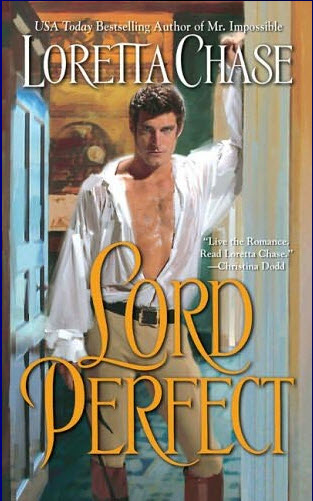
I am including this review for one reason only. Look at him:

I know it’s discomfiting, but do it for me. Note the manly open shirt, the manly sheen on his chest, the manly Coty cologne advertisement feathered hair and sideburns. The insolence. The seduction. The riding crop. The smolder. It’s not the book I’m reviewing, but Lord of Scoundrels is by the same author, and its cover is boring and staid. How could it not be in comparison to this wheel of Gouda? Not that Lord Perfect isn’t completely acceptable, it’s just that Lord of Scoundrels is a classic. It has a much deserved Amazon rating of 4 1/2 stars after 284 reviews. If I am embracing the historial romance genre, this book needs to be included as one of the ultimate romance novels: larger than life characters, operatic kisses in the rain, a battle of wills and, most of all, fun. It is thisclosetocamp, probablycloser, and the result is a delicious wet kiss of a book.

Our hero, full name Sebastian Ballister, Marquess of Dain, is 6’6″, black hair, black eyes, big nose, all man. Wealthy, arrogant, and clever, he meets his match in Jessica Trent, a pert, patient (she’ll need it), self-possessed spinster who has come to Paris to retrieve her gormless brother from the demi-monde Dain inhabits. He takes one look at Jessica and wants to lick her from head to toe. She takes one look at Dain and wants to rip all his clothes off. LET THE GAMES BEGIN! It’s beauty and the beast meets reformed rakes make the best husbands meets tortured hero, with a side of moustache twirling by minor characters trying to ruin everyone’s day. From Paris, the book moves to Dain’s ancestral home with machinations about a Russian icon and an illegitimate child, and an intense romance long on passion and blessedly short on maudlin.

Loretta Chase is, above all, an engaging and confident romance writer. She sets the scene deftly and excels at creating entertaining characters. If you like a touch of intrigue with your romance, she’s your gal. There will be chases, treasures and grand adventures. If you’re like me, you will revel in it despite the B story that does go on a bit. I find myself glossing over those parts hoping I don’t miss any major plot points. Truth be told, I can never tell if the subplot issue is with me (Why aren’t they kissing or bantering? When will they get back to the kissing and bantering? I DEMAND KISSING AND BANTERING!) or with the stories themselves, and I really don’t care.

Links to my other reviews can be found on my complete reading list of books sorted by author or Author Commentary & The Tallies Shameful.

The Turner Series: Unveiled, Unclaimed, Unraveled by Courtney Milan

It is a truth universally acknowledged that romance novels are not necessarily very well-written; however, if you are curious about them and want to know who is the best writer out there (of the more than two dozen I’ve tried) Courtney Milan is where you should start. Lisa Kleypas is actually my favourite writer, but I’ve already consumed her entire output and am looking out for other authors. Milan is a newer writer, very much better than most, and she makes interesting choices which neatly turn genre tropes, if not upside-down, at least on their side. This trilogy contains one book each for three popular romance storylines: the revenge plot, Unveiled, the reformed rake, Unclaimed , and the tortured hero, Unraveled . I read the books in reverse order, admittedly starting with the best one.

The Turner brothers grew up with an absent father and a deranged religious zealot mother. Their names are actually bible verses, so they each use a shortened nickname from their verse in daily life: Ash, Mark, and Smite, yes, Smite. Each man bears unique wounds of their traumatic experiences. The oldest, Ash (Unveiled), left his brothers behind to build a secure future for them. He was gone for several years, returned a wealthy man (in the manner of self-made men in romance novels, he is hardworking and magic at math, and that is all it takes to become rich), and as we join him at the beginning of his story, he is poised to steal a dukedom out from under a noble family based on his manipulations of primogeniture. Hoping to find his weakness, Margaret, the daughter of the house, stripped of her legitimacy by Ash’s actions, is posing as the current Duke’s nurse to spy on the Turners. Ash takes up residence with his brother, Mark, at the ducal estate, ostensibly to assess the family’s finances before the final act of transferring inheritance takes place. Normally, these vengeful men are dark, intense and intimidating. Ash is a giant mastiff that nuzzles you into acquiescence. While he is intense and “cheerfully ruthless”, he is also a profoundly nice man, plagued by insecurities and not a small amount of survivor’s guilt. Margaret has been treated as a pawn her entire life, reduced to who she can marry and dependent on the (sorely lacking) kindness of the men in her life to ensure her security and happiness. Ash objects to these notions and to the effect they have had on Margaret as a person. Many romance novel heroes become caretakers to the heroine, but almost none wage a campaign of relentless kindness and encouragement regardless of his personal goals. He wants her as a partner, but more than that he wants Margaret to see herself as a person in her own right, and with her own rights, in charge of her own happiness.

The hero of Unclaimed , Mark, is a 28-year-old virgin. Let me repeat that and emphasize that it is unprecedented in my experience: Mark is a 28-year-old VIRGIN, and not just a virgin, one who has become a celebrity after writing a tract on chastity, the first line of which is “Chastity is hard.” Mark is the youngest brother of the trio and while he is chaste, he is not innocent. His elder brothers protected him to the best of their ability, but his mother’s insanity resulted in choices and situations that no child should endure. With a virginal hero, the reformed rake role in this story falls to Jessica, a courtesan who has been hired to seduce and publicly humiliate Mark. She was “ruined” and disowned by her family at the age of 14 and has made her way in the world with a series of “protectors”. It is the most recent of these who has promised a payment equal to lifelong financial security to destroy Mark’s reputation, but here’s the thing: Mark isn’t really concerned about his reputation. He is honest in his chastity, but he dislikes the fame it brings and the resulting loss of control over his very simple message about the societal repercussions of sex outside of marriage. In most romance novels, there is an extreme disparity in sexual experience. The hero has had mistresses and lovers, and in their polite way, the writers make it clear that all of those women were available and unscathed. When the heroine has experience, it is extremely limited, she thought she was, or she actually was, in love and the result was her personal downfall. Even if she is older, she is chaste. In Unclaimed, Jessica has used the one thing she had to survive in the world alone. It has cost her emotionally, and even physically, but she is not viewed with the disparagement normally accorded a woman “no better than she should be”. Mark likes himself and he genuinely likes her, and he wants her to feel the same way. Her transformation from someone simply trying to survive into someone trying to build a real life for herself is believable and charming.

In Milan’s novels, not everything is country dances and house parties. Although I do not look for devotion to historical accuracy when I read these books, I mostly just enjoy the period costume descriptions and the home life details, Milan creates a true sense of the squalor and dangers lurking close to the surface in Victorian England. Unraveled in particular, dwells in the horrifying poverty of Bristol and the severe limitations and prejudices of the so-called justice system of the era – all of which brings us to Smite. Well now, Smite is my favourite. He is a brilliant, dark, pensive man, enmeshed in duty, and possessing of a wry sense of humour. Who could resist a man who says to his mistress, “I would not like you half so much, if you weren’t sarcastic,”? Not I, dear reader, not I. He is Milan’s tortured hero. He bore the brunt of his mother’s madness, he bears it still in PTSD, and in the roles he chooses in life. He works as a magistrate hoping to prevent the disregard of society that brought him and his brothers to such a vulnerable state. But he is still a man, so when he encounters a vibrant and canny young woman, Miranda Darling, posing as a witness at a trial, something happens that is again extremely unusual in a romance novel: he asks her to be his mistress and she accepts. For one month of sexual intimacy, Miranda will receive the princely sum of 1,000 pounds and a house. Miranda has just barely survived on her wits and has fashioned protection for herself by association with the local crime lord, so this business arrangement is an escape, but one which will be complicated by the tenacity of the underworld’s grip on her. She can earn lifelong financial independence in exchange for something/someone she also desires, and it gives Smite gets one month to dwell in the land of the living before returning to his self-imposed exile. What works about this tortured hero is not that he is broken and needs to be fixed by some innocent, inexperienced chit, as would normally be the case, rather Smite is in tact and what he and Miranda both require, and find in each other, is a kindred spirit who can meet each other’s needs and their own together.

Milan’s men have attitudes inconsistent with the era. They have no judgement of past indiscretions at a time when being seen alone with the wrong someone could ruin a woman’s reputation. The Turners treat the women as equals and want the women to see themselves in the same way. It is the latter element that makes her books so wonderful. Mark thinks well of himself and wants the same for Jessica; he wants her to want more, to expect more and to be her own person. Ash wants Margaret to see herself as a complete person, in turn she helps him smooth over his own wounds. Smite and Miranda balance each other and provide the freedom to be who they want to be.

A complete summary of Courtney Milan’s catalogue, with recommendations, can be found here.

Links to my other reviews can be found on my complete reading list of books sorted by author or Author Commentary & The Tallies Shameful.