Tag Archives: romance review

Undone by Lila DiPasqua

Awful. God awful. By turns gross and offensive. Also? Horrible.

I wasn’t hopeful going in because Undone, by Lila DiPasqua, was subtitled ” A Fiery Tale”. Punny titles/sub-titles aren’t really indicative of anything more than publishers patronizing their readership, so I decided to give it a chance. Undone was billed as “erotic” which can mean:

  1. Nothing. It is a misnomer, they are trying to move product.
  2. More sex than the average romance novel.
  3. The usual amount of sex, but more graphic in its depiction.
  4. For want of a better term, more creative sex.
  5. Off-putting sex masquerading as eroticism.

In this case the answer was, of course, number 5. The book is neither romantic, nor erotic, so 0 for 2.

Set in the 17th century, Simon Bname leaves his carriage to deal manfully with some ruffians and encounters a nun sneaking back to her convent. Angelica literally runs into him and knocks him over; nonetheless, having had his recently threatened and assaulted prostrate form landed on, and seeing a glimpse of be-wimpled face, Simon is totally turned on and follows Angelica into the convent. Then he brings her out of the convent because they are so mean to her! They sail away; sex scenes take place containing WORDS THAT NO ROMANCE NOVEL SHOULD EVER CONTAIN, “FIERY” OR NOT, AND A SENTIMENT THAT LESS THAN FOUR WOMEN HAVE EVER EXPRESSED IN THE ENTIRE HISTORY OF SEX; time is spent on a Caribbean island; more SEX; they are separated; deus ex machinations™ ensue; evil-doers are brought to justice; they get married.

Simon saves Angelica, he pursues her, his interior monologue goes on and on about how beautiful (and on) and sexually attractive (and on) he finds her. They finally consummate their relationship and his first post coital thought is, “Hold the phone! Where’s the blood?”. Simon, renowned rake/slattern, is irate with Angelica (and on) for not being a virgin, so he proceeds to treat her abominably. He doesn’t even talk to her about it. Obviously, she is a liar (and on) and a faithless jade. Obviously, he is mistaken because this is one of those books where her so-called virtue is important (and on), and his is not.  Madonna/Whore Complex, Table for Simon!

I don’t like romance novels set in the 17th or 18th centuries. Not even the well-written ones which this, and I cannot emphasize this enough, is not. I keep thinking “unclean, UNCLEAN!” when it comes to day-to-day life. I could give a toss about political machinations that affect the top 0.1% while everyone else is scrabbling against poverty and disease. (Medieval settings take these sentiments and multiply them by 10 to the power of 4 times infinity for the subjugation of women.) Moreover, this is the admittedly shallow part, but this is escapist reading so the judges will allow it: I don’t like men’s 17th century clothing and I hate 18th century men’s formal dress. Regardless of scintillating political intrigue, the ornateness of the clothing for both periods jars with my 21st century notions of manliness and diminishes the reading experience. No one looks testosteriffic in a heavily embroidered saffron waistcoat, turquoise pantaloons, and a powdered wig. Nobody.

Links to my other reviews can be found on my complete reading list of books sorted by author or Author Commentary & The Tallies Shameful.
When You Give a Duke a Diamond by Shana Galen

I would love to start a proofreading/editing service for historical romance novelists. I’d hold the author’s hand and say things like, “It’s not really appropriate for the hero and heroine to get randy in the home of his recently deceased fiancée, especially as they are searching said home for clues as to her violent demise. It may come across as insensitive.”

When You Give a Duke a Diamond was like the movie The Return of the King: It had several endings starting about 70% of the way through, and then somehow managed to keep going via deus ex machinations and unnecessary complications. Also, that title is truly appalling.

The Plot: Will is an uptight Duke. Juliette is a famous courtesan. Something with murder and spies.

In addition to wanting to offer my services as an editor, I often read these books thinking an author has potential. Then I look her up on Amazon, discover she has published many novels, in this case eleven, and realise that this is as good as it’s going to get.  Since Shana Galen is not paying me to be nice about it, here is what is wrong with this book:

  • It is a little too busy establishing its subplots.
  • There are too many subplots.
  • Will is “tired of fighting it”? It’s been, like, 37 hours.
  • Everyone is crazy beautiful.
  • The aforementioned excess of endings.
  • It needs more banter.
  • No one gets back and forth between London and Yorkshire that easily by carriage. This time would be well spent having Will and Juliette get to know each other (in the non-biblical sense).
  • Any romance that includes “Prinny” is instantly on notice. This is, admittedly, a personal issue.
  • JESUS CHRIST! TWO MURDERED DOGS?!

Here is what is right with this book:

  • The moments of tenderness are actually rather sweet.
  • The eruptions of violence are shocking and frightening.
  • There are some really fun touches of humour.
  • The hero must accept the heroine’s past as in no way indicative of her value, or morality, as a human being before his suit is even considered.
  • A particularly harrowing and thrilling triumph over one of the villains, even if his presence was deus ex machinations.

I might read more by Shana Galen, if the price is right: $1.99 or less/free from the library.

NEXT!

The Lion’s Lady by Julie Garwood

This time, I’m kicking it old school…

I went through a romance genre phase after I graduated from university in 1990. I don’t think I read a so-called real book for about two years. My boyfriend at the time was ENDLESSLY horrified by my choices. Then, I woke up one day and went to the library for works by the Algonquin Round Table. That kind of awakening hasn’t happened so far, and as I’ve read what I believe to be everything good currently out there,  I decided to go back and read an author from my last genre episode.

In the early 1990s, Julie Garwood was the best writer of historical fiction and, according to Wikipedia anyway, I can congratulate myself on my excellent taste as she was apparently important to the genre for introducing quirkier heroines and the use of humour. I read most of her historical output, and during my romance novel cleanse, her book The Gift was one of only two I kept. It was also the first thing I picked up when the current fever set in.

Here, in a nutshell, is Julie Garwood’s The Lion’s Lady:

Christina, is young, not quite 19, and bee-yu-ti-ful. As with all Garwood heroines, she has a sprinkle of freckles across her nose. Her mother fled an abusive marriage to a non-determinate European royal before dying and passing on her child to be raised by — wait for it — the Lakota Sioux. After a year of “Acting English” training, Christina has arrived in London to help her (villan alert!) aunt claim Christina’s inheritance before disappearing back to the Lakota.  Oh, and her evil father is skulking in the wings twirling his moustache because of a subplot about stolen jewels. As Christina is Blondey-Blonde von Blondersen, I remember wondering in 1992, and again this time, why her skin apparently has no sun damage from 16 years living on the plains. Did her adoptive mother make her wear a bonnet?

The hero, the Marquis of Lyonwood (Lyon), is thirty-ish, the size of a door, very male, also patient.

I would describe this book as fluffy. The subplots are dead serious, but the love story is approached with lightness and whimsy. There is a playfulness to the writing which is quite charming. The love scenes were considered quite graphic at the time. They would still qualify as fairly explicit, but have nothing on what one can find today depending on one’s tastes. Last year, when I read my first romance with anatomically correct terms (The Devil in Winter) my eyebrows made it halfway up my skull.

I won’t be seeking out any more Garwood. The genre has developed since the early 1990s, and I have little patience for impossibly beautiful leads and a borderline creepy age difference. My recollection of the books at the time was that all the heroines were very young, chaste, beautiful Victims of Circumstance, and I greatly prefer the more mature Wallflower heroines that proliferate today.

(The other book I have kept all these years was Vows by LaVyrle Spencer. She was well-regarded in the genre for writing “real people” historical romances set in the United States in varying time periods. Spencer retired in the late 1990s, but her entire back catalogue is available for e-readers. Julie Garwood transitioned to contemporary hardcover romance and thrillers and is still publishing today.)

With This Ring Series: Reforming a Rake, Meet Me at Midnight, and A Matter of Scandal by Suzanne Enoch

More B+ romance from an author I go to in a pinch and only if the price is right. Suzanne Enoch is almost really good. Her romances leave something to be desired, but I can never quite put my finger on what. It may be that she’s not good at conveying passion, or maybe intimacy, or even besottedness.  Love beyond the initial attraction? I’m still trying to puzzle it out.

Reforming a Rake

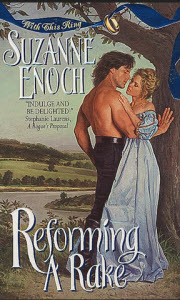
Amazon is giving a publication date of 2009, but the cover art tells a different story:

rake

Despite appearances to the contrary, the hero is not Kevin Sorbo of Hercules: The Legendary Journeys.

Lucien Balfour, a rake and some sort of noble, needs a social tutor/guide for his country cousin. He is impeded by both the cousin’s gauche behavior, and the young woman’s vulgar, grasping mother. He hires Alexandra Balfour, a genteel-y impoverished lady, to act as her governess; not because of sterling references or experience, but because he really wants to have sex with Alexandra, and he figures she can teach his cousin to be alluring to men as well and thus get the young woman off his hands and out of the house with alacrity. Lucien and Alexandra fall in love, he locks her in his basement (in a fun way) for reasons I cannot begin to remember, they get married, the end.

I feel behooved to mention that only in romance novels can a name like Lucien, or Sebastian, be ruggedly masculine, although, truth be told, I actually like the name Lucien. Not enough to burden a child with it, but certainly well enough to aggrandize a cat, if I weren’t violently allergic to them, which I am.

Meet Me at Midnight

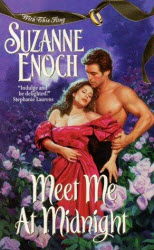
rake midnight

The woman’s 1987 prom dress appears to be sliding off her body.

I almost always like romance novels when they get married at the beginning. This is one of those.

Victoria Fontaine, nicknamed Vixen, is beautiful (Regency Elizabeth Taylor), bright, and vivacious. Tired of her “my eyes are up here” life, she’s a hoyden whose parents don’t know what to do with her; fortunately, she gets caught making out with her new acquaintance, Sinclair, Marquess Althorpe, at a party in Chapter One. Victoria’s parents know an out when they see one, so they insist these two gorgeous, sexy people marry right away.

Sinclair, nicknamed Sin, louche by all appearances, is the standard indolent-younger-son-who-was-never-supposed-to-inherit-and-now-has-to-make-good. Lucien (Kevin Sorbo up there) was in the same position. Sin has recently returned from a life of endless indulgence on the continent, but he was really a spy, of course. Victoria figures it all out pretty quickly and sets out to help him with the maguffin-y sub-plot.

Speaking of sub-plots, Vixen has a menagerie of animals that she brings to Sinclair’s house with her. Animals that, once again, are you listening romance novel authors?,cannot be house-trained. Plus there’s a parrot that repeats what was said during love scenes. It’s kind of charming, but also kind of COME ON! PARROTS DON’T LEARN PHRASES THAT QUICKLY!

Regardless of the bluebirds on her shoulder, Victoria and Sinclair are rather delightful together, and I enjoyed their jaunt to a happy ending. There were moments of genuine humour and Enoch did a good job at the falling in love narrative. I didn’t even mind their nicknames, Vixen and Sin, since they represent the personas they had hi— RECORD NEEDLE SCRATCH!

I just discovered that there is a third book in this series, A Matter of Scandal, and I scooped that sucker up on Amazon for $1.99 in 1.3 seconds flat. There will now be an indeterminate delay while I read the book and add it to this review.

[Muzac version of The Girl from Ipanema]

I’m about a third of the way through. So far, so good. Great banter, good chemistry. Funny.

Greydon Bsomething, Duke of Wycliffe is helping his uncle reorganize his finances and the first step was a huge and long overdue rent increase for all of his tenants. That’s endearing. The lovely redhead, Emma Grenville, who owns and runs the finishing school on the estate is displeased, to say the least, so she and the Duke enter into a wager to prevent the increase. She has to come up with a better plan than the Duke’s to fix his uncle’s finances. He has to teach a class at her school for some reason. Translation: They have to spend a lot of time together.

Wycliffe is gorgeous (natch), large (obvs), thinks all women are trying to ensnare him ( ’cause, you know, Duke), and is magnetically drawn (of course) to the bluestocking who doesn’t give a toss about any of it, except his dismissal of her school and efforts (natch).  Apparently,  the best way to improve someone’s opinion of women is to make him spend extended periods of time with a group of teenage girls. Has the author ever met a teenage girl?

Wycliffe is annoyingly arrogant so far. I’m hoping he’ll be taken down SEVERAL pegs.

[Muzak resumes]

There is a hilarious moment when Emma is giving Grey what for at a dinner party and his entire response is to silently wish everyone else would go away so he can enjoy her insults without interruption.

[Muzak transitions to We’ve Only Just Begun]

A Matter of Scandal

rake scandal

 Why is Clint Eastwood pushing her into that rose bush?

Well, that was Enoch’s best effort: very funny, great chemistry, a romp; and once again, it was lacking something I can’t quite put my finger on. Do the leads need to talk to each other more? Talk to each other differently? Is there only sexual chemistry and no intellectual connection and therefore although that part works, it doesn’t go deeper? Is it something about the intimacy? Blargh!

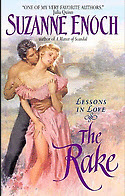
I discovered another book in the series, The Rake, but it’s $7.59 on Amazon, so this won’t be happening any time soon:

rake rake

Pity.

Also by Suzanne Enoch
The Rake (Tristan/Georgiana)
England’s Perfect Hero (Robert/Lucinda)
The Devil Wears Kilts  (Ranulf/Charlotte)

Links to my other reviews can be found on my complete reading list of books sorted by author or Author Commentary & The Tallies Shameful.

One Good Earl Deserves a Lover by Sarah MacLean

Girl meets boy. Girl asks boy to ruin her. Boy refuses. Boy gives in.

I’ve read about 140 romance novels in the past year, and attempted another two or three dozen. I feel depressingly confident in saying that I’ve read all the good ones. At least, all the good ones that I can get my hands on, as I am unwilling to pay $7.99 each to purchase an author’s out of print backlog as it spills into Amazon’s Kindle stock.  This means I do a lot of three things:

  1. Wait for the good authors to release new books.
  2. Take a chance on new authors on Amazon.
  3. Try random library books with titles like:                                                                                 If You Give a Girl a Viscount                                                                                                Sex and the Single Earl                                                                                                  Cloudy with a Chance of Marriage

Between the awful titles and covers, the publishers really do manage to convey what they think of their extremely profitable readership. This book has an awful title, too. I don’t blame the author. I’m sure she would have preferred something less excruciating.

One Good Earl Deserves a Lover is the second book in Sarah MacLean’s Regency Rule of Scoundrels series. Each book features one of four displaced lords who run a notorious, and therefore extremely fashionable and popular, gaming club called The Fallen Angel. The first book, A Rogue By Any Other Name, introduced the gentlemen, and told Bourne and Penelope’s story. That book was good, but the hero suffered from a prolonged case of Head Up Posterior. This book is much better, lovely in fact. It picks up exactly where the Epilogue of the last book left off. I love it when they do that!

Pippa Marbury is getting married in two weeks. She is a woman of insatiable intellectual curiosity and as such is extremely inquisitive about what to expect on her wedding night. Instead of doing the logical thing and throwing herself at her very nice, very boring fiance, she approaches a notorious rake to provide the “ruination” she seeks; however, Cross is not actually the roue he appears to be, so he naturally/correctly/wisely refuses Pippa’s request, but he doesn’t really want to. Hijinks ensue.

Cross (Jasper, Earl Something) is likeable, fiercely intelligent, and kind, a quietly tortured hero. He’s also a redhead which is extraordinarily unusual for heroes in the genre; what’s more, he’s tall and he gangles (H/T Douglas Adams). The men in these books are never short, but at 6’6″ Cross, dwarves Pippa. I’ve complained about the practicalities of height differences before. These are details that occur to me while reading romance novels and break my otherwise extraordinarily willing suspension of disbelief. What does absurdly tall Cross do when he wants to kiss Pippa? He picks her up, they both sit down, he kneels in front of her. Not in swooping romantic gestures, but simply as a practicality. It’s small details like this that make Sarah MacLean the writer she is and put her on my autobuy list. I’m so grateful for the effort to keep things logical.

Pippa is bespectacled and bookish. She’s odd. An intellectual at a time when such efforts would have been barred to her, she’s also rich and has disinterested parents, and thus free to follow her scientific interests. I don’t normally latch on to the heroines as much as the heroes, but I loved Pippa and related to her strongly.  Her insistent uniqueness was really endearing. Pippa knows she’s unusual, she always has been, and while she doesn’t necessarily like it, she embraces it as who she is. In my family, speaking in a clever and complicated way is seen as a game. As a result, I tend to sound like a Gilmore Girl by way of Katharine Hepburn. It’s not a good thing. It’s a thing I was mocked for as a child and a thing that I still constantly try to temper in my everyday life: Don’t be too clever, don’t use words people might not know, don’t be too enthusiastic, don’t talk too quickly, don’t use references. I loved Pippa for being herself in a way I don’t often feel I’m allowed to be. Defiantly so. Defiantly curious, defiantly intellectual, defiantly demanding what she wants and needs, and being rewarded for it with a lovely man who genuinely understands, cares for, and delights in her.

And now I can go read Malin’s review of this book and see if we agree. We usually do.

Penelope by Anya Wylde

An open letter to Anya Wylde author of Penelope (A Madcap Regency Romance)

Dear Ms. Wylde:

Sincere congratulations on completing and publishing your second novel. It is indeed a great achievement and one which I certainly cannot claim; however, I have read very, very many historical romances, so if it is true that novels are never finished only abandoned, I have some notes for you. If you have moved on, they might help with your next effort.

1. The writing itself is perfectly serviceable. The plotting, characters, tone, and editing are problematic.

2. The bit with “Are you thinking about your grandmother?” was very clever.

3. The heroine, Penelope, arrives at Duke’s London residence with a PET GOAT. She may be a bumpkin with no filter, but this is patently ridiculous.  It is neither endearing, nor whimsical. It is malodorous and incontinent. Why not a puppy? It could grow up, calm down, and, this is the important part, be house-trained.

4. The reader is given two random and extremely brief scenes of Penelope’s dead mother in heaven looking down on her between rounds of tossing her halo for wolfhounds to fetch. Sure. Why? Give a dog to Penelope and kill the dead mother (and the damn goat).

5. Your hero, Charles, is an awful person and does not become any more tactful, likeable, or sympathetic as the story progresses. He finds Penelope gauche, embarrassing, and appalling. He tells her so regularly with spectacular insensitivity. He’s even rude to her in the Epilogue and refers to their children as “brats”.

6. Know your genre tropes: If the hero and heroine are opposites and set against each other, they must also have an intense sexual attraction underlying their interactions as they find common ground. Charles should find Penelope’s lack of pretension refreshing and charming, even if he doesn’t want to. Tell the reader what he is thinking. Penelope is flighty and blithers endlessly. He could help her feel comfortable and relax. She could help him remove the stick from his bottom.

7. Penelope and the duke’s sister act like 15 year olds. Why on earth would anyone be attracted to them, unless he/she too was a silly teenager? It makes the romantic relationship, such as it is, jarring and incomprehensible. Penelope may be sweet and well-intentioned, but she’s childlike.

8. Calling the story “madcap” does not excuse these elements:

  • The openly gay, openly transvestite modiste who teaches Penelope to be a “proper woman”, AND who is a peer AND a spy because of a late and inexplicable espionage subplot.
  • All the men have to wear a moustache to dinner to appease an elderly grandfather. This is silly, but it’s also a squandered opportunity. At some point, Penelope should either wear a moustache to dinner as a joke, or rip off the Duke’s in a fit of pique.
  • The lovelorn highwayman Penelope prattles into submission before the story even begins. Why did you not start with this episode?
  • The return of the lovelorn highwayman in some bizarre plotting which includes the Duke in costume declaring his love for Penelope despite the fact that he clearly can’t stand her.

9. I’m 99.96437% sure that no one in The Regency used the word diddlysquat.

Thank you for your time.

Yours truly,
Prolixity Julien

The Revenge of Lord Eberlin by Julia London

Almost completely joyless. This will be my only Julia London book.

I selected this novel randomly from the romance spinner at the library, read a few pages, shrugged, and decided to give it a go. The Revenge of Lord Eberlin feels like a romance novel from the early days,  i.e. the 1970s/1980s. For the uninitiated, that means that the hero is a gorgeous, but cynical, brooding bastard who treats the heroine abominably, and the heroine is nonetheless magnetically attracted to him. His sole redeeming trait for most of the book is that he is nice to children. His only sympathetic quality, I think that was the author’s intent, is that he has panic attacks and since it is 1808 he has no idea what is going on and they terrify him. Julia London is a decent writer, sentences like “her heart was beating like the wings of a thousand birds” not withstanding, but this book was not engaging and, frankly, I’ve seen the revenge plot (the clue is in the title) done better by Julie Anne Long and Courtney Milan.

When Lord Eberlin, once Tobin Scott, was 13, his carpenter father was hanged for stealing jewels from the Ashwood estate. Central to the case was the testimony of Lord and Lady Ashwood’s adopted eight year old daughter, Lily Boudine. She saw Mr. Scott senior riding away from the manor on the night of the theft. Scott’s family was destroyed by the scandal: his mother and brother died in penury, and Tobin helped place his sister in service before he went to work on merchant ships. Fifteen years later, having purchased a title and clawed his way to wealth as an arms dealer (how revolting), Lord Eberlin has come back to destroy the Ashwood family, its finances, the estate, and anything else that isn’t nailed down. He’s really very grumpy. He has a charming friend named Mackenzie who might actually make for a fun book, but his appearance was disappointingly brief.

Lily and Tobin played together as children; more accurately, Lady Ashwood and Mr. Scott senior asked Tobin to occupy Lily while “work” was being done at the manor. Now Lady Ashwood in her own right, Lily is a smart, patient, and preternaturally mature and understanding young woman. She also has a young ward who appears now and then to be winsome and prove hero isn’t a complete ass. Tobin wants revenge, but he is drawn to Lily. She wants to protect her land and dependents, but is drawn to the foxy  rude man who turns her crank even as he takes her livelihood.

The proposal was charming, but this book was no fun; more importantly it was essentially humourless.  The tone was so serious that I started to wonder if the problem was me. Was I in a bad mood? Was I misreading the tone? Was I projecting emotions onto the story? Mostly, it was disappointment. I need to find a new romance writer’s catalogue to march through and with every new book I’m hoping I’ve found her. London used the word “visceral” on page three, so I had high hopes, but it was not to be.

The (Shameful) Tally 2013 – Ongoing

Things That Occur to Me While Reading Historical Romance Novels – Ongoing

To Love a Thief by Darcy Burke

Meh, but more on that later.

There are a lot of large men in period romance novels: tall, dark, and handsome, with historically-inaccurate muscle definition. Excellent traits all.  I’m a woman of average height and I’ve never dated anyone tall, although it has a definite appeal. Feeling petite is one of those things I just know I would delight in. The heroine of To Love a Thief, Jocelyn, is a tiny little thing who just manages comes up to the middle of the hero’s chest, so about like this –

heights 2

which is totally fine, but I always wonder about the upright kissing. Romance authors like to say that the characters “fit perfectly”, or are “pressed along each others length”, but what are the practical considerations of this height differential? My former boss was about 6’4″, and when I hugged him goodbye, I stood on tiptoe and barely cleared his shoulder; moreover, the heroine is always putting her arms around the hero’s neck. Is that even possible from a standing start? He would have to bend over and therefore away from her to reach, right? I want to read a romance with a running joke that the hero is always making sure the heroine is on a step, or he sits down on the edge of a piece of furniture, or simply lifts her straight up (swoon) to deal with the issue. And don’t even get me started on the impossibility of certain positions with such a pronounced height difference.  He’d throw his back out. It’s contrary to the laws of physics, no matter how historically-inaccurate his muscles are. No one could vigorously squat or, conversely, stand on tiptoe for that long. This is what gnaws at me while I read these books. Well, this and “aren’t they freezing?”; “just how big is this bed?”; and “that’s not really feasible with the bathtub you just described”.

In To Love a Thief, Jocelyn Renwick is on the shelf, but still in circulation. Her only season was cut short by a series of unfortunate events, including a traumatic burglary and her father’s death. Two years later, she has returned to society as a lady’s paid companion. During her absence Daniel Carlyle, a former constable, inherited a title and has devoted himself to learning his new duties and to navigate the world he has joined, aided by his close friends Lord and Lady Aldridge. When first they meet, Daniel is captivated, but Jocelyn is distracted by Lady Aldridge’s necklace. It is identical, down to a surface scratch, to one that was stolen from her home.

Jocelyn sets out to retrieve/steal her family heirlooms from the Aldridges and Daniel catches her in the act. They work at odds, and then together, to solve the really quite obvious mystery of Lord Aldridge’s nefarious activities. There is some traipsing through London’s underworld, villainous mustache twirling, and a beleaguered household staff that keeps getting tied up. None of it is very exciting or fresh, and I admit to having perused certain portions rather quickly.

I don’t know if Darcy Burke is a new author, but the writing feels like she is. There were occasional flashes of potential, but overall it was pretty flat. The main problem was that the reader is told Daniel and Jocelyn have fallen in love rather than being shown. For obvious reasons, the ability to convey attraction and emotion is essential to success in this genre.

To Love a Thief was free for Kindle on Amazon; I downloaded it as one of several such items. It’s a clever marketing ploy, if it gets you to buy more of the writer’s work. It won’t, but I can’t blame Burke, or her publisher, for trying.

Julie Anne Long also has a historical romance called To Love a Thief and it is delightful.

This Wicked Gift by Courtney Milan

I’ve written about the two men and seven plots that occupy all romance novels, but I’ve given short shrift to the women, so this is what I’ve learned since my first romance novel review 136 books ago: She’s still either a Wallflower or a Victim of Circumstance. The Wallflower is a lovely, pert, overlooked woman who needs to get her light out from under that bushel. The Victim of Circumstance is someone who, usually due to exigencies beyond her control, has dim prospects and has to make her own luck. Both women are bright and self-sufficient, and, contrary to what I suspect many people think about romance novels (when they think about them at all), they are not being “rescued” by the hero. They either rescue him, or they find their way together.

When people are kind enough to ask me to recommend a romance writer to them, I always suggest Courtney Milan unreservedly. Correction: One reservedly, Trial by Desire, her second book. With the novella This Wicked Gift, I have read her entire output and thus have to writhe in anticipation of her next publication; fortunately, this one did not disappoint. It broke my heart and then put a smiley-face band aid around it.

A Christmas story, This Wicked Gift, is part of Milan’s first trio of published works, which also includes Proof by Seduction and Trial by Desire. William Q. White, a clerk scraping by after being perfunctorily disinherited, is in love with Lavinia Spencer. Astute, determined, and vivacious, she runs the local lending library to which he has a subscription, and she thrills to his presence as well. William takes advantage of an opportunity to be of service to Lavinia, and then takes advantage of her indebtedness to him, or so he thinks.

Milan never shies away from the grinding poverty of 19th century England and this book dwells not with the lords and ladies of so many romance novels, but with honest people trying to eke out a living in an often harsh and loveless world. To weave the fight against one’s own penury, place in the world, and the striving for some semblance of a comfortable life into a genre story based around romantic love is quite an accomplishment. It is indeed romantic and it feels realistic.

The last Milan novella I read, A Kiss for Midwinter, contained a heart-stoppingly romantic moment. This book contained a sentence that broke my heart into a thousand pieces, “You would need never feel cold again.” It wasn’t a romantic line, it was meant literally: You will have the financial wherewithal to purchase warm clothing and fuel to heat your home. Imagine a life where being warm seems like an unattainable luxury. Being cold is something I despise and resent. Whenever I read a book with characters living in poverty, being cold always occurs to me. I won’t even read the Highland Laird romance genre because I am always thinking, “God, it must be so damp. It would just crawl through your clothing and envelop you for nine months of the year. I don’t care how good a kisser he is, he’s not worth it.”

Links to my other reviews can be found on The (Shameful) Tally 2014 or my list of books by author.

Also from Courtney Milan

The Carhart Series
This Wicked Gift – please see above
Proof by Seduction
Trial by Desire – one of only two Milan books I don’t recommend

The Turner Brothers Series
Unveiled
Unclaimed
Unraveled – personal favourite
Unlocked

The Brothers Sinister Series
The Governess Affair – very good novella
The Duchess War – great
A Kiss for Midwinter – CLASSIC
The Heiress Effect – the secondary plot was lovely
The Countess Conspiracy – superlative
The Suffragette Scandal – CLASSIC, MASTERWORK
Talk Sweetly to Me (novella) – August 19, 2014 (bouncing with excitement)

Independent Novellas
The Lady Always Wins
What Happened at Midnight

The Mackenzie Series: The Seduction of Elliott McBride by Jennifer Ashley

I lovehate Jennifer Ashley. I went on about my feelings at length in an earlier review and yet I still read the next novella, A Mackenzie Family Christmas: The Perfect Gift, and novel in the Mackenzie series.

The Seduction of Elliott McBride may be the book that cures me of my love and brings me down solidly on the side of hate, or at the very least never, ever paying for one of Ashley’s books ever, ever again.  The novel opens with very proper Juliana St. John being left at the altar as her fiance has married his piano teacher. Quelle horreur! Taking a moment alone in a chapel, Juliana SITS ON her childhood friend  Elliott McBride. He has recently returned from India a shattered, but appealingly bronzed, man, and, since they have always loved each other from afar, they decide to marry right away, like, RIGHT AWAY, in the next 15 minutes, and so begins the story.

As with all Ashley men, Elliott McBride has a histrionically torturous back story. He wants Juliana to ground and heal him, so after impulsively marrying, they go straight to the manor he has bought in a remote area of Scotland. With the patience of a saint and the personality of a handkerchief, Juliana passively endures all manner of ridiculous subplots including Elliott’s blackouts and unpredictable violent rages (which are never directed her and that somehow makes them okay); accusations of murder; a stalker; a home in complete disrepair; the home’s violent and irascible existing resident; a culturally patronizing portrayal of Elliott’s Sikh servants; a mixed-race lovechild; Elliott’s random disappearances; his history of imprisonment and profound abuse up to, and including, brainwashing; and hostility from the locals, all while isolated from her family and any semblance of the life she has known. Juliana is fine with it. All of it. She only wants to help. She makes a lot of lists to help organize things. None of the lists seem to include the following:

  1. hide all knives
  2. hide all  guns
  3. install stout padlock on bedroom door
  4. have doctor secretly examine husband
  5. have husband committed
  6. make conjugal visit to asylum

A laundry list of plot ridiculousness is typical of Ashley, but she usually balances it with a love story sufficiently charming to counteract said ridiculousness. That is not the case here. The book is awful and NOT because of everything I’ve already mentioned, though it certainly helps. The fundamental problem is that it’s not a romance novel: Elliott and Juliana start out in love. They stay in love. Their love does not waver. They get busy from the get go. There is nothing actually keeping them apart. The story doesn’t build to anything in their relationship. That is not a romance novel. It’s Ashley attempting to hit all the highlights of her most popular book, The Madness of Lord Ian Mackenzie, and skipping the sincere love story part that endeared her to me in spite of her farcical plotting. She completely missed the point.

I will be resetting my romance reading summary, The (Shameful) Tally for the New Year. I’m under the impression I’ve read everything decent in the historical romance genre and now I have to wait for the good authors to publish new work, so I am anticipating far less shame and a proportionately reduced tally. I may have to read a real, proper book work of literature.

A summary of Jennifer Ashley’s catalogue can be found here. Links to my other reviews can be found on my complete reading list of books sorted by author or Author Commentary & The Tallies Shameful.