Tag Archives: historical romance

The Worth Saga: Her Every Wish by Courtney Milan

Courtney Milan
Iconoclast

… is what I assume Ms. Milan’s business cards say.

Could she please to stop almost bringing me to tears with her messages of empowerment and self-determination? Why almost? Because I am made of steel. Why tears? Because the truths she writes about touch me deeply.

hew-small

Her Every Wish is the first novella in Milan’s new Worth Saga Victorian romance series. In the long-term, it will contain eight books for us to devour, for now there is just one other novel, Once Upon a Marquess, which I don’t recommend. I do suggest you read this one though, most ardently. Do some stretches first. You’ll want to be limber for all the fist pumping you find yourself doing.

Sole supporter of herself and her invalid mother, Daisy Whitlaw “manages” financially with her job at a flower shop and her mother’s occasional tatting work. Even so, like everyone, she dreams of more, so she has entered a charity competition to try to secure 50 pounds and open Daisy’s Emporium, a shop that will cater to working class women by providing affordable clothing and small luxuries. She knows it is virtually impossible that she will win, but, goddamn it, she will try. Derided by most of those present, Daisy is still allowed to move along in the competition. Witnessing her first pitch to the judges is her former inamorato, Crash, and he hatches a plan to help Daisy and himself.

Crash seeks Daisy out to assist in preparing for the final presentation, and to help his odds on the bets he has taken on the outcome of the competition. They were devoted sweethearts in the past, but Daisy is determined not to fall back into Crash’s arms and he is equally sure he doesn’t want her to. Equally aggrieved of each other in their parting, this is to be a business arrangement. At least, that’s what they tell themselves. Crash begins with velocipede riding lessons as he teaches Daisy that the necessary response to (riding) challenges is to go faster.

Clash, no last name, is a bright, charming man with an intractable vision for his own future. Bisexual and of mixed race, he has used his verve and ironclad self-worth to create a life on his own terms in a world that not only doesn’t necessarily welcome him, but goes so far as to question “What are you?” in their quest to lower him. People may find him attractive, but being enticingly exotic is just another pigeon-hole the culture uses to limit him.

The strength and courage to be true to yourself and, more importantly, insist on it when the world tries to slap you down is a theme in all of Milan’s books. Never preachy, never saccharine,  and eliciting some barks of laughter, Her Every Wish has themes of personal strength, identity, and autonomy, reminding readers that the world may try to stand in our way, but that life’s smaller victories, such as those of Crash and Daisy, are what pave the way for those and them that follow (see also: The Suffragette Scandal).

Milan

A complete summary of Courtney Milan’s catalogue and the books in the Worth Saga, with recommendations, can be found here.

Links to my other reviews can be found on my complete reading list of books sorted by author or Author Commentary & The Tallies Shameful.

The Reluctant Bride Collection: To Catch a Spinster, To Tame a Dragon, To Wed the Widow, and To Tempt the Saint by Megan Bryce

51n09fzov7l-_sx310_bo1204203200_

The four Reluctant Bride Collection novels,  jaunty in tone and virtually chaste, provided a great introduction to Megan Bryce’s work. Connected by theme, but not characters, each of the books in this Regency historical romance series tackles a female stereotype and features an unusual and fiercely independent heroine:

  1. To Catch a Spinster – The Frump
  2. To Tame a Dragon – The Virago
  3. To Wed the Widow – The Maneater
  4. To Tempt the Saint – The Manipulator

What I enjoyed most was that the women did not change over the course of their stories. They may grow emotionally, but their essential nature is not changed. Each one simply meets a man who is her ideal counterpart. Brava!

To Catch A Spinster

Olivia Blakesley is a self-proclaimed spinster and glad of it. Bookish,  disinterested in fashion, and plain, she has a large family, her passion for painting constellations, and leads a full life. She knows marriage would curtail her freedom and wants none of it; however, there is one aspect of that state she wants to experience and she has chosen Nathaniel Jenkins to perform the task. He is an older man, “Tall, but not too tall. Handsome, but not diabolically so,”,  suffering through his mother’s tedious parade of potential mates whose youth makes him uncomfortable. When Olivia proposes her own seduction, he refuses, agrees, and then finds himself desperately trying to convince her to marry him, despite promising her he would not when they planned their “transaction”. What can he offer that is worth her liberty?

To Tame a Dragon

“She swept from the room like a hurricane on a mission.”

This delightful entry was my favourite of the series, though I enjoyed all of them and when I revisited the To Catch A Spinster, I found myself pleased to be torn. Bryce’s writing is just such droll fun.

Jameson Pendrake, Earl of Nighting has, moments before the novel opens, jilted his fiancée. The reader meets him prostrate on a sofa nursing his recently assaulted wedding tackle. His best friend, Robin, is there making sympathetic noises; Robin’s sister, Amelia, is there also, but with  a no-nonsense approach and offering to defray the impending scandal. The trio have known each other virtually their entire lives with Robin and Jameson having been school friends and Amelia insisting on tagging along whenever the boys went on adventures.

Amelia is an emphatically capable woman, deliciously wry and practical in her approach to the world. Jameson is irreverent, fun, and naughty in that way that can be so tempting in a prospective suitor. Not that she has ever allowed herself to think of Jameson that way. He is too good-looking by half and his exuberance leads to a lot of scrapes. Winning and adorable, he’s also got a good head on his shoulders because he comes to the realisation that Amelia is the perfect woman for him, “He shook his head, imagining himself in the role of her husband and she of his wife. The rightness  of it filled him. The peace of it filled him. And what an adventure it would be. The fun of it.” Now all he has to do is convince her of that:

She sighed and took a small step away from him. “There are two problems, and you are both of them.”
“I usually am.”
“You usually are.”

Of course, she capitulates and they get married,  all that’s left is for them to stop quipping at each other long enough to admit their true feelings.

The next two Reluctant Bride books feature men named George Sinclair (sin) and George St. Clair (the saint) respectively. I appreciate this on two levels:

1. as a clever play on words
2. I think it highly likely that there were a lot more men named “George” and a lot fewer men named “Logan” in historical romance than authors like to admit to, so the realism of it pleases me.

To Wed the Widow

As is the way of things, I read these books out-of-order and To Wed the Widow was my first foray into Bryce’s catalogue. The so-called maneater of this collection is someone who has been widowed five times.  To misquote Oscar Wilde, “To lose one husband may be regarded as a misfortune; to lose five looks like carelessness.” No one thinks she murdered the men, but their tendency to parish whilst married to her does give society pause; moreover, she has observed successively, shockingly shorter mourning periods after each husband even though she looks fabulous in black.

Lady Haywood is just too perfectly scandalous and tempting for George Sinclair. The younger brother of an Earl whose marriage has produced four daughters, George has just returned from many happy years in India to do his duty by the familial line of succession. The Earl’s wife, a lovely woman, nearly died when her last child was born and her husband has vowed never to chance a pregnancy again. The Countess is not on board with this plan and seeks Lady Haywood’s help in remedying the situation. Everyone skirmishes their way through the book towards a happy ending in spite of the Earl’s preferences and Lady Haywood’s awful brother who keeps showing up to throw a wrench into the works.

To Tempt the Saint

Bryce maintained the same clever voice as in the preceding books in the series, but To Tempt the Saint had a more serious tone and content overall. Relatively speaking, I found it the least enjoyable of the group, despite the excellent portrayal of complex characters and relationships. To Wed the Widow had a sinner, To Tempt the Saint has the opposite. George St. Clair wants to be left alone to pursue his business interests. His family considers this vulgar and wants him marry a decent woman and go into the Church. It’s what younger sons do, after all.

Precipitated by scandalous events in her youth and working with her aunt and uncle,  Honora makes her living through betrothals. She becomes engaged and then forces the man’s hand into breaking the marriage contract. Suing for damages, as was the way of the era, she then moves on to a new location and another man. Like the con in a heist movie going for one last job, the trio feel they need just one more big score before they can retire. Choosing independence, even through illegal activities, Honora is in a race between getting caught and collapsing under the emotional toll of her own subterfuge.

Attending a lecture on steam power as a potential investment – her ill-gotten gains aren’t going to languish in those famous Regency Five Percents – Honora meets and annoys George St. Clair thus gaining his attention. Falling apart emotionally as a result of her machinations, she remains resolute that if she can tempt George, the reward will set her little family up for life.  He is, naturally, the first man she has set her cap for who sees the real her and this complication propels the story.

As I got the first three Reluctant Bride novels free on Bookbub, I had no objection to paying full price for To Tempt the Saint. I felt that I owed Megan Bryce the money and probably a gratuity.

I have also read a contemporary Megan Bryce novel, Some Like It Charming,  that I will get around to reviewing eventually. It was light, fun, and required slightly more willing suspension of disbelief than I was able to provide.

Links to my other reviews can be found on my complete reading list of books sorted by author or Author Commentary & The Tallies Shameful.


The Survivors’ Club: Only a Kiss by Mary Balogh

The Survivors’ Club series has had a really good run and there is one more book to go that I will be reading when it becomes available, but Only a Kiss was a swing and a miss. I never really connected with it and, in particular, didn’t get a handle on the hero.

Before I start, let’s take a moment to enjoy the gorgeous and mostly accurate (!) cover.

91itfresqhl

The Survivors’ Club series follows the aftermath of the Napoleonic Wars for six men and one woman. They spent three years together recovering from their respective visible and invisible war wounds and now, several years out from their injuries, they are each moving on to the next phase of their life with relationships and families. Only a Kiss is book six and features the lone woman of the group, Imogen. She has been described repeatedly as seemingly made of “marble” and it’s an excellent characterization. She experienced profound loss and psychological trauma during the War and has coped with life by going through the motions, but placing strict limits on her participation in the world and on her emotions. Occupying a dower house in Cornwall, her life is turned upside-down when the Earl whose land she lives on has the temerity to move home.

Percival, called Percy, thank heavens, the Earl of Somesuch can tick off every single box on the “Fabulous Life of a Privileged Nineteenth Century Man” list:

√  rich as Croesus
√  titled
√  well-educated
√  beloved of his family
√  possessed of friends
√  charming
√  good with children
√  healthy
√  genuinely handsome and not just told so because of the preceding attributes

So why is he incapable of being polite to Imogen and why won’t that stray dog leave Percy alone? The answer to both questions is that they see him as he really is. Imogen’s view is self-protectively jaundiced, the canine’s is, as is the way of the species, pure, unadulterated love. He comes to terms with both over the course of the story. Percy has no horrible secret lingering in his psyche. He is a good man whose usefulness has yet to be discovered, happily floating along knowing he has everything in life and a little disappointed in himself to discover he is overwhelmingly bored. Imogen takes care of this issue as she inspires  bluntness in him and he asks questions no one else has dared about her wartime experiences.

Events in Only a Kiss proceed predictably apace as one would expect in a romance, but I didn’t feel particularly invested in either of the characters. I was pleased Imogen allowed herself to truly re-enter the world of the living, but didn’t necessarily see the excellent qualities in Percy I was supposed to. Weighed down by a non-glamourized smuggling subplot (Huzzah for repudiating organized crime!) the book was enjoyable by virtue of being written by Mary Balogh, but not up to the standard readers know her to be capable of, or of the two books immediately preceding Only a Kiss in the Survivors’ Club series.

When you get this far into a series, there are a lot of feet on the ground and, in this case, they all have titles in addition to their given names to keep track of. I can mostly manage to keep up, but if I were to start with Only a Kiss, I’m sure I would find it frustrating. On the other hand, Balogh has created overlapping social circles between her many books and it is always fun to get glimpses of favourite characters from this collection and her other works.

The Survivors’ Club:
The Proposal  (Hugo/Gwen) – pleasant
The Arrangement  (Vincent/Sophia) – very sweet, understated
The Escape (Benedict/Samantha) – meh
Only Enchanting (Flavian/Agnes) – Wonderful, read this one. Read it twice.
Only a Promise  (Ralph/Chloe) – very good
Only a Kiss (Percy/Imogen) – see above
Only Beloved – sweet

Balogh has another popular series, all titled with “Slightly”, and Slightly Dangerous is a classic of the genre.

I created a romance review template to amuse myself when discussing Balogh’s  Handful of Gold.

Links to my other reviews can be found on my complete reading list of books sorted by author or Author Commentary & The Tallies Shameful.

The Dressmakers Series: Dukes Prefer Blondes by Loretta Chase

Short Version: I adored the hero and heroine and can’t remember another time I liked both protagonists so much. The plot was very good, but not quite great, so read it for Clara and Oliver, their every moment together is a delight.

51m1lonrejl

Long Version: Looking forward to Clara’s book in Loretta Chase’s Dressmaker’s Series, I was not disappointed. You have to love it when it feels like a book was written with you in mind. Dukes Prefer Blondes featured a Nick and Nora Charles style courtship but, as it is a historical romance, in the Regency. Chase uses the narrative structure incredibly effectively to both maintain the brittle, consciously closed-off outward appearances of the main characters while still sharing their true feelings and the effect they have on one another. All books with an omniscient narrator can do this, but this genre really lends itself to it, and few novels have done it quite so well as Dukes Prefer Blondes.

Clara is beautiful and rich which is hard to feel sorry for, but she is also considered the top marital prize of her season and her time as a trophy is wearing on her. Men pursue and propose to her, but only for the potential notoriety of being the man who gains her acquiescence. They don’t really see her; they talk at Clara, not to her. She is “wrapped in cotton wool” and stifled in every attempt to assert, not even her independence, but her brainpower and energies in anything other than the most safe and stultifying activities. Her mother is very concerned about social status and any notion of womanhood which maintains it, so Clara is allowed to participate in charity work and her efforts bring her into contact with an impoverished young woman looking for her missing brother. When Clara needs someone to help her locate the boy, she is brought to barrister Oliver “Raven” Radford.

Having embraced a nickname originally intended as an insult, Raven is the cousin of a duke and the son of a younger son who made good practicing law. He’s not touched by scandal, but his family is, though they don’t care – at least not until he falls for Lady Clara. A man of searing intellect and deficient in tact, he is startled and fascinated by the goddess who has appeared before him and appears to have wits on par with her beauty, not that he will admit that out loud, although occasionally his powerful reaction to his magnificent equal overwhelms him long enough for some imprudent physical contact. Raven helps Clara out and she plagues him until he marries her. He knows they are a bad match on paper, as deeply as he may want her, but he cannot resist and she does not play fair. In the end, they find a surprising way forward and Clara gets the freedom she hoped for, but not in the form she expected.

The sub-plots about Raven’s contentious relationship with London’s underworld did not work as well for me as the love story, but as long as Raven and Clara were in the same room, I didn’t need anything else. Dukes Prefer Blondes had all the smart banter I love and managed to convey true depth of emotion without any flowery speeches and dramatic declarations which would make people trained not to express emotion uncomfortable.You want to read this book, you’ll want to re-read it, too. I have added Dukes Prefer Blondes to my streamlined recommendations list to make sure as many people know that as possible.

Also by Loretta Chase – I’ve read twelve of her books, but only reviewed two:
Lord of Scoundrels – CLASSIC!
Silk Is for Seduction

Links to my other reviews can be found on my complete reading list of books sorted by author or Author Commentary & The Tallies Shameful.

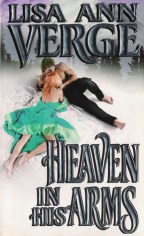
Heaven in His Arms by Lisa Anne Verge

25204789

Bookbub Synopsis: Fiercely independent fur trapper André …

That’s all I needed. As a Canadian, how could I resist that historical romance introduction? The promise (unfulfilled) of beaver viscera and the potential for freezing to death were too tantalizing. I don’t know what your knowledge of the fur trade is, but voyageurs, while badass, aren’t exactly a romantic group, unless you are one of those people who wants to eat rocks for breakfast and live off the grid in an especially harsh climate.

Originally published in 1995, Lisa Ann Verge’s Heaven in His Arms tells the story of the sassiest street urchin that ever sassed and the fur trader she finds herself married to. Desperate to escape the Paris workhouse, Genevieve Lalande trades places with a “King’s Girl” for the chance to travel to the New World in 1670 and make a life as a wife and mother with one of her compatriots. She doesn’t care which one, she just wants out. When she arrives in Quebec, Genevieve falls ill and is married off in a fevered stupor to André. He is seeking the ultimate marriage of convenience: New statutes require him to have a wife to get a trapper’s license, so he chooses the bride he thinks will die the fastest. Imagine his surprise when she shows up at his lodgings and insists he take her into the bush with him. She’s neither going to die and use the burial plans he set for her, nor will she agree to being deposited as a governess with his business partner. And away they go…

Growing up Canadian, we are raised to:

  • respect winter
  • look askance at the United States
  • treasure socialized medicine
  • understand World War I helped define us as a country
  • admire our pioneers

Heaven in his Arms hits a couple of those squarely on the head. The conditions that André lives with and Genevieve has to accustom herself to are rough. They set out in the spring and plan to reach their destination before the snow flies (October) so they can set up camp for a winter’s worth of forays to trade for pelts with local tribes. I hope this map will give some sense of the scale of what they will be undertaking by canoes and portaging to get from Quebec City to the southern shore of Lake Superior. It’s the world’s largest freshwater lake and roughly the size of Austria. Also of note is the fact that the north shore of Lake Superior in the fall is one of the most beautiful things I have ever and will ever see; however, while it may be making me misty and homesick to think about, it doesn’t mean I want to winter there.

Where were we? Ah yes, the map. Does it give a good sense of how far they are going?

Heaven Map.jpg

For additional perspective, when you cross the border from Manitoba into Ontario, it is still an 18 hour drive to reach Toronto because Canada is HUGE.

So Genevieve who is hella intrepid, André who is made of steel, and his team head out into the wilds for a seemingly endless slog through rapids, forests, and blackflies to reach Chequawegon Bay. Genny and André fall for each other en route, but decide on an “everything but…” marriage. Since they are in love, young, and healthy, that doesn’t really last. After a happy winter in a poorly insulated cabin in an aboriginal village, they head back to civilization where there is a giant pile of complications poised and ready to hit the fan.

I suggest you read Heaven in His Arms if a grand adventure in the wilderness is your cup of tea. The challenges and lifestyle are presented as matter of fact in keeping with how the characters would have responded to them. Genevieve takes to her new situation like a duck to water and embraces every moment of the experience. As a city person reading about another city person, I wondered if she was too accepting and cheerful about her lot, but since her background is 17th century France and mine is 20th century Toronto, she might be a little more comfortable with hardship than I. As a partner to André in his endless quest for the unexplored and life outside of civilization, they make an excellent pair. If they can overlook how incredibly tough their lives will be and the likelihood of dying young, I guess this reader can, too.

Fun aside:  The original 1995 cover is a Gouda wheel of cheesy magnificence.

3010059

Links to my other reviews can be found on my complete reading list of books sorted by author or Author Commentary & The Tallies Shameful.

Beau Crusoe by Carla Kelly

My list of unread novels from Carla Kelly’s Regency romance catalog is ever dwindling. I have as much faith that I will get to all of them eventually as Kelly herself does in the innate goodness of people. Beau Crusoe, like Libby’s London Merchant, goes in a different direction from many romances and it was pleasing to read something a little bit different and from such a skilled and experienced author.

From Amazon: Stranded alone on a desert island, he had lived to tell the tale. A triumphant return to the ton saw James Trevenen hailed as Beau Crusoe—a gentleman of spirit, verve and action. But only he knew the true cost of his survival! Susannah Park had been shunned by Society. She lived content with her calm existence—until Beau Crusoe determinedly cut up her peace! The beautiful widow wanted to help him heal the wounds of the past—but what secrets was this glorious man hiding?

After years living alone and tracking the local fauna to keep himself sane, James is back in civilization, (Regency England) and an unwilling national celebrity. He is understandably traumatized by his experiences, moreso than the reader learns initially, and in possession of a few eccentricities as a result. When asked to present a paper on his island’s crabs to a zoological society, James needs a place to stay and lands at the house of an odd, isolated family. One of the daughters of the house, a widow with a young son, works as an illustrator for a friend of the family and the man who is James’ host, if not his hotelier. He gives James a To Do list:

  1. Get rid of the toucans living in the front hall of Susannah’s family home
  2. Do something about Susannah’s awful sister
  3. Marry Susannah

Accomplishing all three tasks, the first by simply leaving the front door open, James forms a bond with Susannah and her young son. Desperately lonely and intermittently haunted, James’s embrace of an instant family feels logical as does Susannah’s longing for adventure and making good her chance for escape. Her decision to marry for love created a family scandal that no one, particularly her sister, will let her live down.

Beau Crusoe suffers from a bit of saviour syndrome, though James himself doesn’t, and everyone must be very glad he’s there to put everything to rights. Because Kelly is such a good writer and I was reading this off-kilter romance with absorption, it wasn’t really a problem, just something I noticed. The overall tone of the novel might be from what people are accustomed to, but with Kelly’s usual sincerity and lovely prose style, I simply appreciated what she was doing and that it succeeded so well.

My summary of Carla Kelly’s catalogue can be found here.  Links to my other reviews can be found on my complete reading list of books sorted by author or Author Commentary & The Tallies Shameful.
My Fair Concubine by Jeannie Lin

71+FsqsQuIL[1]

Every so often, I think I am over my romance obsession. I’ll find myself reading a new, well-recommended novel and it doesn’t grab me and my brain says, “Maybe, I’m free? I’M FREE!” and can soon start reading other things as well. However, whenever it happens, as soon as I go back to something I have liked in the past, I am as ensnared by my kissing book obsession as ever. This was the case with My Fair Concubine. A Pygmalion themed historical romance set in China in 824 CE, it was a nice departure from the standard fare, but although I have read another Lin romance set in the same world, and have a third waiting on my Kindle, neither story quite caught my interest and I doubt I will ever get to that last book.

From Amazon: Yan Ling tries hard to be servile—it’s what’s expected of a girl of her class. Being intelligent and strong-minded, she finds it a constant battle. Proud Fei Long is unimpressed by her spirit—until he realizes she’s the answer to his problems. He has to deliver the emperor a “princess.” In two months can he train a tea girl to pass as a noblewoman?

With a time limit and a bait and switch deadline pressing down on them Yan Ling and Fei Long work to transform her into the lady she needs to be. Things go predictably, romantically awry as the two are inevitably drawn to each other.

The characterizations and milieu in My Fair Concubine were well-portrayed and interesting. It’s an era I know nothing about so I can’t even manage the veneer of dubious historical knowledge I cling to for all those 19th century British romances I love so much. As with them, and as is the case in all romances built on differences in social standing, Yan Ling and Fei Long’s success guarantees she will join the ranks of her society’s powerful elite. Of course, when reading I choose to think of that as financial security or, as Courtney Milan once put it, “You would need never feel cold again.” It is an extremely appealing notion.

Speaking of  Courtney Milan, it was her recommendation of Jeannie Lin as an author who deserves more attention that made me seek out her books. When I didn’t like the first one I read, I decided to give this second one a try. My lukewarm response to both disappointed me because this genre could use a change of pace and love stories are universal, but Lin’s writing just isn’t for me.

Links to my other reviews can be found on my complete reading list of books sorted by author or Author Commentary & The Tallies Shameful.

The Mackenzie Series: A Mackenzie Clan Gathering by Jennifer Ashley

Lovehating Jennifer Ashley’s books continues to be my romance reading pleasurannoyance. This entry into her Victorian Mackenzie series (listed below) isn’t even a kissing book, A Mackenzie Clan Gathering is a story about her most popular hero as the writer cashes in on the success of her novels. I don’t begrudge her that, a woman’s got to eat. HOWEVER, however, right off the top, I am saying it: I don’t believe that Jennifer Ashley wrote this book. I think it was ghostwritten. There were telltale stylistic elements that didn’t ring true for my experience of her writing.

From Amazon (notes from me): The Mackenzie clan is about to gather for (loathsome douchecanoe) Hart’s birthday at the sprawling family estate in Scotland (Yay! Do we get to see Cameron and Mac? BOO! Only in passing). But before the festivities can start (the entirety of the book), the house is robbed, and thieves make off with an untold fortune in rare art (for a really stupid reason).

Ian and Beth Mackenzie, who are alone at the castle during the robbery (being perfect and perfectly in love and having perfect children who are each perfect in their own perfect way), must do what they (almost exclusively Ian) can to retrieve the family treasure and find out who is targeting the family (the Mackenzies are aristocratic jerkwads, so there is a Nixon Enemies List worth of suspects). But Ian is distracted by a family friend (Beth’s brother-in-law from her first marriage) who claims he might have the power to “cure” Ian of his madness forever (Ian’s madness is actually something along the lines of autism with social challenges and extensive, varied, and ridonkulous savant elements).

End Amazon. (I’m just getting started)

The Madness of Lord Ian Mackenzie is included on top 10 romance lists and it is everything bad and good about Ashley’s books all at once. The plotting is histrionic, the hero extreme, and the love story surprisingly sincere in a way that both irritates one for being too farfetched and sucks one in because “he loves her so,” and “that’s hot”.  One skips the silly elements on rereading and it helps with the experience considerably. A Mackenzie Clan Gathering takes place a full decade after Ian and Beth’s love story when they are happily domestic and have three children.

The Mackenzie family castle having been robbed, Ian sets out to solve the crime using all the Ian Is Amazing Skills at hhis disposal: He can track a falcon on a cloudy day; play any piece of music on the piano after hearing it once (which is sadly not relevant to the matter at hand); memorize treaties and treatises; build elaborate Rube Goldberg domino machines; remember any conversation he participated in, but not necessarily understand the subtleties of it; he’s a mathematical genius; a crack shot; can improve your odds when gambling; he can hear a noise anywhere in a 100,000 square foot castle and ascertain immediately a) where it came from and b) if it is a threat to his family; he has superior autobiographical memory, and, GOD DAMN, does he love his wife and please her in bed.

Who wouldn’t want to spend more that with that guy? Me. I wouldn’t. The book had no romance plot and all Ian’s cure consisted of was the already known healing power of Beth’s love (redemptive affection plots are Ashley’s bread and butter), getting to the bottom of a conspiracy against the family (also serving to encourage one to read The Stolen Mackenzie Bride) and  reaffirming that the aforementioned skill sets and adoring wife are enough for Ian and he doesn’t need to be fixed.

The Mackenzie Series:
The Madness of Lord Ian Mackenzie – No, but sometimes yes, when I feel like it. He loves her so.
Lady Isabella’s Scandalous Marriage – Occasionally.
The Many Sins of Lord Cameron – Guilty pleasure. I just really like it, okay?
The Duke’s Perfect Wife – No. I loathe the hero.
A Mackenzie Family Christmas: The Perfect Gift – Visits with the ones I like and the ones I don’t.
The Seduction of Elliott McBride – No, I’m proud of the review though.
The Untamed Mackenzie  – novella – NO. Don’t.
The Wicked Deeds of Daniel Mackenzie – No, but very almost yes, so maybe, plus Lord Cameron.
Scandal and the Duchess – Quite fun, enjoyable novella.
Rules for a Proper Governess Nothing special.
A Mackenzie Clan Gathering – novella – Please see above
The Stolen Mackenzie Bride – Set in 1745, no thank you.

A summary of Jennifer Ashley’s catalogue can be found here. (Hint: That’s all of it right above this paragraph) Links to my other reviews can be found on my complete reading list of books sorted by author or Author Commentary & The Tallies Shameful.

The Survivors’ Club: Only a Promise by Mary Balogh

Oh, Mary Balogh, reading one of your Regency romances is like slipping into a warm bath. Comfortable, always enjoyable and relaxing, you are so wonderfully consistent in your heartfelt stories about broken people finding a kindred spirit to fit their pieces to.

Only a Promise is book six in Balogh’s current series, Survivors’ Club, and one I greatly enjoyed. The full series, so far, is as follows –

The Survivors’ Club Series:
The Proposal (Hugo/Gwen) – pleasant
The Arrangement (Vincent/Sophia) – very sweet, understated
The Escape (Benedict/Samantha) – meh
Only Enchanting (Flavian/Agnes) – Wonderful, read this one. Read it twice.
Only a Promise (Ralph/Chloe) – very good
Only a Kiss (Percy/Imogen) – meh
Only Beloved – sweet

As is the way of things for women in all but certain parts of the modern era, Chloe Muirhead is a victim of circumstances beyond her control. Blessed with the kind of vibrant good looks and vivid red hair that have made men tell her she looks like an elite courtesan (much like that time someone told me, “You have a really nice voice, you should be a phone sex operator”) and a trio of family scandals, Chloe has made not one, but two precipitous departures from London matchmaking seasons. Settled into spinsterhood as the companion of an elderly family friend, it’s not an unhappy arrangement, but neither is it one in which she is particularly content. It will do.

Ralph (which I know is pronounced “Rafe”, but I have to constantly correctly myself) Stockwood is one of the survivors of the series name. He went to war at eighteen with three of his closest friends and came back alone, horribly wounded, and with deep-seated guilt for both his role in convincing his friends to buy commissions and for not dying with them. His recovery was slow and fraught with suicide attempts, but many years on he is once again functioning, although not fully emotionally connected to his life. Like Chloe, Ralph is largely going through the motions, although he is more obviously weighed down by his demons.

When Ralph’s elderly grandmother, and Chloe’s host, summons him for a Your Grandfather Is Ancient, You Need to Marry and Produce an Heir to the Dukedom discussion, Chloe takes a wonderfully bold step. She knows Ralph isn’t looking for a love match and she wants a home and family. She proposes to him. He refuses, then reconsiders. Lickety split, Chloe and Ralph are married, the duke dies, and the two of them are thrust into a new world.  Not only are they negotiating the terms of their relationship, one they had agreed would not go beyond mutual respect and politeness, but also how they’ll function in their public roles.

Ralph is a very closed off character, a polite and dutiful automaton. He’s not cold per se, just distant and unengaged. His unfurling takes time and Balogh gives it to him. Weeks pass instead of the usually compressed timelines in these novels and that’s one more reason Balogh is very good at what she does: People heal slowly. Chloe is likeable, relentlessly capable, and practical, but she has issues eating at her as well and has one fantastic, and I felt realistic, freak out that relieves her character from being too ideal. She’s strong, but she’s not invulnerable. The quietly stalwart and encouraging way Chloe and Ralph support each other confirms how well they match as a couple.

Of the Survivors’ Club series, I enjoyed this book and Only Enchanting the most. Only a Promise did reference a lot of characters from Balogh’s other series and that gave me mixed feelings as I both wanted a visit with the Duke and Duchess of Bewcastle (CLASSIC!) and had trouble keeping everyone straight. There are enough characters in this series to keep track off without bringing in guest stars. I am on my library waiting list for the next book, Only a Kiss, and would buy it immediately if Balogh’s publisher caught up to the rest of the romance world and lowered their prices for e-copies of their authors’ works.

Also by Mary Balogh is A Handful of Gold  for which I created a romance review template.

Links to my other reviews can be found on my complete reading list of books sorted by author or Author Commentary & The Tallies Shameful.

The Worth Saga: Once Upon a Marquess by Courtney Milan

Courtney Milan is the best, the very best, romance writer currently publishing, but she is not perfect and Once Upon a Marquess is a delightfully imperfect novel. Her trademark elements – eloquence, unexpected romantic moments, family politics, deciding for oneself who one will be – are here, they just don’t come together quite as successfully as they have in some of her previous efforts. The first book in her new Worth Saga, Milan is laying a lot of groundwork and she is mostly successful in establishing not only the main characters, but the necessary supporting relationships that leave the reader looking forward to the novels to come. I’d pre-order them now, if I could.

Lady Judith Worth is living in less than genteel poverty after a treasonous father and brother ruined the family name and fortune. At 26, she has held her remaining family together for eight long years through force of will and the kind of determination a general would marvel at. In her care, she has a fourteen year-old sister and a twelve year-old brother. The latter has just come home from a term at Eton, bloodied, bowed, and refusing to return. The former is somewhat spoiled and meant, I think, to come across as eccentric, but I found myself wanting either a fuller explanation for her behavior or some movement towards maturity. I assume both the reasons for her character and the growing up will be ongoing through the series.

Christian Trent, the Marquess of both Ashford and the novel’s title, comes back into Judith’s life when she requests his help. Once upon a time, they were young and in love. Once upon a time, he was asked to press the case against Judith’s brother and he did so successfully. Knowing he broke her heart – and she his – Christian wants nothing more than to do something, anything, to help the Worth family, even if it means keeping himself from Judith. He really does try, but Judith may be practical and managing quite well as head of the family, but she’s still unable to resist to the undeniable chemistry Milan has created for her leads. It handily separates itself from the “his eyes looked into her soul” fare of many genre works and, like real life couples, Judith and Christian have so much fun together and truly revel in each other’s company. Of course, their history stands in their way and Judith is determined to forge ahead on her own, but Christian is the world’s most adorable and charming tortured hero even when his quirkiness can be a bit much.

A complete summary of Courtney Milan’s catalogue, with recommendations, can be found here. Since it’s the holiday season, I’ll specifically recommend A Kiss for Midwinter as both a classic of the genre and one of my top five (three? two?) romances of all time.

Links to my other reviews can be found on my complete reading list of books sorted by author or Author Commentary & The Tallies Shameful.