Tag Archives: book reviews

The Pennyroyal Green Series: A Notorious Countess Confesses by Julie Anne Long

I’ve started on reviews of many random novels and revisited the basic, and, I discovered, quite outdated romance tropes introduction from my first entry. But let’s be honest, I only wrote it because I was embarrassed about reading historical romance novels genre fiction, and wanted to be wry and self-basting. It’s one hundred and twenty books later and I know the current constructs, character types, and that the consummation devoutly to be wished occurs around page 200. I can explain which authors write the best love scenes and that the books range from fade-to-black to thisclosetoerotica. (Wikipedia tells me the when it is thisclosetoerotica, they call it “romantica” which sounds like an android sex worker who, for 5 dollars more, will tell you that she loves you.) None of this matters. What I like and don’t like in regard to the love scenes is of interest only to me, Mr. Julien, and the version of Daniel Craig that lives in my id. It would tell you more about my tastes and proclivities than about the genre; however, if YOU want to read this kind of book, I recommend not only reading the first couple of pages as you would any book, but also flipping forward to about page 200 when they get busy. Running into an off-putting love scene can derail the entire reading experience, so you should get a preview first. I once looked at a book by a major romance author and found the phrase “and sucking, and sucking, and sucking, and sucking”. That’s right, four “and suckings”. An apt description of the writing, as well.

Julie Anne Long’s A Notorious Countess Confesses continues her Pennyroyal Green series focused on the Redmond and Eversea families. In my review of What I Did for a Duke, I congratulated Long on pulling off a huge age difference. Her challenge this time is the character Malin and I enjoy referring to as “the hot vicar”. He is indeed very hot: tall, literally and metaphorically broad-shouldered, hard-working, sincere. The novel setting is Regency (God, I hate the clothing), so it was church or military, and Adam Sylvaine ended up with a family living from his Eversea uncle. It means he need not have been chaste nor uptight, but simply a good man who ended up in an available profession, and one he turned out to be very well suited for*. The heroine is the Countess of the title, Evie. I did not realise until quite far into the book that the main characters were Adam and Eve. It is mostly forgivable and also indicative of Long’s tendency towards the quietly twee.

Evie supported her brothers and sisters by working as an actress, then a courtesan, although “there were only two”, and lastly she married an Earl who won the right to wed her in a poker game. When the story begins, she has just come out of mourning for the Earl and moved to the house he bequeathed to her in Pennyroyal Green. She has a scandalous reputation, just enough money, and a desire to start again. She falls for the hot vicar because, while he is drawn to her, he is so self-possessed and at ease with himself that he is immune to her attempts to charm him, and to the facades she wears as self-protection. He is a good man, albeit a preternaturally attractive and charming one, but this is romance fiction after all. Adam takes Evie under his wing to help her join local society and find friends. The local women are alternately horrified and deliciously shocked by her. Evie is able to build a new life and Adam is given a safe haven from the constant demands and burdens of being the (hot) vicar.

Despite the fact that I prefer more sardonic rake in my heroes, I LOVED 90% of this book and Julie Anne Long is on my auto-buy list. She always manages to balance fantastic sexual tension, sincere characters, and be funny. She is so good at the tension that the most intense scene in the book involves Adam kissing Evie on her shoulder. There were flames shooting off my Kindle. Long also pulls off a very clever running joke about embroidered pillows that crescendos with dueling Bible verses about licentiousness. So what went wrong with that last 10%? I overlooked the patronizing attitude towards the harried mother, and the whole boots and breeches impossibility, but the ending was TWEE AS FU*K. It started out swooningly-romantic and then kind of fell apart for me. Her last novel, How the Marquess Was Won, (she needs to fire whomever approves these titles) suffered the same fate: Fantastic romance undermined by trite plotting choices. Right up to that point though, it was wonderful, and head and shoulders above the “and suckings” of the genre.

A complete summary of Julie Anne Long’s catalogue, with recommendations, can be found here.

Links to my other reviews can be found on my complete reading list of books sorted by author or Author Commentary & The Tallies Shameful which includes the aforementioned observations.

*Given that Julie Anne Long usually has a couple of enjoyably detailed love scenes, part of me secretly hopes that some naive fool looking for “Christian romance” bought this because it was about a (hot) vicar, had her hair blown straight back, and will follow up with a horrified one star review on Amazon.

The Dressmakers Series: Silk Is for Seduction by Loretta Chase

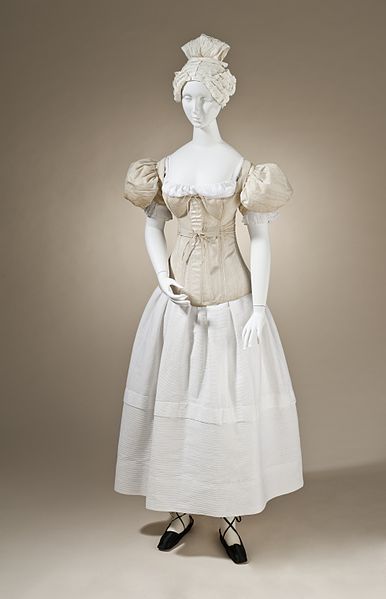
I signed up for a quarter Cannonball (13 books) with my online community, but I’ve completed it and I’m working on my half Cannonball (speaking of cannonballs, my behind is one), and, not wanting to let the 79 works I’ve read in this genre since February go to waste, I now return to Loretta Chase, who, while not my favourite romance novelist, is extremely reliable and entertaining. I’ve chosen Silk Is for Seduction because it’s about romance and fashion, specifically 1830s clothing which is particularly ridiculous. Look at what the fashionable wore under their clothing, and keep in mind that a shift, drawers, and more petticoats would be added, and that those things on her shoulders would be like wearing down pillows –

Once fully dressed, she might look like this:

Isn’t the thumbnail hideous? I dare you to click on it.

Have you stopped laughing yet?

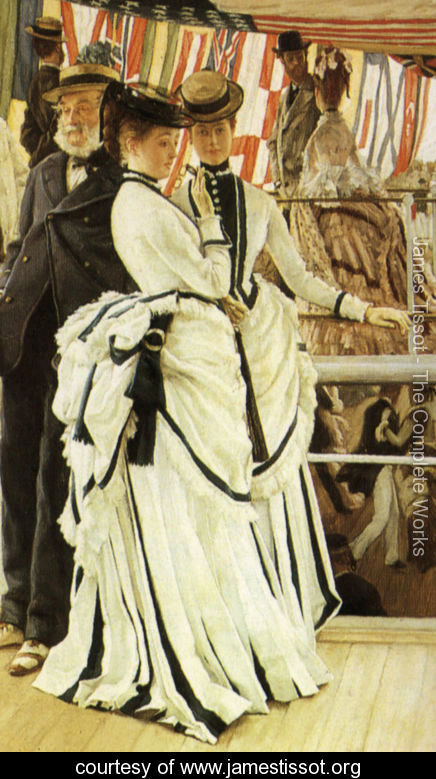
Now, you would not know it to look at me, but I really like fashion, past and present. My interest in period clothing has led to the purchase of coffee table books, museum visits, and hours of trawling the internet for drawings, extant clothing, recreations (huge subculture), and I have a lovely memory of cooing through drawers of lace samples at the Victoria and Albert museum with the Dowager Julien. These efforts have resulted in a reasonably decent overview of 19th century dress styles by decade. My favourite era is the 1870s, famous for its bustles. Can you blame me? I mean, Sweet Fancy Moses, I nigh on swoon when I look at this kind of dress –

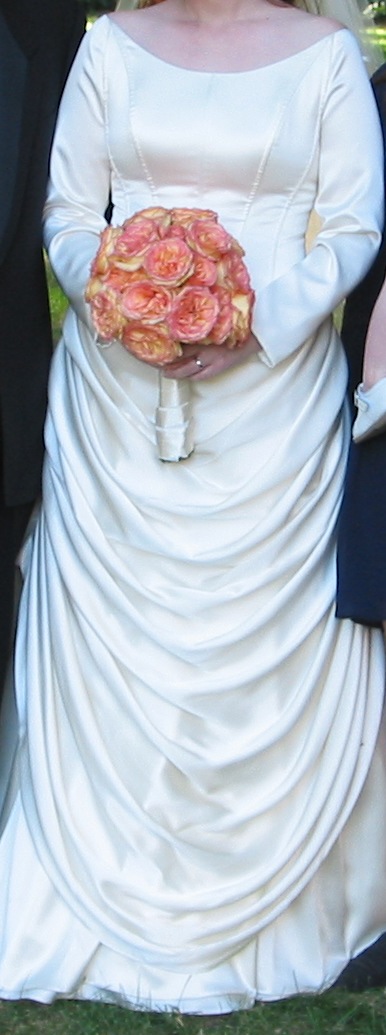
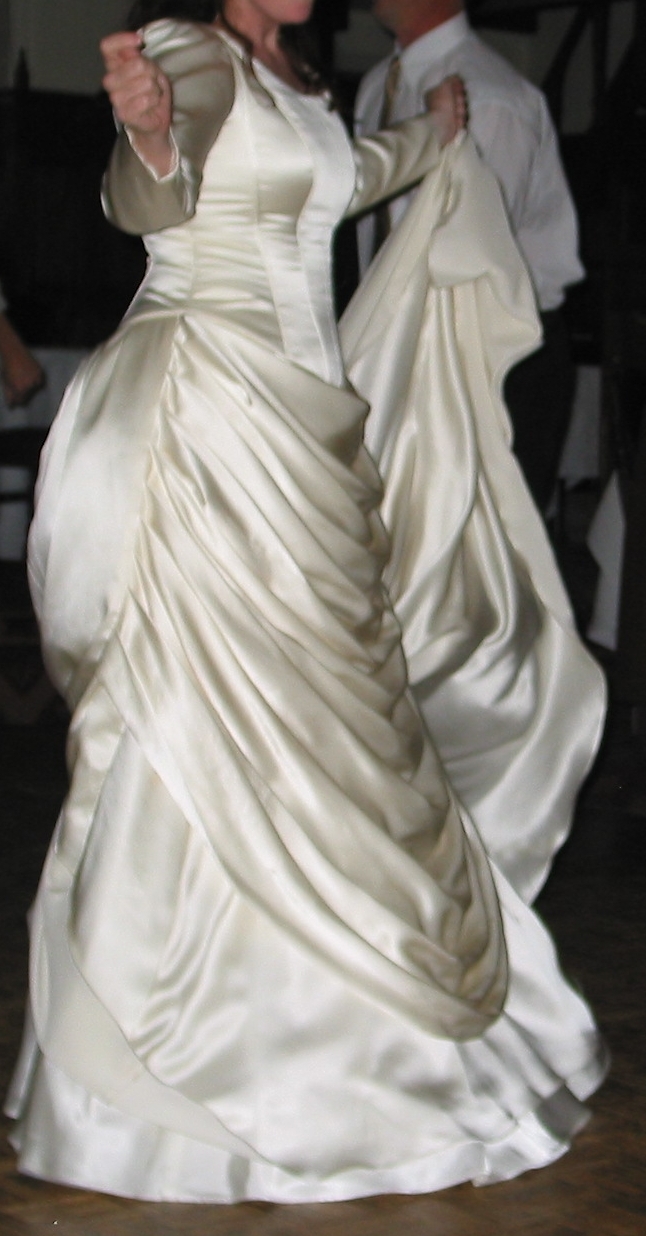
How could I not? It is all that is beautiful and good. So beautiful and good, that when it came to my wedding dress, I unconsciously chose this kind of style even though I hadn’t started learning about specific eras yet. To wit –

I know, I know the overskirt is too long! It mocks me in the photos. That is not a bustle, by the way, it is the aforementioned cannonball. These days, it’s an entire armory.

Loretta Chase’s Dressmakers Series features the three Noirot sisters who work as modistes. In contemporary language they would be couturiers, but since Frederick Worth hasn’t quite blazed his trail yet that term is not used. Marcelline, the oldest and the designer, is featured in the first book, Silk Is for Seduction; Sophy, the saleswoman, is featured in book two, Scandal Wears Satin; and Leonie, the money manager, will be the heroine of the third book, as yet unnamed, but let’s go with Velvet Is for Viscounts. They are “in trade”, but come from a shady upper class background. Their work requires them to rub shoulders and cultivate relationships with the aristocracy and wealthy gentry. They seek a young, beautiful aristocrat to dress and enhance their reputation and set their sights on Lady Clara Longmore who is the almost fiancée of the Duke of Clevedon. (His first name is given as Gervase, but in keeping with the era, he is referred to as anything other than “Clevedon” only once). Marcelline approaches His Grace in hopes of winning his lady’s patronage for her shop. From there, it all goes as one would expect from the genre. Poor Lady Clara, there are two books published so far and she gets a fuzzy lollipop in both. I hope Chase takes proper care of her in the next book.

The women’s clothing is an important element in historical romance novels. The men’s clothingalways skirts around any effeteness that would be consistent with the era and is plain and elegant. With main characters who are dressmakers, Chase spends a great deal more time than usual describing and talking about clothing. She either did a lot of research or is very good at making up words. Of particular enjoyment in both Marcelline and Sophy’s books is the acknowledgement of the extremely complicated nature of a woman’s toilette. Some romance authors simply ignore these details and with a quick pull of a few buttons the heroine is fully disrobed. Julia Quinn, who writes charming, funny, and mostly chaste novels, often has the heroine wearing ONLY the dress and it annoys me every time the hero unfastens a row of buttons and BOOM! she’s naked. I wear more cannonball management layers than that and it’s 2012. Any 19th century man trying to get to the good stuff would have to get through gloves, the dress, layers of petticoats, maybe crinolines, corset, drawers, shift, shoes, garters and hose, and possibly the “sleeve plumpers” seen above, plus any outerwear, bonnet or head covering, not to mention a potential Gordian knot of a coiffure (H/T Courtney Milan). These layers could have hooks, pins, myriad buttons, and/or lacings. It was like penetrating an Eastern Bloc bureaucracy to get all the way to the woman herself. Loretta Chase includes all these details and plays them for laughs and practicality. As fashion purveyors, the Noirot sisters’ clothing is especially complicated. Marcelline actually stops Clevedon from trying to undress her at one point because they simply don’t have time. Still, these are romance novels, so the men are very experienced and at some point the heroine can’t help but notice how adept he is with her assorted fastenings and adjustments.

Loretta Chase is one of the big names in romance for good reason. Lovely banter. Good at the smolder. Her Lord of Scoundrels is considered a classic of the genre and I’ve been working my way through her collection as my favourite writer, Lisa Kleypas, has moved on to writing exclusively hardcover contemporary romance. (It’s more profitable.) I will read “Velvet Is for Viscounts” when it comes out and until then I have books I return to again and again to re-read the “good bits” which sometimes means exactly what you think it does, and also really does not mean that at all.

Other reviews can be found on my list of books by author or The (Shameful) Tally 2014 which includes recommendations and author commentary.

Thank you Malin for recommending this book.

Dragonfly in Amber, Voyager, Drums of Autumn, The Fiery Cross, A Breath of Snow and Ashes & An Echo in The Bone by Diana Gabaldon

This review concludes my frantic devouring of Diana Gabaldon’s Outlander series. How frantic? When I started this review, it was of books 2 and 3, but now includes the rest of the published series as noted below. I covered book one in a previous effort. The 8th volume, Written in My Own Heart’s Blood, will be released in 2013.

1. Outlander
2. Dragonfly in Amber
3. Voyager
4. Drums of Autumn
5. The Fiery Cross
6. A Breath of Snow and Ashes
7. An Echo in the Bone
8. Written in My Own Heart’s Blood

Theoretically, each Outlander book stands alone, but, really, it’s just one very, very long story. Once a reader is drawn into the series (there is quite a subculture out there), I imagine they are in it for the long haul and not just randomly picking up the books out of order. I also believe that if they do, they will want to go back and find out what they missed. Gabaldon incorporates call backs to situations, conversations, and characters with such aplomb that she must have them planned out several books in advance. Events and references lie dormant for thousands of pages and may be only incidental to the story, but recognizing when these elements are reincorporated brings my reading experience a little extra joy.

In Outlander, Claire Randall was on a second honeymoon with her husband, Frank, in the Scottish Highlands, after a six year separation during World War II. She visited a local henge and through the magic of fiction walked between two standing stones and ended up in the same place, but in 1743 where/when she was taken in by the MacKenzie clan. As an outsider, she was viewed with suspicion and forced into a protective marriage with the chief’s nephew, Jamie Fraser. What started as a marriage of convenience quickly developed into a profound bond between the two. It is a time of growing political unrest in Scotland leading inexorably to the Jacobite rising of 1745 which ended with the infamous Battle of Culloden. The ensuing books continue to trace their lives and relationships over time.

The historical elements of the books, specifically the day-to-day details, are of particular interest to me. The political elements play out largely as forces beyond the characters’ control, and elaborate machinations interest me neither in fiction, nor in real life. With the time travel element, of immediate import is how a modern person comes to live in the past and must cope with the challenges it presents culturally and practically. Having present day events and traveling with a “modern” character back in time gives the reader an anchor in the historical immersion process. It’s a tougher and more restricted world from which none of the inhabitants come away unscathed. Gabaldon’s willingness to subject her characters to the ugliness and strife of the 18th century, as well as its pleasures, holds the books together for me.

If you are here looking for book recommendations: Read these books. Are they Great Works of Literature? No, but they are engrossing, well-written, and highly entertaining. “Begin at the beginning,” The King said gravely, “and go on till you come to the end: Then stop.”, and wait for the next book to be published. I bought all SEVEN Outlander books in one impetuous and financially guilt-racked gesture while reading volume 3. The large paperback versions. Though they seem perfect for a Kindle given their weight, I needed to have them to hold onto, and it’s a great forearm workout. All my e-reader ever gave me was a numb hand and a serious case of Kindle Klaw™. I’m going to present the books in a kind of review summary/cluster with self-indulgent maundering about them. If you find my company as delightful as I do yours, and laugh in the face of extremely vague spoilers, please follow me …

ARE YOU JUST JOINING ME FROM THE CANNONBALL READ SITE? PLEASE START HERE:

Dragonfly in Amber , book 2, takes place in two timelines. We’re still not at Culloden, but we are coming to the precipice. Opening in the new present,1968, Claire and her daughter, Bree, are visiting Scotland on a historical hunting expedition. After the brief introductory chapters, the book mercifully moves back in time to the 1740s with all due haste. Not too much haste mind you, just enough non-haste to leave me writhing in anticipation of Jamie Fraser’s first appearance. Here, the story picks almost exactly where the last book ended and follows Claire and Jamie’s lives in the Paris Jacobite expat community as history wends its way inexorably to the infamous battle. Gabaldon wisely expands her narrative perspective to include an omniscient narrator. It would be hard to imagine a book of this scope without one, and it is crucial to expanding the character roster and plot development.

This is where any plot revelations get a soupcon spoiler-y :

The third book, Voyager, continues Claire’s historical search for Jamie as we learn his fate in an extended flashback. I can’t reveal the crux of the book, so I’ll just say this for the initiated: The wait nearly killed me. The anticipation, resolution, and aftermath were delicious. This book has up to three story lines going at once with present day events, quick flashbacks for background details and extended past/present story lines. It sounds complicated, but it isn’t really. It also takes the show on the road, as it were, and the Frasers are flung farther afield, sometimes literally. The book is harrowing, often in an overly episodic way, but somehow it all works because, despite the tendency towards frequent cliffhangers, the character interactions are so compellingly written that other sins can be forgiven.

It was during Voyager that I realised my willing suspension of disbelief has been comprised by my atheism. I told Mr. Julien these books made me wish that I still believed in God because then I could believe in magic, and that would add another level of enjoyment to the story. I’m not bothered by the time travel framing device, since I have enough cursory knowledge of physics to recognize that time is a construct and theoretically malleable, it’s some of the other elements that are too much for me, specifically the occasional indulgences in esoteric spirituality.

The timelines meld and go forward as one with Drums of Autumn . The action has moved, seemingly permanently, to a new location and provides a prolonged view of everyday life in another time. Claire and Jamie are mature characters now and it lends a weight to their interactions. The highlight of every book is the time these two share as a couple; their marriage is familiar and comfortable, as are their personalities. They still have fire, but the supporting characters start to take up some of the weight of the reckless passion they once shared. My only complaint about this book comes from my reading experience: It was hot, so hot, Abu Dhabi hot, that weekend, and the story was taking place in a similar climate, thus leaving me feeling even warmer and praying for the onset of narrative winter. Mercifully, the next volume starts on a cold November day.

I slowed down, relatively speaking, when I got to The Fiery Cross to help dispel the fog of a story that is thousands of pages long. Gabaldon, bless her, does a good job of bringing readers up-to-date on things that happened somewhere in the preceding thousands of pages, but while reading them in a burst helps one keep track, there were times in The Fiery Cross when I couldn’t remember what the hell she was talking about. It seems minimizing to say this book was “more of the same”, but it was and that sameness was what I was reading it for. Still, there were two notable elements in The Fiery Cross, first, that the opening 200 pages or so take place over the course of a single day. (You know a book is long when you say “the first 200 pages”). Gabaldon is writing such a sprawling work that I can appreciate the desire to try something like this, and it works well to lay the foundation of past events, the current book, and the rest of the series. The second stand out item was the rare and welcome inclusion of Jamie’s full perspective and thoughts. It was startling to realise that virtually his entire character arc had been related by Claire, or in the third person, but without revealing his inner monologue. The reader met him as a young soldier and outlaw, and watches him mature through seemingly unendurable trials. In many ways, his character arc is more complex than Claire’s, and it is fascinating to follow through the years.

That sameness I mentioned, the lovely sameness, of this epic disappeared with A Breath of Snow and Ashes . Diana Gabaldon seemed to get her second (22nd?) wind and I again found myself vibrating in my begreyed cubicle waiting for chances to read. I thought I had read enough to know, basically, where the story will and will not go. At the very least, history was pointing very strongly in one direction. There would be enough surprises in the personal relationships to keep me interested. I wanted to stay with the Frasers, and their extended family, to see where it all ended up and how it gets there; however, this book hunkers down with Jamie and Claire and mostly stays there. It’s a smart choice and a captivating one. I suspect it is also a product of Gabaldon’s maturity as a writer. The characters’ lives are just as fraught as ever, but she is so at ease in her storytelling by this point that any rough edges have been smoothed and she is willing to take the time she has given herself to let things development more organically.

Replete with enjoyment of A Breath of Snow and Ashes , I actually delayed starting An Echo in the Bone as it would be the last new volume for a while (and to combat my obsessing). Now, I started reading these books on June 10th and it’s only 5 weeks later, so “delayed” is an extremely relative term and in this case means “one week”. The main plot is built around a war and Gabaldon has included major characters on both sides. It’s the luxury of writing such a long work, if you plan it well, and aren’t afraid of convenient coincidences, everyone and everything can come around again. The drawback is that the reader might not be equally interested in all of the characters and that was certainly true for me; however, the book gained steam over the last 150 pages and crescendos in a trio of cliffhangers that set up the next book and ties up one storyline with a bow to give the reader a sense of completion.

A 6500 page story has time to explore ideas, to develop characters, and, yes, to fill. Amazingly, most episodes when I started thinking “Get on with it, Gabaldon!” the story took a turn, or the character interaction got particularly interesting, and my impatience was lost. Occasionally, it could feel like the Perils of Pauline with multiple Paulines, and I’d ask, “Really? You have this major crisis PLUS these 3 other things happen just to ratchet things up a bit? You need an editor my friend, with a red pen and the will to wield it!”. There are also a lot of coincidences and a tendency towards deus ex machina in times of crisis, but I read every single word anyway. “Really,” you ask, “every single word? You didn’t skim at all?” Okay, I skimmed a little. A very little, mostly while muttering, “Okay, peril, peril, politics, peril, there we go back on track. Where’s Jamie? “ because he is the soul of the books, and their heart is his relationship with Claire.

The Outlander series is a grand adventure, but don’t be fooled by the time travel, the politics, or the panoply of characters. Trust me, in many ways this is the biggest, baddest romance novel of all time, an expansive story played out over time and against a backdrop of politics and tremendous upheaval; however, like all the best books of any supposedly-limited genre, it transcends itself and inevitably moves into a territory with far broader and more satisfying range.

Links to my other reviews can be found on my complete reading list of books sorted by author or Author Commentary & The Tallies Shameful.

Outlander by Diana Gabaldon

I finished Outlander this morning and will go to the library on my way home from work to get the next two books in the series. I am vibrating with anticipation in my begreyed cubicle. Although uncertain of whether I will read all eight, I am sufficiently motivated to make sure I have enough of the books in my hot little hands to prevent anyone getting in my way. In order of publication, the series includes

1. Outlander
2. Dragonfly In Amber
3. Voyager
4. Drums of Autumn
5. The Fiery Cross
6. A Breath of Snow and Ashes
7. An Echo In The Bone
8. Written In My Own Heart’s Blood

Also by Diana Gabaldon and falling in between Dragonfly in Amber and Voyager is The Scottish Prisoner.

[Interjection: I took a break from writing this review to read the first chapters of Dragonfly in Amber on Amazon, and now I am desperately trying not to cry at my desk.]

After a six year separation during World War II, Claire Randall is on a second honeymoon with her husband, Frank, in the Scottish Highlands. She visits a local henge, Craigh na Dun, and through the magic of fiction is able to walk between the two halves of a broken stone slab and end up in the same place, but in 1743. Despite being an “outlander”, or “Sassenach”, she is rescued by the MacKenzies and participates in clan life as a healer (she was a field nurse during the war) and gardener. It is a time of growing political unrest leading inexorably to the Jacobite rising of 1745 which ended with the infamous Battle of Culloden. As an outsider, Claire is regarded with suspicion and is thus pulled into a protective relationship with the chief’s nephew, Jamie Fraser. The compelling bond between these two characters is the core of the book and the fulcrum around which the story moves.

Outlander is a ripping good yarn. Diana Gabaldon creates a fascinating world for her characters and story. Claire’s first person narration gives the reader someone “modern” to latch onto and adds a layer of intricacy to the novel that asks more questions than it answers. There were some elements of the book that I was unimpressed with, but the story so clearly had me in its clutches that I can’t be bothered to complain. If I can get past a time portal, I can live with irksome details. The book is not really science fiction as the only element that can be thought of as such is the portal through which Claire passes, and there are no other comparable elements in the book; moreover, even with the unforgettable relationship between Claire and Jamie Fraser, it is a disservice to call the story a romance; rather, it is an epic adventure story enfolding love, intrigue, and socio-political history.

[Interjection: I went the library at lunch and got the next two books because I could NOT wait another second. I brought Dragonfly in Amber with me to my desk just in case, well, I don’t know what, but I wanted it to hand.]

Coming into a series such as Outlander late is really enjoyable because so much of it is already available to you. With seven books published, there is enough to keep me busy through the summer, especially if I focus on my actual responsibilities instead of flopping down on the chesterfield with a book for three hours every evening. The other advantage to being a latecomer is that there is a ready-made community of people cheering you on with “DID WE TELL YOU OR WHAT?”, and “Jamie will RUIN you for all other fictional men,“ as you progress through the books.

Thank you to my friend Mswas for her persistence in recommending this book to anyone who would listen.

Links to my other reviews can be found on my complete reading list of books sorted by author or Author Commentary & The Tallies Shameful.
Lord of Scoundrels by Loretta Chase

I am including this review for one reason only. Look at him:

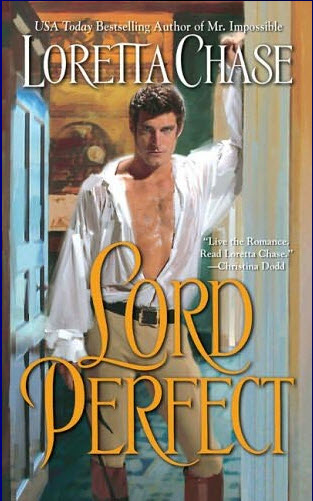
I know it’s discomfiting, but do it for me. Note the manly open shirt, the manly sheen on his chest, the manly Coty cologne advertisement feathered hair and sideburns. The insolence. The seduction. The riding crop. The smolder. It’s not the book I’m reviewing, but Lord of Scoundrels is by the same author, and its cover is boring and staid. How could it not be in comparison to this wheel of Gouda? Not that Lord Perfect isn’t completely acceptable, it’s just that Lord of Scoundrels is a classic. It has a much deserved Amazon rating of 4 1/2 stars after 284 reviews. If I am embracing the historial romance genre, this book needs to be included as one of the ultimate romance novels: larger than life characters, operatic kisses in the rain, a battle of wills and, most of all, fun. It is thisclosetocamp, probablycloser, and the result is a delicious wet kiss of a book.

Our hero, full name Sebastian Ballister, Marquess of Dain, is 6’6″, black hair, black eyes, big nose, all man. Wealthy, arrogant, and clever, he meets his match in Jessica Trent, a pert, patient (she’ll need it), self-possessed spinster who has come to Paris to retrieve her gormless brother from the demi-monde Dain inhabits. He takes one look at Jessica and wants to lick her from head to toe. She takes one look at Dain and wants to rip all his clothes off. LET THE GAMES BEGIN! It’s beauty and the beast meets reformed rakes make the best husbands meets tortured hero, with a side of moustache twirling by minor characters trying to ruin everyone’s day. From Paris, the book moves to Dain’s ancestral home with machinations about a Russian icon and an illegitimate child, and an intense romance long on passion and blessedly short on maudlin.

Loretta Chase is, above all, an engaging and confident romance writer. She sets the scene deftly and excels at creating entertaining characters. If you like a touch of intrigue with your romance, she’s your gal. There will be chases, treasures and grand adventures. If you’re like me, you will revel in it despite the B story that does go on a bit. I find myself glossing over those parts hoping I don’t miss any major plot points. Truth be told, I can never tell if the subplot issue is with me (Why aren’t they kissing or bantering? When will they get back to the kissing and bantering? I DEMAND KISSING AND BANTERING!) or with the stories themselves, and I really don’t care.

Links to my other reviews can be found on my complete reading list of books sorted by author or Author Commentary & The Tallies Shameful.
The Turner Series: Unveiled, Unclaimed, Unraveled by Courtney Milan

It is a truth universally acknowledged that romance novels are not necessarily very well-written; however, if you are curious about them and want to know who is the best writer out there (of the more than two dozen I’ve tried) Courtney Milan is where you should start. Lisa Kleypas is actually my favourite writer, but I’ve already consumed her entire output and am looking out for other authors. Milan is a newer writer, very much better than most, and she makes interesting choices which neatly turn genre tropes, if not upside-down, at least on their side. This trilogy contains one book each for three popular romance storylines: the revenge plot, Unveiled, the reformed rake, Unclaimed , and the tortured hero, Unraveled . I read the books in reverse order, admittedly starting with the best one.

The Turner brothers grew up with an absent father and a deranged religious zealot mother. Their names are actually bible verses, so they each use a shortened nickname from their verse in daily life: Ash, Mark, and Smite, yes, Smite. Each man bears unique wounds of their traumatic experiences. The oldest, Ash (Unveiled), left his brothers behind to build a secure future for them. He was gone for several years, returned a wealthy man (in the manner of self-made men in romance novels, he is hardworking and magic at math, and that is all it takes to become rich), and as we join him at the beginning of his story, he is poised to steal a dukedom out from under a noble family based on his manipulations of primogeniture. Hoping to find his weakness, Margaret, the daughter of the house, stripped of her legitimacy by Ash’s actions, is posing as the current Duke’s nurse to spy on the Turners. Ash takes up residence with his brother, Mark, at the ducal estate, ostensibly to assess the family’s finances before the final act of transferring inheritance takes place. Normally, these vengeful men are dark, intense and intimidating. Ash is a giant mastiff that nuzzles you into acquiescence. While he is intense and “cheerfully ruthless”, he is also a profoundly nice man, plagued by insecurities and not a small amount of survivor’s guilt. Margaret has been treated as a pawn her entire life, reduced to who she can marry and dependent on the (sorely lacking) kindness of the men in her life to ensure her security and happiness. Ash objects to these notions and to the effect they have had on Margaret as a person. Many romance novel heroes become caretakers to the heroine, but almost none wage a campaign of relentless kindness and encouragement regardless of his personal goals. He wants her as a partner, but more than that he wants Margaret to see herself as a person in her own right, and with her own rights, in charge of her own happiness.

The hero of Unclaimed , Mark, is a 28-year-old virgin. Let me repeat that and emphasize that it is unprecedented in my experience: Mark is a 28-year-old VIRGIN, and not just a virgin, one who has become a celebrity after writing a tract on chastity, the first line of which is “Chastity is hard.” Mark is the youngest brother of the trio and while he is chaste, he is not innocent. His elder brothers protected him to the best of their ability, but his mother’s insanity resulted in choices and situations that no child should endure. With a virginal hero, the reformed rake role in this story falls to Jessica, a courtesan who has been hired to seduce and publicly humiliate Mark. She was “ruined” and disowned by her family at the age of 14 and has made her way in the world with a series of “protectors”. It is the most recent of these who has promised a payment equal to lifelong financial security to destroy Mark’s reputation, but here’s the thing: Mark isn’t really concerned about his reputation. He is honest in his chastity, but he dislikes the fame it brings and the resulting loss of control over his very simple message about the societal repercussions of sex outside of marriage. In most romance novels, there is an extreme disparity in sexual experience. The hero has had mistresses and lovers, and in their polite way, the writers make it clear that all of those women were available and unscathed. When the heroine has experience, it is extremely limited, she thought she was, or she actually was, in love and the result was her personal downfall. Even if she is older, she is chaste. In Unclaimed, Jessica has used the one thing she had to survive in the world alone. It has cost her emotionally, and even physically, but she is not viewed with the disparagement normally accorded a woman “no better than she should be”. Mark likes himself and he genuinely likes her, and he wants her to feel the same way. Her transformation from someone simply trying to survive into someone trying to build a real life for herself is believable and charming.

In Milan’s novels, not everything is country dances and house parties. Although I do not look for devotion to historical accuracy when I read these books, I mostly just enjoy the period costume descriptions and the home life details, Milan creates a true sense of the squalor and dangers lurking close to the surface in Victorian England. Unraveled in particular, dwells in the horrifying poverty of Bristol and the severe limitations and prejudices of the so-called justice system of the era – all of which brings us to Smite. Well now, Smite is my favourite. He is a brilliant, dark, pensive man, enmeshed in duty, and possessing of a wry sense of humour. Who could resist a man who says to his mistress, “I would not like you half so much, if you weren’t sarcastic,”? Not I, dear reader, not I. He is Milan’s tortured hero. He bore the brunt of his mother’s madness, he bears it still in PTSD, and in the roles he chooses in life. He works as a magistrate hoping to prevent the disregard of society that brought him and his brothers to such a vulnerable state. But he is still a man, so when he encounters a vibrant and canny young woman, Miranda Darling, posing as a witness at a trial, something happens that is again extremely unusual in a romance novel: he asks her to be his mistress and she accepts. For one month of sexual intimacy, Miranda will receive the princely sum of 1,000 pounds and a house. Miranda has just barely survived on her wits and has fashioned protection for herself by association with the local crime lord, so this business arrangement is an escape, but one which will be complicated by the tenacity of the underworld’s grip on her. She can earn lifelong financial independence in exchange for something/someone she also desires, and it gives Smite gets one month to dwell in the land of the living before returning to his self-imposed exile. What works about this tortured hero is not that he is broken and needs to be fixed by some innocent, inexperienced chit, as would normally be the case, rather Smite is in tact and what he and Miranda both require, and find in each other, is a kindred spirit who can meet each other’s needs and their own together.

Milan’s men have attitudes inconsistent with the era. They have no judgement of past indiscretions at a time when being seen alone with the wrong someone could ruin a woman’s reputation. The Turners treat the women as equals and want the women to see themselves in the same way. It is the latter element that makes her books so wonderful. Mark thinks well of himself and wants the same for Jessica; he wants her to want more, to expect more and to be her own person. Ash wants Margaret to see herself as a complete person, in turn she helps him smooth over his own wounds. Smite and Miranda balance each other and provide the freedom to be who they want to be.

A complete summary of Courtney Milan’s catalogue, with recommendations, can be found here.

Links to my other reviews can be found on my complete reading list of books sorted by author or Author Commentary & The Tallies Shameful.
 

The Pennyroyal Green Series: What I Did for a Duke by Julie Anne Long

I’m still reading historical romance novels and I keep a list of them as though tracking such things makes it any less ignoble. I call it The Shameful Tally. I also track the heroes’ names (Alex and Sebastian being the most popular), and the books so awful that I gave up on them.

What I Did for a Duke is from Julie Anne Long’s “Pennyroyal Green” series about the Redmond and Eversea families. She has set herself up quite nicely for a large group of interconnected novels as is a standard practice in this genre. It gives the reader a chance to revisit their favourite characters and is something I particularly like; so much so that I must confess, I have even bought a book only because I knew I’d get to see “Sebastian and Evie” (Lisa Kleypas The Devil in Winter) again. I adore them. I will buy any book they are in. Publishers are smart and I am easily led. From this Julie Anne Long series, I’ve also read How the Marquess Was Won. That book was so good, so good, oh Sweet Fancy Moses that is romantic, wait, is this high school?, oh, now, it’s all fallen apart, RATS! By the way, if you think these titles are bad, Long has a book called I Kissed an Earl that is waiting for me on my Kindle. As if the cover art weren’t embarrassing enough, these titles add insult to ignominy.

I’ve sampled about 2 dozen writers and you’ve got to give a writer credit where it is due: If you can pull off an almost 20 year age difference and make it not only palatable but irrelevant, you are on the right track. What I Did for a Duke pairs 20 year old Genevieve Eversea with “almost forty” (a phrase often and lovingly repeated) Alex Moncrieffe, Duke of Falconbridge. He is a widower out for revenge against Genevieve’s brother, Ian, for attempting to bed the Duke’s fiancée. Over the course of a house party, Alex sets out to seduce and leave Genevieve, but, pleasantly enough, the revenge plot is called off when this young woman figures it out, and is far lovelier and more attractive than Alex had anticipated. She’s bright and banters well. He’s charming and kind of autocratic. Tra la la. They get married. YAY!

There is nothing new here which is good because I am not looking for anything new, just fresh. It’s nice to see a standard revenge plot dismantled, but the real reason that this book works is simple: Julie Anne Long is very funny and she writes great smolder. That’s all it takes really; in fact, if you can pull off the funny, you don’t necessarily need the smolder, and, yes, she is that funny. [There was more here, but I’ve redacted the original pointlessly scathing review details.]

Edited April 17, 2013: I now consider Julie Anne Long one of the best romance writers currently publishing. Lisa Kleypas really skewed the curve for a while there when I was starting out with this phase. I bought this book as well as almost everything else Long has published, and she is on my autobuy list.

Edited October 1, 2013: What a bitchy review. So bitchy, this is the second time I have edited something that only I will see. What I Did for a Duke is a CLASSIC and I couldn’t see it at the time. The hero, Alex, is in the pantheon of great heroes. There are some issues with the structure, but the fact  is that in addition to the overall charm, humour, and delicious smolder, there is a two or three chapter section in the middle of the book that is simply magnificent. It features the hero and heroine having the kind of conversation that people falling in love have. The dialogue is honest and beautifully written, but what truly elevates it is the silences. There are long pauses during which the characters think and the reader follows their emotions to their conclusion. It’s just superlative and because it, and the rest of the book, are true to the emotional lives of the characters, Long accomplishes what every romance writer sets out to do.

A complete summary of Julie Anne Long’s catalogue, with recommendations, can be found here. Links to my other reviews can be found on my complete reading list of books sorted by author or Author Commentary & The Tallies Shameful.
The Bridgertons Series: The Duke and I by Julia Quinn

Let’s start with a visual, shall we? After all, it is a romance novel and book cover art can be so dull.

The Duke and I is the first novel in Julia Quinn’s Bridgerton family series. It features Daphne Bridgerton, a young woman in her second season “out”, and Simon, Duke of Hastings, the erstwhile best friend of her brother, Anthony. Simon has been away for 6 years waiting for his father, a complete bastard, to die. He has returned to London to inherit his title and in doing so both accept and reject, as far as he is able, his role in life. Simon attends a soiree at the home of (recurring character) Lady Danbury and runs into Daphne as she tries to quash her only suitor’s advances. Daphne has not had luck with beaux. Men only see her as a friend because, rather than a fashionable flibbertigibbet, she is lovely, grounded, and kind. Now, who would want that? Guess. Simon is attracted to her instantly, but realising she is his best friend’s sister, errs on the side of propriety and backs off. The Fates and Plot Points intervene and the two of them settle into a friendship based on London society’s perception of their affection for each other: He escorts her to balls to deflect the unwanted attentions of marriage-minded women and to simultaneously make Daphne seem more appealing to suitable men by association with him. It works, but of course they fall in love, and, of course, there are obstacles, specifically Simon’s reluctance to marry and carry on his family name. The moment he gives in to his feelings for Daphne, they are caught in a compromising situation and the dance toward the happy ending is set in motion as, of course, they must marry…

While it would seem that I read the best of the Bridgerton, series first, I really enjoyed The Duke and I. Julia Quinn is especially good at the banter I look for in these books and she also manages to create a sense of anticipation in a story with a pre-determined ending. That is no small feat. This novel also had the added advantage of characters having genuine conversations. It doesn’t seem like a lot to ask for, but often romance novel interactions consist of projecting personality factoids at each other and waiting to kiss. Quinn creates believable people; they are beautiful, rich and charming, but at least they seem real enough to let you care about them. Lastly, Quinn is by far the best author I have found for balancing the love and sex elements.

A Bridgerton series summary is included in my review of Gregory’s book On the Way to the Wedding.

Reviewer’s Note:

I’ve read 20 historical romance novels in the past month and I have to ask –

What is with all of the French kissing? As God as my witness, last weekend, I read a kissing description in which the hero licked the roof of the heroine’s mouth. Is that even possible? Was he Gene Simmons? Is that an image you want in your head reading one of these books? Let me answer that for you: No, it is not. Do you remember when you discovered kissing, or, better still, kissed someone you were so smitten with that it was heady, electric, devastatingly swoony, and so many other delightful things? Remember those kisses? These books need more of that. In romance novels, the men are experienced, but the woman are certainly unaccustomed to being kissed. So imagine yourself as an inexperienced and, no doubt, uninformed young woman. You are being kissed by this man, this beautiful man. How much tongue is involved? How quickly? Is he flossing your uvula? These writers use tongue calisthenics to show the intensity of the leads’ connection, but don’t necessarily capture that magical kiss feeling. The racier the novel, the more violent, thrusting (in a “primitive rhythm”), sweeping, possessive, and getting into every nook and cranny of her mouth his tongue gets. There must be a way to describe kissing that is romantic, passionate and erotic, and doesn’t slide into inept erotica.

A summary of Julia Quinn’s catalogue can be found here. Links to my other reviews can be found on my complete reading list of books sorted by author or Author Commentary & The Tallies Shameful.

The Bridgertons Series: An Offer From a Gentleman by Julia Quinn

As my ignominious devouring of romance novels continues and I present another one for review, I must start by making sure everyone bothering to read this is on the same page: There are two basic types of heroes in these books a) Laconic Warrior (usually a Laird or Cowboy) and b) Reformed Rakes Make the Best Husbands (titled and/or rich charming rake) as detailed in my first review. I prefer the Rakes by a mile. The books below are what I have read recently; I’m not counting them in my CBR total, but this is what I have been up (sunk) to:

Ransom – Julie Garwood – Laconic Warrior – predictable Garwood (which is not a bad thing, she’s reliable)
Honour’s Splendour – Julie Garwood – Laconic Warrior predictable Garwood
Prince Charming – Julie Garwood – Laconic Warrior, sub par Garwood
The Bride – Julie Garwood – Laconic Warrior – predictable Garwood
Once and Always – Judith McNaught – Reformed Rakes Make the Best Husbands. Charming Cynical Bastard. Gorgeous Bastard. Asshole. Rapist.
Temptation and Surrender – Stephanie Laurens – Surprisingly graphic, thisclosetosmut, occasionally hot, but not romantic
An Ideal Bride – Stephanie Laurens – Surprisingly graphic: 20 page sex scenes, really? Nervous virgins do things like that? Really?
The Heir – Joanna Lindsey – Tepid, underwritten, and dull.

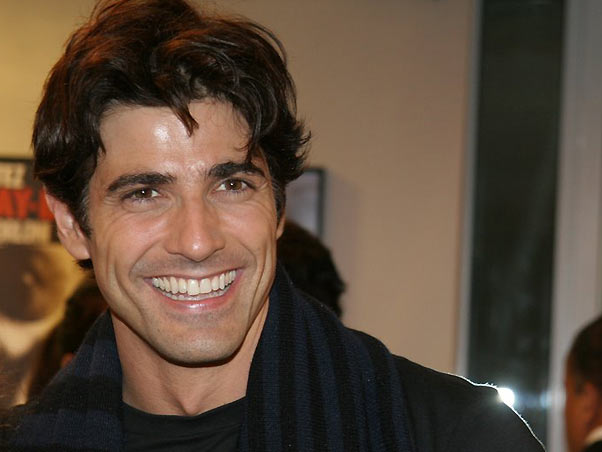
Oh, but then Amazon helped me discover Julia Quinn. She knows her way around a Reformed Rake, although, truthfully, they are more experienced charmers than genuinely rakish. I so don’t care. As is common with romance writers, Quinn created a series of books built around a family group, in this case the 8 Bridgerton children. Each is given their own book and, according to Amazon, the quality diminishes as one progresses through them. Last Friday, I picked up An Offer from a Gentleman (Bridgerton Family #3) about Benedict, and Romancing Mr. Bridgerton (Bridgerton Family #4) featuring Colin. I’d finished both of them by Saturday night. All of the family are described as having chestnut hair and wide mouths, and, although their eye colour varies, I choose to picture the men as all looking like a variation of this (but English and during the Regency):

I’ll give you a moment to collect yourself.

Now THESE are romance novels. Not the overwrought conflagration of sex scenes of Stephanie Laurens wherein everyone is on fire and ends up in the stars, or the tepid high school insufficiencies of Joanna Lindsey. Julia Quinn gets it right: There are no dramatic subplots just to fill pages; the writing is funny; the relationships are romantic; and there is playful banter. Oh, how I love the banter. The men are extremely attractive, and the women, well, the women are of the Wallflower/Why Didn’t Anyone Notice Me Sooner? variety. As a woman who never garnered much male attention, I relate to this type quite well because, in the real world, people don’t actually find it enchanting when you talk like a Gilmore Girl by way of Katharine Hepburn. Anyway, in An Offer from a Gentleman , Benedict (son #2) first meets Sophie Beckett (abused bastard daughter of the late Earl of Penwood) at a masked ball her stepmother has forbidden her to attend. She has to leave quickly and he doesn’t even find out her name.  Left with only the mystery woman’s glove, Benedict spends months looking for, and dreaming of, the woman he met. Mercifully, the description of those months lasts just a couple of pages. Meanwhile, Sophie is a little busier as she is cast out of her home and must find work as a servant. Their paths cross again two years later when Benedict saves her from being attacked and then, conveniently, falls ill and she stays with him. All of these books contain these contrivances and, again, I so don’t care. They fall for each other all over again, but she will not reveal they have met before, and he cannot marry a woman of her station/origins. In between the meeting and the marrying, the reader gets delightful interplay between the characters, genuinely romantic descriptions of how they feel about one another, and some well-written love scenes (although at least one more would have been nice). This book was exactly what I was looking for. I may even have taken a reading break to run into the living room to yell at Mr. Julien, “OH MY GOD! I LOVE THIS BOOK!”

I have ordered Julia Quinn’s Bridgerton books 1 and 2 (Daphne, then Anthony) used from Amazon. If I’m going to read this stuff, the least I can do is only pay 1 cent, plus shipping, for it. Next up after Quinn is Lisa Kleypas’ The Devil in Winter. I’ve decided not to review any more of these books, but I can tell you that the Devil excerpts I’ve read on Amazon held the promise a genuine rakehell at last. (2019 Update: HA! HA! HA!)

A summary of Julia Quinn’s catalogue can be found here. Links to my other reviews can be found on my complete reading list of books sorted by author or Author Commentary & The Tallies Shameful.


Almost Heaven by Judith McNaught

When last we met, I had just read a book (not to be confused with a work of literature) featuring an iron-thewed Highland Laird and his lady love, a Victim of Circumstance. Now, as I go through this phase, I’m all for a man can bench press Stonehenge and glower at me lovingly; however, while the whole Laird thing will do in a pinch, the Highlands are cold and damp, and I’d be constantly chilled to the bone, no matter how closely the hero “pulled me to his warmth”. Plus wool makes me itchy. What I need is a Reformed Rake to Make the Best Husband. He’s the charming, cynical bastard at the heart of most historical romance novels. It makes for better repartee and what’s the point of reading, if the man in question isn’t intelligent, magnetic and devastatingly seductive? Let me answer that for you: There is no point at all. Judith McNaught knows her way around a charming bastard: They require a lot of forgiveness and she makes sure he is worth it. The gentleman in question is so entirely delicious, and such a magnificent combination of everything swoonworthy, that I’d forgive him 17 times too. Almost Heaven is silly, the writing is overwrought yet strangely repetitive, and, oh my God, I LOVED EVERY SINGLE PAGE, even the ones I skipped to get back to the love story.

The Sacrificial Lamb of Almost Heaven, Elizabeth Cameron, is a Countess who will lose her beloved ancestral home should she marry against her vile and greedy uncle’s wishes. Because romance novel heroines are basically PG13 Disney princesses, she also has a worthless brother complicating things, and a household staff that dotes on her every move. Elizabeth is quite young, but I ignore that part. If I can ignore all the other strains on credulity, I can certainly pretend she is 5 years older. She is, of course, beautiful, but Elizabeth is also educated, independent and proud. Pride is considered a virtue in these books. I assume it’s their tenuous connection to the ultimate romance novel Pride and Prejudice. There are worse places to start. It also helps delay the denouement because everyone has to get over themselves for the happy ending to be achieved.

When the novel opens, Elizabeth is in disgrace because on the cusp on announcing her engagement to an appropriate young man, she met gambler Ian Thornton at a house party. He is gorgeous, charming, and, really, I can’t emphasize this enough, just smokin’ hot. (He is also rumoured to be the illegitimate grandson of the wealthy Duke of Stanhope. Guess how that turns out.) In flashback, they meet, fall in love instantly, he proposes, there is a misunderstanding owing to her naivety and his cynical bastardism, and her world implodes. Two years later (page 150 or so), she comes back into his life, they are still irresistibly drawn to each other, they establish a fragile peace, she has to leave, he FINALLY realises it’s ALL his fault, humbles himself, repairs her reputation, marries her, and there’s, like, two chapters of wedded bliss. Then it all goes to hell again because secrets are bad, jumping to conclusions is unfair, and sometimes people are idiots. But don’t worry, you already know how it turns out.

Links to my other reviews can be found on my complete reading list of books sorted by author or Author Commentary & The Tallies Shameful.