Tag Archives: book reviews

Indigo, Night Hawk, & Always and Forever by Beverly Jenkins

New author? NEW AUTHOR!

How did I find a new writer in amongst all the dross? I clicked “African-American”  on the Amazon historical romance sidebar and abandoned Victorian England for nineteenth century North America. HELLO, BEVERLY JENKINS! She’s a great writer and justifiably highly rated on Amazon and Goodreads. I read three of her books in four days and I’ll get to the other two, but first I want to talk about Indigo, her highest-rated book. It is really good. Definitely a “recommend” and possibly a classic.

Northern Michigan, 1859. Born a slave and now a free woman, Hester Wyatt is a “conductor” on the Underground Railroad. As the book begins, she and her fellow conductors are helping a family that has just arrived from the South. The family will move on quickly to Canada, barely stopping to rest and replenish themselves, but their guide was seriously injured during the flight. Severely beaten, the man, known as “the Black Daniel”, cannot possibly be moved. He remains in a secret room in Hester’s basement to be cared for, even as he suspects that someone in Hester’s circle has betrayed him, and more importantly, their work.

Hester nurses the Black Daniel, Galen Vachon, back to health. Initially very difficult to deal with, he relaxes as he heals and they form a tenuous bond before he returns to his work. They each try to forget the other, but when Galen returns in the spring, it is with very serious intentions towards Hester. Objecting to the differences in their stations, Hester holds out against his charm offensive for as long as she can, but ultimately surrenders. Because of the setting, their happily ever after is vulnerable and the reader knows it will be challenged as the American Civil War begins.

Almost any other historical romance written in 1998 would feel dated. Indigo does not (mostly) and I think that is owed to both Jenkins skill as a writer and the seamless way she weaves genuine historical detail into the story. Every once in a while, there is a history lesson/succinct summary of what the reader needs to know about the political and cultural climate at the time. The fraught situation creates a sense of jeopardy that no other romance has ever possessed for me. Normally, I view the “historical” part of the romance as something that creates narrative distance: It’s another world and the clothing is pretty. Indigo is a love story in which the historical context is truly essential. The characters are not real, but the bravery and boldness required in their situation calls out to all of the people who fought against the injustice of a repugnant society.

Night Hawk (also a recommend) and Always and Forever reviews after the jump…

Night Hawk is set in Kansas and Wyoming in the 1870s. The Civil War is over and The Reconstruction is still in force. Jim Crow has not yet reared its ugly head, but endemic racism is always an issue.

Indigo’s Hester was dignified and humble, Night Hawk’s Maggie is a force of nature, bloodied but unbowed. After losing her beloved parents, Maggie has managed to scrape by, occasionally finding sanctuary, but often falling prey to unscrupulous people, and also to her own temper. Her latest mess is the accidental death of her boss while she was fighting off his sexual assault. She is of mixed race and poor which is enough to condemn her in the eyes of the dead man’s father and the community. The local lawman attempts to transport her to another town to await her reprieve in peace, but things go horribly awry and she is passed off to a US Marshall, Ian Vance, “The Preacher”. The book is largely a road trip undertaken by the two as Maggie tries to escape and Vance keeps trying, unsuccessfully, to find another person to deliver Maggie to for safekeeping so he can go home to his ranch.

Night Hawk was the first Beverly Jenkins books that I read. It’s clever and well-paced, not to mention laugh out loud funny. One thing I particularly enjoyed about all three of these books is that the couples married a. after much persistence from a scrumptious man who knows a good thing when he sees it and b. in the middle of the story, so that the balance of the book takes on a “you and me against the world” tone. If romance novels are about finding the right partner, it makes sense for that partnership to be used and tested. All men in romance novels are delicious: gorgeous, strong, and sometimes heroic, but in these books they are truly heroes, not just for plotting purposes, but in the context of their times. For the equally heroic women, Jenkins acknowledges something that I often think of with stories set in the past. In our world, beauty can be a gift and a ticket to a better life. For women living in a time when women, especially those of colour, had no power, beauty could be a liability. It certainly was for Maggie.

Always and Forever (SPOILERS)

It’s 1884 and the Civil War is long over, but the dismantling of the Reconstruction and the insidious expansion of Jim Crow laws has created an exodus of African-Americans to the plains and the West. Grace Atwood is contacted by her cousin and told that the men in his community in Kansas need wives. Grace, who owns and runs a bank in Chicago, has just been left at the altar and takes up the project to distract herself. She decides that despite the potential ease of train travel, the risk for mistreatment (being forced to ride in the livestock cars or summarily dumped beside the tracks) at the hands of Jim Crow means a wagon train is the most logical choice. She finds 35 women to join her and sets up the trip, but she needs a wagon master…

Enter Jackson Blake. A former (Jim Crow again) deputy US Marshall, he wants to get back to Texas to clear his name and to lay his ghosts to rest. He hires on with Grace as a way to get there. The book makes it clear that home/Texas is not only not a safe place for him to be, it is not a safe place for ANYONE of colour to be. It is a time of devastating violence and he should not be going back. Jackson’s internal battle between his need to make things right and common sense is one of the central conflicts in the story.

Despite Indigo’s pre-Civil War setting, Always and Forever was actually the most graphic and disturbing in terms of giving witness to the burden and potential horror for people of colour at the time. Indigo reports the experiences of many people, Always and Forever shows us: The hero is actually drawn (as in “hanged, drawn and quartered”) in preparation for lynching what is left of him. It was heartbreaking and extremely difficult to read.

I found the preparation for the wagon train fascinating. Not just organization and purchase of  supplies, but the actual training, practice and extensive coordination the women undertake to get ready. That said, the plotting of this book was actually the weakest of the three. Grace and Jackson consummate their relationship and he decides that it was so amazing she must have been impregnated and therefore they must absolutely, positively get married rightright away. This results in a little more Come here! Go away! than was necessary.

Beverly Jenkins is a very good writer and I am so pleased to have discovered her. Despite the realities of the characters lives, I would not describe the books as dark, but rather as possessing a verisimilitude uncommon in my romance reading experience. There are trauma survivors and victims strewn throughout the genre. In these three novels, the difference is that the characters are at risk of being victimized again. The history lesson interjections are interesting even when they slow things down a bit, and I loved the feeling that Jenkins just really wanted you to know more about the remarkable real people living and working at the time. To her back catalogue!

The Lost Lords of Pembroke Series: Lord of Wicked Intentions by Lorraine Heath

Lord of Wicked Intentions, now that is a proper title for a historical romance novel!

Lorraine Heath is on my romance B list. B- really, but this was the best book of hers I’ve read so far. It’s the third and last in her Lost Lords of Pembroke trilogy and so much better than the boring and annoying preceding novel, Lord of Temptation, and the overwrought first novel, She Tempts the Duke. You’ll note that despite the B- factor, I have indeed read all three books, but I only paid for one of them and I regretted it.

Following the romance series convention of the toughest nut getting his story last, Lord Rafe is the youngest of the three Easton brothers and the most damaged. Rafe, Tristan, and Sebastian (every romance writer has a Sebastian, eventually) fled for their lives from their murderous uncle. The 15-year-old twins went to the military, Sebastian the army, Tristan the navy, and they left their 10-year-old brother Rafe at a work house terrified and alone. Fifteen years later, he has clawed his way out of poverty through whatever means necessary and available to him, and is aged beyond his years by experience. Rafe, like so many self-made men in romance, runs a gambling establishment. He has wealth beyond the dreams of avarice, a kind heart he does his best to conceal, and some serious physical contact issues. He’s attractive and damaged in the way that is appealing in romance novels and RUN, RUN, RUN AS FAST AS YOU CAN! in real life.

The daughter of an Earl and his mistress, Evelyn Chambers has grown up very sheltered. Taken in by her father and raised in his home after the death of her mother, she is left vulnerable to the whims of her (legitimate) brother when their father passes away. After promising “she shall have all she deserves,”, her brother promptly sets up an auction of his sister’s innocence to pay off his gambling debts to Rafe. Disgusted by what he sees, Rafe forgives the debt and brings Evelyn home for himself. He’s not a good enough man to decide not to make her his mistress, but he is kind, they fall in love in the process, and Rafe exacts some rather lovely revenge on Evelyn’s feckless brother.

Evelyn is the strongest characterization in the book and a great heroine. Heath manages to make her naive and innocent, but not a fool. It’s quite a tightrope walk and Heath absolutely succeeds with it.  Caught off guard by the reality of her circumstances and its implications about her father, Evelyn rises to the occasion with a calm dignity and believable self-possession, while still being appropriately hurt and let down by the revelations. Evelyn matures and takes on responsibility for herself and her future in tandem with Rafe’s unburdening and the relinquishing of his demons.

Lord of Wicked Intentions was a compelling, romantic, and entertaining read. Romance readers buy a lot of books, but we don’t keep very many. There is both an assumed disposability and a sought after re-readability in the genre. There are books I have read many times (there’s that shame spiral I’ve been looking for) and while Lorraine Heath wrote a very enjoyable book, it doesn’t inspire revisiting.  It was a great distraction, but not a keeper. Just the same, thank you to Malin for giving it to me when a distraction was exactly what I needed.

If you’re interested, the ultimate “hero from the gutter” historical romance is Dreaming of You by Lisa Kleypas. Derek Craven is a tortured hero masterpiece and a magnificently rakish character. Lisa Kleypas also has the ultimate Sebastian in another classic, The Devil in Winter, as Rachi3879 recently discovered.

Also by Lorraine Heath:

Deck the Halls with Love – from this series
As an Earl Desires

The Scoundrels of St. James Series:
In Bed with the Devil
Between the Devil and Desire
Surrender to the Devil
Midnight Pleasures with a Scoundrel
The Last Wicked Scoundrel

London’s Greatest Lovers Series (snort):
Passions of a Wicked Earl
Pleasures of a Notorious Gentleman – bonus tirade in my review!
Waking Up with the Duke

The (Shameful) Tally 2014 and links to my other reviews.

Along Came a Duke/And the Miss Ran Away with the Rake by Elizabeth Boyle

I was given Along Came a Duke plus And the Miss Ran Away with the Rake by the lovely Malin to help occupy me during my ongoing two-sprained-ankles-and-a-broken-foot extravaganza. Elizabeth Boyle is a new historical romance author to both of us and I found her style to be entertaining and light, but ultimately forgettable.

Along Came a Duke

Plot Summary: Preston is a duke. Tabitha is a poor relation much abused by her family. She inherits wealth, but her family tries to control her marriage choice so as to maintain control of the money. They fail.

This was the weaker of the two books. They fell in love very quickly and things went on too long. It was fun though. Fun and amusing.

And the Miss Ran Away with the Rake

Plot Summary: Romeo and Juliet with different names (Henry and Daphne) and a happy ending. Also, by turns an epistolary romance.

As a joke in Along Came a Duke, Preston placed a “wife wanted” advertisement in the newspaper for his sensible, yet wonderfully handsome uncle, Henry. Now Henry has to deal with the repercussions and ends up writing to a woman who took him to task for the ad and who just happens to be a. Tabitha’s best friend and b. a McCoy to Henry’s Hatfield.

There were some lovely moments in this book, in particular a scene at Preston and Tabitha’s engagement ball in which Henry and Daphne fall in love at first sight and without benefit of introduction. Things go awry when the truth comes out. The action then shifts to Preston’s family estate for the celebration of his wedding to Tabitha and to focus on Henry and Daphne’s “I’d like you so much better if you weren’t my sworn enemy” relationship.

It was pleasant. How’s that for damning with faint praise? Very pleasant. I was quite caught up in the story, it was funny and silly, but then it went on too long and …

yawn 3

I jumped ahead to the ending.

Both stories felt too immature in their own way, like books about young adults instead of grown ups. The romance was well-conveyed, but lacked weight and wasn’t successfully frivolous enough to compensate for any shortcomings. Boyle did include enough Regency-esque details to go a little bit further than most in creating a historical mood, and she should receive some sort of award for Least Annoying Play on a Nursery Rhyme in Jejeune Book Titling.

The (Shameful) Tally 2013

Love with the Proper Husband by Victoria Alexander

And with that the Victoria Alexander historical romance experiment is over. I’d read a novella and a novel and decided to give her one more go with her highest rated book on Amazon: Love with the Proper Husband.

There’s a woman, Gwen, whose sister ran away when she was young and then her parents died, but not at the same time, and she was left penniless and alone, so she went to the United States and worked as a governess there, even though she doesn’t like children, but then a solicitor sent her free passage home because of something with her father’s estate, and she’s not penniless after all and has a house, and she will be financially secure, but she can have even more money if she gets married but she doesn’t want to.

There’s this guy, Marcus, whose dad was friends with Gwen’s dad and he finds out from the same solicitor that there were conditions in his father’s will that no one ever mentioned before and he will lose everything, and so will his mum who he loves dearly, if he doesn’t get married before he is 30, in three months, but he has to marry Gwen and only Gwen or all his wealth and privilege will go away.

The guy asks Gwen to marry him and she says “No!” and he says “Please”, and then Gwen finds out that her long-lost sister is dead and she had three little girls she has to take in cause the only other person available is, as the girls point out, a “pickleface”. So Gwen needs money to raise the plot moppets and agrees to marry the guy and things proceed from there in the standard fashion.

The book was fine. It was pleasant and moved along nicely, it had some funny moments, and was nothing special whatsoever. He was a charming. lovely guy, but Gwen was what is known as TSTL* in the vernacular of the genre and she was so more than once, but still it all turned out fine because it always does in these books that’s the point and it’s the journey not the destination. The End.

The (Shameful) Tally 2013

TSTL: too stupid to live

Spindle Cove Series: Beauty and the Blacksmith by Tessa Dare

I’m not going to lie: I love the cheesy title. It sets just the right tone.

Tessa Dare is one of five writers on my historical romance autobuy list and she earned her place there owing to sheer entertainment value. There are different ways for these books to be enjoyable, but Dare’s best books are of the “romp” variety. She is such fun! Oh, there will come a time when she will challenge your profound willingness to suspend your disbelief, but it will be (mostly) be worth it.

Dare’s current series is set in the small seaside town of Spindle Cove where young single women go to recuperate from illness, embarrassment, and/or hide from the world. Local resident Mrs. Highwood has three daughters: Charlotte, for whom I hope a story is in the offing; Minerva, a spectacled academic who has recently married a lord (A Week to Be Wicked); and her favourite daughter, the ethereally lovely Diana, on whom Mrs. Highwood has pinned all of her ambitions. It was Diana’s poor health that brought the family to Spindle Cove and while it worked as a restorative, it also left her at a loose end: Now that she is healthy and has a full life to look forward to, Diana has to decide what kind of life she wants.

Before I had even begun reading Beauty and the Blacksmith, my willing suspension of disbelief was being challenged. Diana couldn’t seriously end up with a blacksmith, could she? Is he the younger son of a lord in hiding? Did he watch Diana from the edge of ballrooms and follow her here? I was very curious to find out because of all the tropes of historical romance that I question, the marriage between someone from the gentry and someone “low born” is the one I regard with the most jaundiced pseudo-historical eye. Unless one of them is rich (him, always him), then all bets are off.

All bets are on. Aaron Dawes, while a strapping sweetheart of a man, is really a blacksmith. One who makes jewelry on the side and this could turn into a loftier career for him, but a blacksmith nonetheless. It fits in nicely with cowboy/fireman/fighter pilot on the Pyramid of Manly Professions, but it slaps the face of historical reality. Dare’s characters get away with all sort of suspension of disbelief-y shenanigans, but this was too much for me. The voice in my head kept saying, “But he’s a blacksmith, but he’s a blacksmith, BUT HE’S A BLACKSMITH,” with ever-increasing volume and HTML formatting. What that voice really meant is that something fell flat in making the pairing sufficiently believable. Diana and Aaron have been mooning over each other from a distance for two years, but how exactly did this mutual yen turn into a convention defying love? Dare included discussions of the ramifications of the relationship, but not enough attention was given to the actual falling in love part of the story.  Which is not to say I didn’t enjoy the novella, even disregarding the even more patently ridiculous things that happened later because of the “romp” factor,  I really did. It just wasn’t quite as fantastic as it could have been.

If you have an e-reader and 99 cents, Dare has a novella called The Scandalous, Dissolute, No-Good Mr. Wright which is charming. Her best novel, so far, is A Week to Be Wicked, and she has one called Any Duchess Will Do (read: The Duke and The Barmaid) coming out at the end of May. I have already “autobought” it.

A complete summary of Tessa Dare’s catalogue, with recommendations, can be found here.

Links to my other reviews can be found on my complete reading list of books sorted by author or Author Commentary & The Tallies Shameful which includes the aforementioned observations.

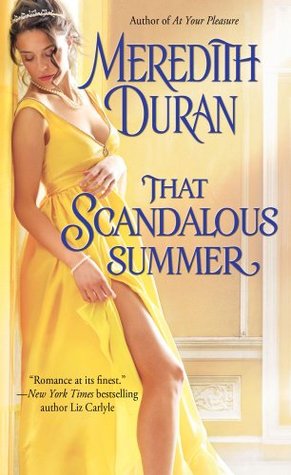
Rules for the Reckless Series: That Scandalous Summer by Meredith Duran

Malin, my romance spirit guide, recommends Meredith Duran very highly. Malin is right. Duran is an excellent writer, but more on that in a tic.

Image

The cover is ridiculous, but not in the usual heaving alabaster bosom way, which is, admittedly, a relief, but rather in a “What does that dress have to do with a historical romance?” way, but since such shenanigans are typical, I went straight to the reading:

duran3

Oooh, it’s set in 1885 and that means bustles. I LOVE bustles! (There were no bustles.)

All atremble in anticipation of the bustles, I started reading, but I quickly wondered which of the men in the first chapter was the hero, so I flipped the book over to read the blurb on the back:

Duran2

I’m not a historian, but aren’t The Regency and 1885 are separated by about 70 years? I point these things out not to show up the writer, but to point out the attitude of the publishers. It’s a mass market paperback, so apparently such details are irrelevant: “Just say it’s Regency. Women love that sh*t! No one will notice.” Also? It’s not set in London.

In a refreshing change of pace, the hero of That Scandalous Summer is not a Duke. Michael de Grey is the brother of a Duke. He is also a doctor who runs a charity hospital whose funds are controlled by said ducal relation. Michael has found a way to make himself useful, in between some renowned rakish naughtiness, but his brother’s heartbreak over a recently dead wife who was insufficiently discreet in her dalliances has led him to act in a self-destructive way and Michael is in his path. Unless he marries an appropriately demure, read “chaste”, upright woman to produce an heir and continue the family line, the Duke will cut him off without a penny and de-fund the hospital. To add insult to injury, this kind of blindly destructive behaviour is typical of their family, but instead of shielding Michael as he once did, the Duke is now acting like those he used to provide protection against.

Hoping to shock his brother back to his senses, Michael disappears from London and takes up residence in a small village in Cornwall where he practices medicine under an assumed, humbler name and waits to be found. Michael meets Mrs. Elizabeth Chudderly, a widow with a fast reputation, and a “professional beauty” in the new era of photography, who turns out to be a lovely person despite that fact that she was passed out in his rose bushes during their first encounter. Their connection is instant and each of them discovers that being their natural self, as opposed to version they act out in Society, is a huge relief, but imposes strict limits on their relationship. Then Society comes to them in the guise of a house party and things get really complicated.

That Scandalous Summer was a very enjoyable read. Meredith Duran’s storytelling is more serious than I ordinarily like, but not in a melodramatic way, rather she focuses on her mature, complex characters and less on banter. Michael and Elizabeth are consistently interesting on their own and together. From the initial startling spark between them and throughout their challenges, they are both sympathetic, even when they are behaving badly, making poor decisions, and saying exactly the wrong thing. Both hero and heroine are constrained by their responsibilities and the specter of financial and personal ruin. It’s all about the money, its expectations and burdens, which feels realistic for a society built around reputation and perception.

Also by Meredith Duran:

Rules for Reckless Series (not entirely interconnected, more of a theme)
That Scandalous Summer – very good
Your Wicked Heart – delightful novella
Fool Me Twice – excellent
Lady Be Good – nothing special
Luck Be a Lady

Not Rules for the Reckless Series
Bound by Your Touch – excellent
Written on Your Skin – not my style, but very good

Links to my other reviews can be found on my complete reading list of books sorted by author or Author Commentary & The Tallies Shameful.

The Bridgertons: Happily Ever After by Julia Quinn

If you want to know if you should read this book, please answer the following questions:

a. Have you read at least five of the Bridgerton family books by historical romance author Julia Quinn?
b. Did you like them? (Except Francesca’s book. No one in their right mind liked Francesca’s book.)
c. Do you like new stories about characters you already know?
d. Did you fall at the zoo because you were carrying your child who is too large to be carried?
e. Did you spend the evening icing your bruised left foot and probably sprained right ankle?
f. Did you fall asleep on the couch with your legs elevated above your heart?
g. When you awoke and hobbled to the bathroom, did you manage to call out to your spouse/significant other right before you fainted on the potty?
h. After coming to, did you have cold sweats for 45 – 60 minutes, you can’t be sure how long because time had lost all meaning, but that’s how long your spouse/significant other said it was?
i. When you went to bed did stomach flu start, but no matter what you tried you couldn’t throw up?
j. Did you go to the bathroom to wait out the nausea and to continue trying to throw up?
k. Did you want something light to read to fill the time?
l. When you succeeded in throwing up (toothbrush), did your spouse/significant other call out a supportive “Yay!” from the bedroom?
m. Did you and your spouse/significant other go to the walk in clinic while your mother who is visiting and had planned to go with you to the Metropolitan Museum to see this exhibit stayed with your child?
n. Did you have three hours to fill at the walk in clinic while they confirmed your bruised left foot and definitely sprained right ankle?

If you answered, “yes” to these questions, this is the perfect book for you.

A summary of Julia Quinn’s catalogue can be found here. Links to my other reviews can be found on my complete reading list of books sorted by author or Author Commentary & The Tallies Shameful.


When She Said I Do by Celeste Bradley

I had not followed my own advice by “reading the first few pages and then skipping forward to check on the canoodling to make sure there will be no unpleasant surprises” before taking this book out of the library. When I made the cursory check later, I decided to read it anyway because, you see, When She Said I Do is a historical romance of the non-vanilla variety. I don’t know what the opposite of vanilla is in this context, chocolate I suppose, so, following this logic, I’d say this novel is grocery store brand vanilla chocolate chip ice cream sparsely populated with chocolate flakes and then one or two chocolate chunks thrown in for verisimilitude.

The story opens with a carriage accident in the Cotswolds. The heroine, an eccentric ray of sunshine named Calliope, and her commensurately odd family find their way to a deserted manor house and take shelter. Wet, barefoot and in her shift, Calliope decides to explore the house and is discovered by its scarred and tantalizing master. He makes somewhat free with her body, she finds she doesn’t really mind, and when her brother shows up, things rapidly proceed through fight, duel, and wedding, until Beauty is alone with her hooded husband, The Beast. Ren (Lawrence) offers Calliope a bargain for her freedom. She will receive a pearl each time she submits to his desires and can leave when she has refilled the necklace they were taken from.

Although Celeste Bradley is quite funny and does interior monologue well, I had my usual romance novel timeline, inconsistency, and overwrought plotting complaints about When She Said I Do. The odd seeming juxtaposition of typical storyline with the darker sexual elements was interesting to me, if unromantic.  Ren and Calliope were typical love story characters who just happened to share the same proclivities. Fair enough. I don’t know if all of Bradley’s books follow this theme and I’m not sure I can be bothered to find out, but When She Said I Do certainly made for a change of pace.

The (Shameful) Tally 2013

The Prince’s Bride by Victoria Alexander

There is a prince, there is a bride, there is ACTUAL BODICE RIPPING!

What more could a historical romance reader ask for?

The Plot: Attempted murder. Marriage of convenience. Obscure European royalty.

Jocelyn Shelton needs glasses and likes big words, plus her given name is one I am in no position to object to. As a child in genteel poverty, she promised herself she would marry a rich, handsome prince, live in a castle, and thus she and her family would be protected from the world. Rand (Randall), Lord Beauchamp, is a devilishly handsome former spy, and her brother-in-law’s close friend. He encounters Jocelyn during a pre-empted assignation and saves her life. For spectacularly maguffiny reasons, the only way he can continue to protect her is by marriage and secreting her away to his uncle’s castle. For further maguffination, Jocelyn is voluntarily kidnapped and pursued to the obscure European country of “Avalonia” [insert eye roll here].

Some notes because I can’t be bothered to compose inter-connected paragraphs:

Jocelyn notices that Rand is about six inches taller than her and thinks this is a perfect difference. As I am a reader who notices height differential illogicalities, this detail won the author a golf clap.

The heroine is problematic and behaves inconsistently: Jocelyn #1 is an extremely ambitious, occasionally petulant, shallow, mercurial character. Jocelyn #2 is mature, calm, charming, devoted, and  tired of being considered an ornament. Frequently, both Jocelyns appear together in one scene resulting in a whole big bunch of COME HERE! GO AWAY!: Rand says something she finds insulting, she storms off, she forgives him before he can apologise, he does apologise, they make up, Rand says something she finds insulting, she storms off…

If I’ve done the arithmetic correctly, Jocelyn is 18 years old, which probably explains a lot, if I am giving Victoria Alexander credit for writing her young as opposed to capricious. Rand is 32. That is a big age difference. I chose to ignore it. I have read a large age difference extremely well-done, but this is not that book. Julie Anne Long’s What I Did for a Duke is that book. It’s fantastic. Go read it.

A bodice gets ripped and a shirt rent in one of the love scenes. Go try to rip open a men’s dress shirt. I’ll wait. [humming, filing nails, sorting feathers] It didn’t work did it? Now try to rip a quilt in half. I’ll be here when you get back. [starting next novel] It didn’t work, did it? EXACTLY. I’ve read novels where the hero deftly slices the laces or starts a tear in her shift with a sharp object, but there is no way in hell that a bodice several layers thick and sewn together with tiny stitches is simply going to give way.

The pacing was wackadoo. People often fall in love quickly in romance novels, and in real life, but I never understand the extremely compressed timelines romance authors use. After Jocelyn and Rand come together as a couple, they get about 3 days of bliss before things go kablooey. Why can’t they have three or four weeks? That doesn’t seem unreasonable to me.

Other than the quibbles above, Victoria Alexander is a competent romance writer. She is funny and she portrays the romantic connection well. Since I enjoyed her novella, Lady Amelia’s Secret Lover, and this book was inconsistent, I’m going to give her another try. Next up was going to be The Importance of Being Wicked, but I didn’t want to buy it and the only copy available at my library was LARGE PRINT. There was no way that was going to happen, not even so I could make a joke here, which I did seriously consider. (I still needed my reading glasses to peruse it. We all age, dearest.) Instead I picked up a couple of Alexander’s other books; a couple by another new-to-me author Celeste Bradley; a Meredith Duran; and the new Suzanne Enoch which is guaranteed to alternately charm and vex me.

13 days to the new Tessa Dare novella Beauty and the Blacksmith! Dare is an autobuy author I haven’t reviewed yet, but look!, I’ve already started my review –

This is the part of the review I wrote before I read the novella:

I am very much enjoying the cheesy title. It’s fun and the Tessa Dare Spindle Cove series is always fun. How is it that I haven’t reviewed any of her books yet? Malin has, if you want to check a couple out.

Other reviews can be found on my list of books by author or The (Shameful) Tally 2014 which includes recommendations and author commentary.

Lady Amelia’s Secret Lover by Victoria Alexander

New author! Victoria Alexander’s latest book, The Importance of Being Wicked, has quite good reviews and I liked what I perused* when I picked it up at a book store, so I decided to give her a test read. Because my never-ending quest for a new historical romance writer has resulted in disappointment, after disappointment, after disappointment, I started with a novella. That way, if I was once again let down, the hope crushing would be less time-consuming.

Not a typical romance, Lady Amelia’s Secret Lover is about a couple going through the seven-year itch. The title character, Amelia Hathaway, shares a name with one of my all time favourite heroines (Mine Till Midnight ), from my all time favourite author, Lisa Kleypas, and I have decided it is a loving homage. Madly in love with her husband when she married, Amelia has noticed that their lives have settled into a comfortable, safe routine. Upon discovering a diamond bracelet she assumes to be for her husband Robert’s mistress, Amelia sets out to get his attention by announcing that she has decided to take a lover. Hijinks ensue.

Lady Amelia’s Secret Lover was a quick, enjoyable read. I didn’t understand why, if one were to embark on an affair, one would choose the identical twin of one’s husband as the whole point is, one assumes, to get some strange, but it was required by the conceit of the story. The writing was of good enough quality and sufficiently entertaining that I have purchased another of Alexander’s books, The Prince’s Bride, and have reasonably high hopes for the novel. If the second book goes well, I might finally have that extensive romance back catalogue that I have longed for. Woo and hoo!

*I’m following my own advice as “peruse” in this context means reading the first few pages and then skipping forward to check on the canoodling to make sure there will be no unpleasant surprises.

The (Shameful) Tally