FBI/US Attorney Series: Love Irresistibly by Julie James

I’m breaking new ground! This novel is an unrealistic American contemporary  romance instead of an unrealistic English Victorian romance. Progress?!

This book made its way on to my Kindle owing to Malin’s excellent review in which she gives a lovely summary and an accurate evaluation of the book. Set in Chicago, Love Irresistibly is the story of Cade Morgan and Brooke Parker who meet cute during a criminal investigation. They are both ambitious, driven attorneys who have been recently jilted because neither really makes time for personal relationships. There are subplots involving criminal investigations, long-lost family, and football. It was a light, quick read.  Julie James is a fun, mostly competent* writer who moves things along well, and has some really nice moments. If this novel were to my taste, I’d seek out more of her books.

Next comes the part where I invent a literary term. If you know the real one, please pipe up.

Continue reading

The Bridgertons Series: On the Way to the Wedding by Julia Quinn

Julia Quinn is an excellent gateway author for people curious about historical romance. I raced through her catalogue (as did my mother) at the beginning of my obsession, when I was greedy and the entire genre lay before me like a shameful buffet.  I came back to her now because even lesser Quinn is better than most everything else, and I just can’t face any more bad romance (although I’m not ready to change what I’m reading). Last year, I didn’t bother to read this last book in Quinn’s justly popular Bridgerton family series because the reviews were comparatively lacklustre, but reading one of her new-to-me books after so much tripe was a treat.

Gregory Bridgerton has watched all seven of his siblings make happy marriages. He longs for true love and will settle for nothing less. Pole-axed when he lays eyes on the beautiful Hermione Watson, he decides that this must be it. Hermione’s best friend, Lucy, is accustomed to witnessing these reactions, but decides to help Gregory because he is the lesser of two evils, the other one being Hermione’s unacceptable secret love for her father’s secretary, and because he is the best of the long line of besotted fools. Gregory gets distracted by Lucy.

Delightfully wry and fun, you will find yourself laughing out loud at Julia Quinn’s books. She is a deft writer, witty and charming. The prose is clever and feels effortless, and she limits herself to the love story which greatly appeals to the purist in me. Quinn does longing and banter extremely well, as well as that fluttery feeling of incipient affection. Her characters are extremely likeable and the family dynamics are particularly entertaining.  The only challenge is that it seems to be hard for her to shift gears when the going needs to get tough.  Everything glides along beautifully, but when the action in On the Way to the Wedding gets ratcheted up, it’s too sudden a tonal shift and jarred with the carefully crafted buoyancy of the rest of the story, but that’s a quibble, not a condemnation.  However imperfect, Julia Quinn is still one of the best writers in the genre.

Continue reading

Wedded in Scandal by Jade Lee

I’m always ready to wade through a new-to-me author’s back catalogue. Jade Lee has favourable-ish reviews on Amazon/Good Reads and Wedded in Scandal was $1.99 on Amazon. That is definitely my preferred price for a potentially disposable historical romance novel. Given the size of Lee’s output, if all goes well, I’ll have new reading material for several weeks.

1. What do I expect from the “historical” elements in these novels?

Distance for escapism, proximity for familiarity.

Obviously, these books are not realistic. Historical accuracy is what Jane Austen is for. I read exclusively 19th century English set novels because I feel like I know something of the way of life at the time, I think I know about the clothing, and there is just enough modernity to make it feel familiar. Just far enough in the past to make it feel distant and separate, and not so long past that my brain is screaming “unclean”, as I do with medieval romances, or “so cold” as I do with the Highland settings. Big historical details can draw the eye towards inaccuracies and undermine the author’s work. Little details give authenticity and create space for the author to subvert authentic historical representations, i.e. put a bonnet on modern sexual and social mores. I believe Wedded in Scandal to be set in the 19th century based on –

  • the cover art
  • the presence of horse-drawn carriages
  • the absence of electricity
  • the theory that if it was the 18th century, people would be wearing wigs

I did not base my conclusion on any details from the book. There were none to draw on. No useful  details, no historical references, and, maybe I missed it, no date at the beginning of Chapter One as is industry standard. There was a cursory class warfare theme, but that’s hardly period specific. Perhaps they are living off the grid, but I’m going with 19th century.

Continue reading

Tempting Fortune and Devilish by Jo Beverly

Caveat: This review discusses sexual assault.

I don’t finish every romance I start. Sometimes, I sort of dance through them, open-minded when I begin, I may lose interest and jump around a bit to see if it can catch my fancy. Sometimes it does, and I go back and read everything. Sometimes, I give up and add those to the reject pile on The (Shameful) Tally. For this review, I am smushing together two failed attempts from Jo Beverly’s Georgian “Malloren” series which is famous for the presence of a classic hero. Based around a sibling group, Beverly saved the most forbidding brother, Rothgar, for last. I’ve read series like this before. Sometimes with great results, sometimes with very bad results indeed, although the bad results make the review a lot of fun to write.

So popular was the Rothgar character, there is a phrase I started to hear in the romance subculture referring to the anticipation of a specific hero’s book, “I’m waiting for Rothgar”. Julie Anne Long is currently building the same anticipation for Lyon Redmond and Olivia Eversea in her Pennyroyal Green series. I suspect that readers who discovered Courtney Milan before I did, felt the same way about the delicious Smite Turner.  I didn’t have to wait for Rothgar. He arrived at my local library thirteen years ago and has been sitting on the shelf ever since. In hardcover, no less, which is an honour accorded very few romance titles. Most of them are set up on spinners (over in a corner away from the “real” books in my library’s case) and cleared out to make way for fresh content on a regular basis.

Since I’m not waiting for Rothgar, but rather a decent author to publish something new, I decided to read other books in the series leading up to his story. I found book 2, Tempting Fortune, on the romance spinner and started with that. I didn’t get very far.

One of the things my husband objects to about romance is his perception that the heroes are aggressive and domineering towards the heroines. Originally published in 1995, Tempting Fortune begins with Bryght Malloren breaking into a home to steal some papers. He encounters an armed house guest, Portia, who tries to stop him. She tries to shoot him, he throws her to the ground to throw off her aim and then lies on top of her, restrains her, and kisses her as a “forfeit”. She’s surprised to find that she doesn’t exactly mind and feels safe with and attracted to him. [RECORD NEEDLE SCRATCH] This is EXACTLY what Mr. Julien was talking about, and EXACTLY where the book lost me. I don’t care if Adonis himself is standing in front of you: the stranger invading your home is not attractive, especially when he is pinning you to the floor.  I danced ahead to see what else happens and found a scene that was even more off-putting, and then skipped ahead a couple more times, jumping to the end.

Giving up on Tempting Fortune meant I’d finished “delaying for Rothgar” and I could start Devilish. I didn’t have high hopes given the sexual power dynamics of the second book and I was thus able to avoid disappointment. He has an intense back story I won’t bother with here, but the result is that the Marquess of Rothgar is pure romance novel Alpha male: Quick with a blade or a quip, arrogant, rich as Croesus, he has the king’s ear, and, of course, he meets his match in Diana, Countess Arradale. But it’s also 1743, so while Rothgar is not effete, he is betimes bejeweled, bewigged, bepowdered, and wearing extremely dandified clothing, including high heels.  My twenty-first century brain cannot process any of that as masculine and I really like emphatically masculine heroes in romance novels.

Devilish, or the portions I read at any rate, is blessedly free from the “forfeits” of Tempting Fortune, but there was an extremely distressing series of events in which Diana is verbally, physically and sexually abused, tied to a bed, her clothing cut off, and then gets rescued seconds before being raped. Now, there are books for every taste and proclivity in this genre, but I’m not talking about a sexual fantasy. Diana is violently assaulted by the villain. It is an attempted rape as a plot point. I hate attempted rape as a plot point. It’s one thing to have things getting a little dicey before the hero quickly swoops in, it is quite another to spend a protracted period on an assault and lead up to a terrifying violation. In her defense, I do think Beverly showed sensitivity and complexity in the characters’ reactions, but it was all way too much for me, and they moved on far too quickly: “I’m traumatized, I’m going to reenact my trauma to claim it and my body as my own, okay, I’m fine now.” The stories in these books are by their very nature unrealistic, but the emotional life of the characters has to feel real for the novels to have any true weight. Devilish managed to have simultaneously too much and too little emotional life, and, dear God, I never want to read a scene like that ever again in a romance novel.

Lessons in Love Series: The Rake and England’s Perfect Hero by Suzanne Enoch

GOD DAMN IT! 

When will I learn with Suzanne Enoch? WHEN? It always goes so well and then falls apart.

The Rake

the rake

This was published less than 10 years ago and yet with 1970s Maid of Honour dress.

The conceit of this historical romance series is that three friends decide that men need to be taught “lessons in love”, or, more precisely, how to conduct oneself as a gentleman and a decent human being.

Tristan Carroway, Viscount Dare, and Lady Georgiana Halley met when he was 24 and she was 18. They were mad for each other. He was young and stupid, so he participated in a silly wager regarding her virtue and broke her heart into a thousand tiny pieces. Despite completing the task *wink*, Tristan kept quiet and protected Georgie’s reputation, but he has regretted his actions as much as, if not more than, Gilbert Blythe did for calling Anne, “Carrots.”

Fast forward 6 years and Georgie is still furious (in a love/hate way) and decides to teach Tristan a lesson. Thence things proceed in an orderly fashion towards a happy ending until the book comes to a screeching halt and derails. It was all going so well. It was romantic and fun. Then Enoch painted herself into a corner and blam! the book ends happily, but with a scandal of truly epic proportions hanging over Tristan and Georgie’s heads, and with me wondering WHEN will I ever learn about Enoch.

Tristan has been added to my favourites list. He’s charming, rakish, and sincere.  I shan’t blame him for Enoch’s storytelling shortcomings. Georgie is delightful as well. They have chemistry and snappy banter that leaps off the page.  Tristan’s four brothers (Bradshaw, Robert, Edward, and Runt) feature as supporting characters and are set up well for their own books; in fact, part way through I realised that I had read Bradshaw’s book last year as part of another series. Robert was set up so endearingly that I immediately bought his book when I finished The Rake despite the aforementioned fiery plot crash. I was, of course, disappointed. WHEN? WHEN WILL I LEARN?! Enoch pulls me in and lets me down every time! The Rake painfully so. It was thisclose to greatness.

England’s Perfect Hero
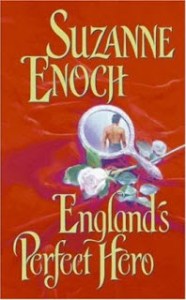
England's_Perfect_Hero

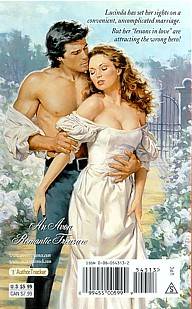
What a surprisingly almost-non-cringeworthy cover, but fear not!, here is the front flap:
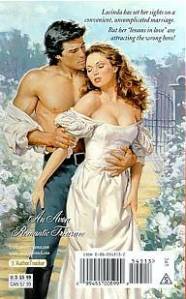
perfect hero

I feel better now.

Because there are as many men in these novels who fought against Napolean as there were actual soldiers at the time, Robert Carroway is one of a legion of Regency romance heroes with PTSD.  He is still struggling to re-enter the world of the living four years after coming home. Lucinda, Georgie’s best friend, is actually in pursuit of another man, the one in the title, but gets increasingly distracted by Robert. She should be. He’s lovely.

England’s Perfect Hero lacked the ebullience of the The Rake, although the characters were sweet and well-drawn, especially the Carroway family. They are such fun. Suzanne Enoch got bogged down in a convoluted, and really rather obvious, subplot and that’s where this one went off the rails.

Both of these novels careened into their endings with ridiculous behaviour from their characters and illogical plotting decisions, thus bringing me back to WHEN? I actually said, “this is stupid” out loud during one particularly egregious incident. If you want to write a love story with neither machinationsnor major subplots, there is nothing wrong with that; in fact, it’s my preference. However, if you choose to have villains and intrigue, you have to make them convincing, compelling, and logical.  As a purist, I won’t like your story as much, but I will appreciate the effort.

Note A: Georgie is heavily pregnant throughout England’s Perfect Hero. It was Chekov’s Womb. Chekov’s Unfulfilled Womb! There’s an unrealised subplot involving fans in The Rake. I mean, honestly!, why set these things up and then leave them dangling. WHEN?

Note B: There is a novel between Tristan and Robert’s in the series, but it doesn’t involve the Carroway brothers, so I wasn’t interested.

Also by Suzanne Enoch
Reforming a Rake (Lucien/Alexandra)
Meet Me at Midnight  (Sinclair “Sin”/Victoria “Vixen”)
A Matter of Scandal (Grey/Emma)
The Devil Wears Kilts  (Ranulf/Charlotte)

Links to my other reviews can be found on my complete reading list of books sorted by author or Author Commentary & The Tallies Shameful.

100 Dresses from The Costume Institute The Metropolitan Museum of Art

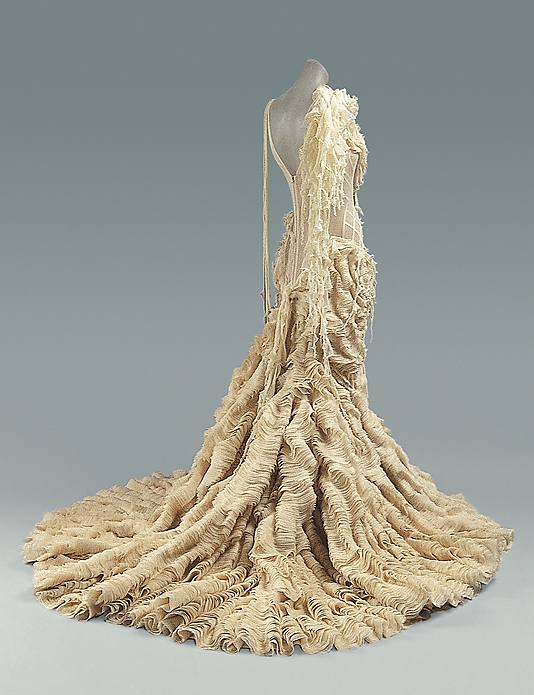
McQueen

Alexander McQueen

I recently added this volume to my burgeoning collection of books on historical fashion (the new-to-me word passementerie* comes up a lot). 100 Dresses is a paragon of self-explanatory book titles. It’s a picture book for grown ups, the more tactful term would be “coffee table book”, but this is not an oversized book, and thus we have circled right back to “picture book”. I am not a fashionista by any stretch of the imagination, or my elasticized-waist pants, but I do love looking at clothing including current collections on Style.com and historical costume.

The book is a kind of primer with selections from The Costume Institute at the Metropolitan Museum of Art’s archives that represent either extant examples of period dress or works by important couturiers. (As the identity of individual designers was a 19th century development, Charles Frederick Worth the progenitor, earlier examples are always uncredited despite their remarkable craftsmanship.) It’s clothing created by artists/artisans for wealthy women. Each dress is presented with a photo and short explanatory essay. As someone who likes to look at clothing, but hasn’t read much, it was an excellent basic education for me, e.g. This is a dress by Cristobal Balenciaga, he was important to fashion design for reasons X, Y, Z. Some things I already knew, but a there was enough new information to keep things interesting, plus really pretty pictures.

Red Bustle Dress 2

Not this one, I just really love this.

*Passementerie or passementarie is the art of making elaborate trimmings or edgings (in French, passements) of applied braid, gold or silver cord, embroidery, colored silk, or beads for clothing or furnishings. So like this gloriousness by the House of Worth also found in the book, then –

House of Worth

The (Shameful) Tally, although this book is technically Shamefree, it’s just one big list this year.

Winning the Wallflower by Eloisa James

I don’t like short stories because they are too short, but I do like romance novellas because the length focuses the plot quite nicely and frees it up from all those extraneous elements (spies, machinations, supporting characters) that usually annoy me. Winning the Wallflower is just such a novella, but all I can really tell you about it is that it is by Eloisa James, an author I have previously rejected. Also, it was 99 cents. It may have been reasonably bantery and enjoyable. I’m not really sure because…

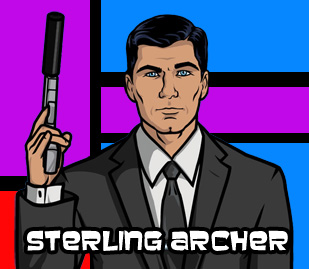
Sterling_Archer_8057
I decided to watch Archer while working from home this week. A lot of Archer. Twenty-three episodes (and counting) in three days, so when I read Winning the Wallflower everyone sounded like Sterling Archer: the hero, the heroine, the heroine’s friend, the omniscient narrator. As did my emails for work. It made for an interesting tonal shift, although with the vaguely florid romance writing style it did work strangely well. Not so much for the emails at work. A lot of careful proofreading required there. Plus the hero, Cyrus (I know, but I have to admit that I think Cyrus is actually a pretty cool name.), looks like Sterling Archer, if Archer weren’t a 21st century spy cartoon character and Cyrus wasn’t a fictional Regency Adonis.

At the beginning of Winning the Wallflower,  Cyrus (You think it’s cool, too. I won’t tell.) and a lovely young woman named Lucy, are engaged. She has recently come into an inheritance and is being forced to jilt his untitled tush so she can marry someone more suited to her newly be-lucred station. Lucy doesn’t know Cyrus, he has barely spoken to her despite the whole proposal thing, but she is very warm for his form because he is totally gorgeous. In the process of throwing him over, Lucy finds her strength and Cyrus discovers that, what?!, she’s actually charming and smart and speaks honestly to him. Not too shabby for a woman he proposed to because she fit into his master plan to rebuild his family’s reputation *cough* cursory revenge plot *cough*. So, she dumps him, he realises he’s an ass, and sets out to woo her. Quickly. It’s a novella.

The (Shameful) Tally

Highland Surrender by Tracy Brogan

Highland Surrender* is a historical romance novel set in the Scottish Lowlands in the 16th century. At one point, the heroine reaches up to undo a button at the hero’s collar. Did they even have buttons in 1537? To the Googles!

My search results included a partial topic listing for “button” on Wikipedia, including –

  • Buttons in museums and galleries
  • Early button history
  • Buttons in politics

How tantalizing!

Some museums and art galleries hold culturally, historically, politically, and/or artistically significant buttons in their collections. The Victoria & Albert Museum has many buttons, particularly in its jewellery collection, as does the Smithsonian Institution.

The list of potential button relevance is giving me life. I would TOTALLY go through all of the button drawers at the V&A. I looked through all the drawers of lace when I had the chance.

Functional buttons with buttonholes for fastening or closing clothes appeared first in Germany in the 13th century. They soon became widespread with the rise of snug-fitting garments in 13th- and 14th-century Europe.

Okay, Tracy Brogan. You win this round, but button knowledge, or no, your figures of speech leave a lot to be desired. I bookmarked some for just such an occasion:

  • But the morning dawned soft and fair, mild as a Highland calf (PAGE ONE!)
  • Her pulse thrummed, like the flap of a thousand swans leaving the surface of a loch.
  • Press this issue further and you’ll find yourself in a storm of regret. (That one was pretty cool.)
  • Questions crashed inside Myles’s mind, clattering like hooves against a cobbled street.
  • Mild relief tapped Myles upon the shoulder.
  • …the gaze of his familiar sapphire eyes pierced through her, splintering her lungs like shards of glass

To be honest, and fair, this book was simply not my cup of tea: wrong era, wrong setting, wrong subplot. I can see how, if it was to one’s tastes, this would be a fun read. The off-putting elements would have been fine with me in a story I was interested in. The writing in romance novels is often exactly this overwrought. Yes, even in the “good” ones. If the characters and story are truly compelling, the reader can/will overlook a multitude of sins *cough*Outlander *cough*. I’m not the audience for this book, and as genre fiction is so readership specific, I should probably keep my big, condescending mouth shut. Highland Surrender has averaged 4.3/5 stars from over 300 reviews on Amazon. It’s a pretty impressive score and likely a safe indicator of quality (violently skewed for the genre), if you are looking for a political intrigue Scottish renaissance romance.

*Not to be confused with Highland Obsession, Highland Legacy, Highland Quest, Highland Vengeance, Highland Betrayal, Highland Defiance, Highland Rescue, Highland Rake, Highland Heart, Highland Healer, Highland Destiny, My Highland Love, A Highland Home, Highland Sons,  The Highlander, Highlander Ever After, Highland Ever After, Sins of the Highlander, Highlander’s Captive, The Highlander’s Hope, The Highlander Takes a Wife, or the other books called Highland Surrender.

The (Shameful) Tally

Things I Enjoy, or Not, in a Romance Novel

If I am not saying I will, but if I do, I enjoy:

  1. When one book picks up where the last one left off.
  2. When they get married at the beginning, or part way through.
  3. A sardonic rake is always good.
  4. Autocratic is fine.
  5. Self made men. (Waving at Lisa Kleypas for 3 – 5)
  6. A big lug for variety.
  7. Historical accuracy in the clothing.
  8. Historical inaccuracy in the woman’s education.
  9. Wallflowers rather than victims of circumstance.
  10. He should be very physically attractive. It’s romantic fiction by and for women.
  11. It must be funny.
  12. A besotted hero, manfully so, but besotted nonetheless.
  13. Subtle references.
  14. A fist fight is always fun.
  15. Character reincorporation/interconnected stories.
  16. A straight up romance and all subplots feed into it.
  17. Acknowledging how complicated the clothing and hair is.
  18. Travel takes a long time.
  19. 19th century English setting, preferably after trains are running.
  20. Sincere romantic gestures.
  21. When the viewpoint switches between the hero and heroine.
  22. Body hair. That’s right, I said it.
  23. Intimate, but not explicitly sexual, contact.
  24. At least 3 love scenes: consummation, in media res, reconciliation/closure.

Or not:

Continue reading

Undone by Lila DiPasqua

Awful. God awful. By turns gross and offensive. Also? Horrible.

I wasn’t hopeful going in because Undone, by Lila DiPasqua, was subtitled ” A Fiery Tale”. Punny titles/sub-titles aren’t really indicative of anything more than publishers patronizing their readership, so I decided to give it a chance. Undone was billed as “erotic” which can mean:

  1. Nothing. It is a misnomer, they are trying to move product.
  2. More sex than the average romance novel.
  3. The usual amount of sex, but more graphic in its depiction.
  4. For want of a better term, more creative sex.
  5. Off-putting sex masquerading as eroticism.

In this case the answer was, of course, number 5. The book is neither romantic, nor erotic, so 0 for 2.

Set in the 17th century, Simon Bname leaves his carriage to deal manfully with some ruffians and encounters a nun sneaking back to her convent. Angelica literally runs into him and knocks him over; nonetheless, having had his recently threatened and assaulted prostrate form landed on, and seeing a glimpse of be-wimpled face, Simon is totally turned on and follows Angelica into the convent. Then he brings her out of the convent because they are so mean to her! They sail away; sex scenes take place containing WORDS THAT NO ROMANCE NOVEL SHOULD EVER CONTAIN, “FIERY” OR NOT, AND A SENTIMENT THAT LESS THAN FOUR WOMEN HAVE EVER EXPRESSED IN THE ENTIRE HISTORY OF SEX; time is spent on a Caribbean island; more SEX; they are separated; deus ex machinations™ ensue; evil-doers are brought to justice; they get married.

Simon saves Angelica, he pursues her, his interior monologue goes on and on about how beautiful (and on) and sexually attractive (and on) he finds her. They finally consummate their relationship and his first post coital thought is, “Hold the phone! Where’s the blood?”. Simon, renowned rake/slattern, is irate with Angelica (and on) for not being a virgin, so he proceeds to treat her abominably. He doesn’t even talk to her about it. Obviously, she is a liar (and on) and a faithless jade. Obviously, he is mistaken because this is one of those books where her so-called virtue is important (and on), and his is not.  Madonna/Whore Complex, Table for Simon!

I don’t like romance novels set in the 17th or 18th centuries. Not even the well-written ones which this, and I cannot emphasize this enough, is not. I keep thinking “unclean, UNCLEAN!” when it comes to day-to-day life. I could give a toss about political machinations that affect the top 0.1% while everyone else is scrabbling against poverty and disease. (Medieval settings take these sentiments and multiply them by 10 to the power of 4 times infinity for the subjugation of women.) Moreover, this is the admittedly shallow part, but this is escapist reading so the judges will allow it: I don’t like men’s 17th century clothing and I hate 18th century men’s formal dress. Regardless of scintillating political intrigue, the ornateness of the clothing for both periods jars with my 21st century notions of manliness and diminishes the reading experience. No one looks testosteriffic in a heavily embroidered saffron waistcoat, turquoise pantaloons, and a powdered wig. Nobody.

Links to my other reviews can be found on my complete reading list of books sorted by author or Author Commentary & The Tallies Shameful.