Category Archives: book review

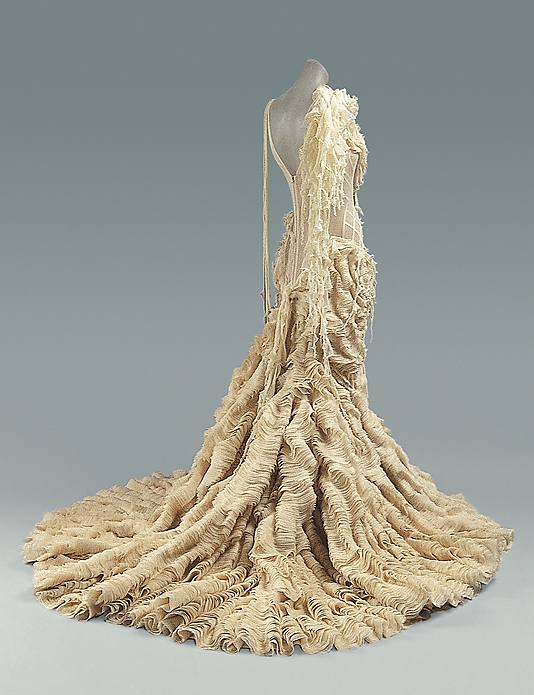
100 Dresses from The Costume Institute The Metropolitan Museum of Art

McQueen

Alexander McQueen

I recently added this volume to my burgeoning collection of books on historical fashion (the new-to-me word passementerie* comes up a lot). 100 Dresses is a paragon of self-explanatory book titles. It’s a picture book for grown ups, the more tactful term would be “coffee table book”, but this is not an oversized book, and thus we have circled right back to “picture book”. I am not a fashionista by any stretch of the imagination, or my elasticized-waist pants, but I do love looking at clothing including current collections on Style.com and historical costume.

The book is a kind of primer with selections from The Costume Institute at the Metropolitan Museum of Art’s archives that represent either extant examples of period dress or works by important couturiers. (As the identity of individual designers was a 19th century development, Charles Frederick Worth the progenitor, earlier examples are always uncredited despite their remarkable craftsmanship.) It’s clothing created by artists/artisans for wealthy women. Each dress is presented with a photo and short explanatory essay. As someone who likes to look at clothing, but hasn’t read much, it was an excellent basic education for me, e.g. This is a dress by Cristobal Balenciaga, he was important to fashion design for reasons X, Y, Z. Some things I already knew, but a there was enough new information to keep things interesting, plus really pretty pictures.

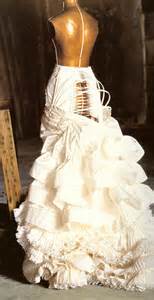
Red Bustle Dress 2

Not this one, I just really love this.

*Passementerie or passementarie is the art of making elaborate trimmings or edgings (in French, passements) of applied braid, gold or silver cord, embroidery, colored silk, or beads for clothing or furnishings. So like this gloriousness by the House of Worth also found in the book, then –

House of Worth

The (Shameful) Tally, although this book is technically Shamefree, it’s just one big list this year.

Winning the Wallflower by Eloisa James

I don’t like short stories because they are too short, but I do like romance novellas because the length focuses the plot quite nicely and frees it up from all those extraneous elements (spies, machinations, supporting characters) that usually annoy me. Winning the Wallflower is just such a novella, but all I can really tell you about it is that it is by Eloisa James, an author I have previously rejected. Also, it was 99 cents. It may have been reasonably bantery and enjoyable. I’m not really sure because…

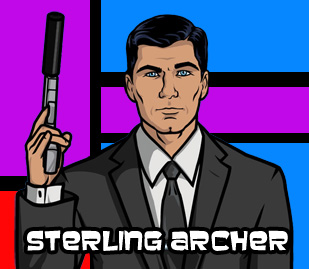
Sterling_Archer_8057
I decided to watch Archer while working from home this week. A lot of Archer. Twenty-three episodes (and counting) in three days, so when I read Winning the Wallflower everyone sounded like Sterling Archer: the hero, the heroine, the heroine’s friend, the omniscient narrator. As did my emails for work. It made for an interesting tonal shift, although with the vaguely florid romance writing style it did work strangely well. Not so much for the emails at work. A lot of careful proofreading required there. Plus the hero, Cyrus (I know, but I have to admit that I think Cyrus is actually a pretty cool name.), looks like Sterling Archer, if Archer weren’t a 21st century spy cartoon character and Cyrus wasn’t a fictional Regency Adonis.

At the beginning of Winning the Wallflower,  Cyrus (You think it’s cool, too. I won’t tell.) and a lovely young woman named Lucy, are engaged. She has recently come into an inheritance and is being forced to jilt his untitled tush so she can marry someone more suited to her newly be-lucred station. Lucy doesn’t know Cyrus, he has barely spoken to her despite the whole proposal thing, but she is very warm for his form because he is totally gorgeous. In the process of throwing him over, Lucy finds her strength and Cyrus discovers that, what?!, she’s actually charming and smart and speaks honestly to him. Not too shabby for a woman he proposed to because she fit into his master plan to rebuild his family’s reputation *cough* cursory revenge plot *cough*. So, she dumps him, he realises he’s an ass, and sets out to woo her. Quickly. It’s a novella.

The (Shameful) Tally

Highland Surrender by Tracy Brogan

Highland Surrender* is a historical romance novel set in the Scottish Lowlands in the 16th century. At one point, the heroine reaches up to undo a button at the hero’s collar. Did they even have buttons in 1537? To the Googles!

My search results included a partial topic listing for “button” on Wikipedia, including –

  • Buttons in museums and galleries
  • Early button history
  • Buttons in politics

How tantalizing!

Some museums and art galleries hold culturally, historically, politically, and/or artistically significant buttons in their collections. The Victoria & Albert Museum has many buttons, particularly in its jewellery collection, as does the Smithsonian Institution.

The list of potential button relevance is giving me life. I would TOTALLY go through all of the button drawers at the V&A. I looked through all the drawers of lace when I had the chance.

Functional buttons with buttonholes for fastening or closing clothes appeared first in Germany in the 13th century. They soon became widespread with the rise of snug-fitting garments in 13th- and 14th-century Europe.

Okay, Tracy Brogan. You win this round, but button knowledge, or no, your figures of speech leave a lot to be desired. I bookmarked some for just such an occasion:

  • But the morning dawned soft and fair, mild as a Highland calf (PAGE ONE!)
  • Her pulse thrummed, like the flap of a thousand swans leaving the surface of a loch.
  • Press this issue further and you’ll find yourself in a storm of regret. (That one was pretty cool.)
  • Questions crashed inside Myles’s mind, clattering like hooves against a cobbled street.
  • Mild relief tapped Myles upon the shoulder.
  • …the gaze of his familiar sapphire eyes pierced through her, splintering her lungs like shards of glass

To be honest, and fair, this book was simply not my cup of tea: wrong era, wrong setting, wrong subplot. I can see how, if it was to one’s tastes, this would be a fun read. The off-putting elements would have been fine with me in a story I was interested in. The writing in romance novels is often exactly this overwrought. Yes, even in the “good” ones. If the characters and story are truly compelling, the reader can/will overlook a multitude of sins *cough*Outlander *cough*. I’m not the audience for this book, and as genre fiction is so readership specific, I should probably keep my big, condescending mouth shut. Highland Surrender has averaged 4.3/5 stars from over 300 reviews on Amazon. It’s a pretty impressive score and likely a safe indicator of quality (violently skewed for the genre), if you are looking for a political intrigue Scottish renaissance romance.

*Not to be confused with Highland Obsession, Highland Legacy, Highland Quest, Highland Vengeance, Highland Betrayal, Highland Defiance, Highland Rescue, Highland Rake, Highland Heart, Highland Healer, Highland Destiny, My Highland Love, A Highland Home, Highland Sons,  The Highlander, Highlander Ever After, Highland Ever After, Sins of the Highlander, Highlander’s Captive, The Highlander’s Hope, The Highlander Takes a Wife, or the other books called Highland Surrender.

The (Shameful) Tally

Things I Enjoy, or Not, in a Romance Novel

If I am not saying I will, but if I do, I enjoy:

  1. When one book picks up where the last one left off.
  2. When they get married at the beginning, or part way through.
  3. A sardonic rake is always good.
  4. Autocratic is fine.
  5. Self made men. (Waving at Lisa Kleypas for 3 – 5)
  6. A big lug for variety.
  7. Historical accuracy in the clothing.
  8. Historical inaccuracy in the woman’s education.
  9. Wallflowers rather than victims of circumstance.
  10. He should be very physically attractive. It’s romantic fiction by and for women.
  11. It must be funny.
  12. A besotted hero, manfully so, but besotted nonetheless.
  13. Subtle references.
  14. A fist fight is always fun.
  15. Character reincorporation/interconnected stories.
  16. A straight up romance and all subplots feed into it.
  17. Acknowledging how complicated the clothing and hair is.
  18. Travel takes a long time.
  19. 19th century English setting, preferably after trains are running.
  20. Sincere romantic gestures.
  21. When the viewpoint switches between the hero and heroine.
  22. Body hair. That’s right, I said it.
  23. Intimate, but not explicitly sexual, contact.
  24. At least 3 love scenes: consummation, in media res, reconciliation/closure.

Or not:

Continue reading

Undone by Lila DiPasqua

Awful. God awful. By turns gross and offensive. Also? Horrible.

I wasn’t hopeful going in because Undone, by Lila DiPasqua, was subtitled ” A Fiery Tale”. Punny titles/sub-titles aren’t really indicative of anything more than publishers patronizing their readership, so I decided to give it a chance. Undone was billed as “erotic” which can mean:

  1. Nothing. It is a misnomer, they are trying to move product.
  2. More sex than the average romance novel.
  3. The usual amount of sex, but more graphic in its depiction.
  4. For want of a better term, more creative sex.
  5. Off-putting sex masquerading as eroticism.

In this case the answer was, of course, number 5. The book is neither romantic, nor erotic, so 0 for 2.

Set in the 17th century, Simon Bname leaves his carriage to deal manfully with some ruffians and encounters a nun sneaking back to her convent. Angelica literally runs into him and knocks him over; nonetheless, having had his recently threatened and assaulted prostrate form landed on, and seeing a glimpse of be-wimpled face, Simon is totally turned on and follows Angelica into the convent. Then he brings her out of the convent because they are so mean to her! They sail away; sex scenes take place containing WORDS THAT NO ROMANCE NOVEL SHOULD EVER CONTAIN, “FIERY” OR NOT, AND A SENTIMENT THAT LESS THAN FOUR WOMEN HAVE EVER EXPRESSED IN THE ENTIRE HISTORY OF SEX; time is spent on a Caribbean island; more SEX; they are separated; deus ex machinations™ ensue; evil-doers are brought to justice; they get married.

Simon saves Angelica, he pursues her, his interior monologue goes on and on about how beautiful (and on) and sexually attractive (and on) he finds her. They finally consummate their relationship and his first post coital thought is, “Hold the phone! Where’s the blood?”. Simon, renowned rake/slattern, is irate with Angelica (and on) for not being a virgin, so he proceeds to treat her abominably. He doesn’t even talk to her about it. Obviously, she is a liar (and on) and a faithless jade. Obviously, he is mistaken because this is one of those books where her so-called virtue is important (and on), and his is not.  Madonna/Whore Complex, Table for Simon!

I don’t like romance novels set in the 17th or 18th centuries. Not even the well-written ones which this, and I cannot emphasize this enough, is not. I keep thinking “unclean, UNCLEAN!” when it comes to day-to-day life. I could give a toss about political machinations that affect the top 0.1% while everyone else is scrabbling against poverty and disease. (Medieval settings take these sentiments and multiply them by 10 to the power of 4 times infinity for the subjugation of women.) Moreover, this is the admittedly shallow part, but this is escapist reading so the judges will allow it: I don’t like men’s 17th century clothing and I hate 18th century men’s formal dress. Regardless of scintillating political intrigue, the ornateness of the clothing for both periods jars with my 21st century notions of manliness and diminishes the reading experience. No one looks testosteriffic in a heavily embroidered saffron waistcoat, turquoise pantaloons, and a powdered wig. Nobody.

Links to my other reviews can be found on my complete reading list of books sorted by author or Author Commentary & The Tallies Shameful.

When You Give a Duke a Diamond by Shana Galen

I would love to start a proofreading/editing service for historical romance novelists. I’d hold the author’s hand and say things like, “It’s not really appropriate for the hero and heroine to get randy in the home of his recently deceased fiancée, especially as they are searching said home for clues as to her violent demise. It may come across as insensitive.”

When You Give a Duke a Diamond was like the movie The Return of the King: It had several endings starting about 70% of the way through, and then somehow managed to keep going via deus ex machinations and unnecessary complications. Also, that title is truly appalling.

The Plot: Will is an uptight Duke. Juliette is a famous courtesan. Something with murder and spies.

In addition to wanting to offer my services as an editor, I often read these books thinking an author has potential. Then I look her up on Amazon, discover she has published many novels, in this case eleven, and realise that this is as good as it’s going to get.  Since Shana Galen is not paying me to be nice about it, here is what is wrong with this book:

  • It is a little too busy establishing its subplots.
  • There are too many subplots.
  • Will is “tired of fighting it”? It’s been, like, 37 hours.
  • Everyone is crazy beautiful.
  • The aforementioned excess of endings.
  • It needs more banter.
  • No one gets back and forth between London and Yorkshire that easily by carriage. This time would be well spent having Will and Juliette get to know each other (in the non-biblical sense).
  • Any romance that includes “Prinny” is instantly on notice. This is, admittedly, a personal issue.
  • JESUS CHRIST! TWO MURDERED DOGS?!

Here is what is right with this book:

  • The moments of tenderness are actually rather sweet.
  • The eruptions of violence are shocking and frightening.
  • There are some really fun touches of humour.
  • The hero must accept the heroine’s past as in no way indicative of her value, or morality, as a human being before his suit is even considered.
  • A particularly harrowing and thrilling triumph over one of the villains, even if his presence was deus ex machinations.

I might read more by Shana Galen, if the price is right: $1.99 or less/free from the library.

NEXT!

The Lion’s Lady by Julie Garwood

This time, I’m kicking it old school…

I went through a romance genre phase after I graduated from university in 1990. I don’t think I read a so-called real book for about two years. My boyfriend at the time was ENDLESSLY horrified by my choices. Then, I woke up one day and went to the library for works by the Algonquin Round Table. That kind of awakening hasn’t happened so far, and as I’ve read what I believe to be everything good currently out there,  I decided to go back and read an author from my last genre episode.

In the early 1990s, Julie Garwood was the best writer of historical fiction and, according to Wikipedia anyway, I can congratulate myself on my excellent taste as she was apparently important to the genre for introducing quirkier heroines and the use of humour. I read most of her historical output, and during my romance novel cleanse, her book The Gift was one of only two I kept. It was also the first thing I picked up when the current fever set in.

Here, in a nutshell, is Julie Garwood’s The Lion’s Lady:

Christina, is young, not quite 19, and bee-yu-ti-ful. As with all Garwood heroines, she has a sprinkle of freckles across her nose. Her mother fled an abusive marriage to a non-determinate European royal before dying and passing on her child to be raised by — wait for it — the Lakota Sioux. After a year of “Acting English” training, Christina has arrived in London to help her (villan alert!) aunt claim Christina’s inheritance before disappearing back to the Lakota.  Oh, and her evil father is skulking in the wings twirling his moustache because of a subplot about stolen jewels. As Christina is Blondey-Blonde von Blondersen, I remember wondering in 1992, and again this time, why her skin apparently has no sun damage from 16 years living on the plains. Did her adoptive mother make her wear a bonnet?

The hero, the Marquis of Lyonwood (Lyon), is thirty-ish, the size of a door, very male, also patient.

I would describe this book as fluffy. The subplots are dead serious, but the love story is approached with lightness and whimsy. There is a playfulness to the writing which is quite charming. The love scenes were considered quite graphic at the time. They would still qualify as fairly explicit, but have nothing on what one can find today depending on one’s tastes. Last year, when I read my first romance with anatomically correct terms (The Devil in Winter) my eyebrows made it halfway up my skull.

I won’t be seeking out any more Garwood. The genre has developed since the early 1990s, and I have little patience for impossibly beautiful leads and a borderline creepy age difference. My recollection of the books at the time was that all the heroines were very young, chaste, beautiful Victims of Circumstance, and I greatly prefer the more mature Wallflower heroines that proliferate today.

(The other book I have kept all these years was Vows by LaVyrle Spencer. She was well-regarded in the genre for writing “real people” historical romances set in the United States in varying time periods. Spencer retired in the late 1990s, but her entire back catalogue is available for e-readers. Julie Garwood transitioned to contemporary hardcover romance and thrillers and is still publishing today.)

That’s a Bad Sign

I tried to read Persuasion last night. I lasted about 3 pages. The prose nearly killed me. Where do I mail my English degree to have it rescinded?

The Mortification Continues

It’s official, in addition to the 2012 and 2013 versions of The Shameful Tally, I have a Shameful folder on my Kindle, and a brand new Shameful wishlist on Amazon.

With This Ring Series: Reforming a Rake, Meet Me at Midnight, and A Matter of Scandal by Suzanne Enoch

More B+ romance from an author I go to in a pinch and only if the price is right. Suzanne Enoch is almost really good. Her romances leave something to be desired, but I can never quite put my finger on what. It may be that she’s not good at conveying passion, or maybe intimacy, or even besottedness.  Love beyond the initial attraction? I’m still trying to puzzle it out.

Reforming a Rake

Amazon is giving a publication date of 2009, but the cover art tells a different story:
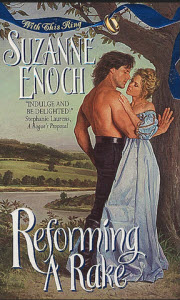
rake

Despite appearances to the contrary, the hero is not Kevin Sorbo of Hercules: The Legendary Journeys.

Lucien Balfour, a rake and some sort of noble, needs a social tutor/guide for his country cousin. He is impeded by both the cousin’s gauche behavior, and the young woman’s vulgar, grasping mother. He hires Alexandra Balfour, a genteel-y impoverished lady, to act as her governess; not because of sterling references or experience, but because he really wants to have sex with Alexandra, and he figures she can teach his cousin to be alluring to men as well and thus get the young woman off his hands and out of the house with alacrity. Lucien and Alexandra fall in love, he locks her in his basement (in a fun way) for reasons I cannot begin to remember, they get married, the end.

I feel behooved to mention that only in romance novels can a name like Lucien, or Sebastian, be ruggedly masculine, although, truth be told, I actually like the name Lucien. Not enough to burden a child with it, but certainly well enough to aggrandize a cat, if I weren’t violently allergic to them, which I am.

Meet Me at Midnight
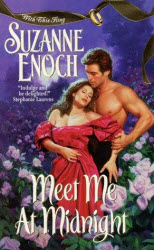
rake midnight

The woman’s 1987 prom dress appears to be sliding off her body.

I almost always like romance novels when they get married at the beginning. This is one of those.

Victoria Fontaine, nicknamed Vixen, is beautiful (Regency Elizabeth Taylor), bright, and vivacious. Tired of her “my eyes are up here” life, she’s a hoyden whose parents don’t know what to do with her; fortunately, she gets caught making out with her new acquaintance, Sinclair, Marquess Althorpe, at a party in Chapter One. Victoria’s parents know an out when they see one, so they insist these two gorgeous, sexy people marry right away.

Sinclair, nicknamed Sin, louche by all appearances, is the standard indolent-younger-son-who-was-never-supposed-to-inherit-and-now-has-to-make-good. Lucien (Kevin Sorbo up there) was in the same position. Sin has recently returned from a life of endless indulgence on the continent, but he was really a spy, of course. Victoria figures it all out pretty quickly and sets out to help him with the maguffin-y sub-plot.

Speaking of sub-plots, Vixen has a menagerie of animals that she brings to Sinclair’s house with her. Animals that, once again, are you listening romance novel authors?,cannot be house-trained. Plus there’s a parrot that repeats what was said during love scenes. It’s kind of charming, but also kind of COME ON! PARROTS DON’T LEARN PHRASES THAT QUICKLY!

Regardless of the bluebirds on her shoulder, Victoria and Sinclair are rather delightful together, and I enjoyed their jaunt to a happy ending. There were moments of genuine humour and Enoch did a good job at the falling in love narrative. I didn’t even mind their nicknames, Vixen and Sin, since they represent the personas they had hi— RECORD NEEDLE SCRATCH!

I just discovered that there is a third book in this series, A Matter of Scandal, and I scooped that sucker up on Amazon for $1.99 in 1.3 seconds flat. There will now be an indeterminate delay while I read the book and add it to this review.

[Muzac version of The Girl from Ipanema]

I’m about a third of the way through. So far, so good. Great banter, good chemistry. Funny.

Greydon Bsomething, Duke of Wycliffe is helping his uncle reorganize his finances and the first step was a huge and long overdue rent increase for all of his tenants. That’s endearing. The lovely redhead, Emma Grenville, who owns and runs the finishing school on the estate is displeased, to say the least, so she and the Duke enter into a wager to prevent the increase. She has to come up with a better plan than the Duke’s to fix his uncle’s finances. He has to teach a class at her school for some reason. Translation: They have to spend a lot of time together.

Wycliffe is gorgeous (natch), large (obvs), thinks all women are trying to ensnare him ( ’cause, you know, Duke), and is magnetically drawn (of course) to the bluestocking who doesn’t give a toss about any of it, except his dismissal of her school and efforts (natch).  Apparently,  the best way to improve someone’s opinion of women is to make him spend extended periods of time with a group of teenage girls. Has the author ever met a teenage girl?

Wycliffe is annoyingly arrogant so far. I’m hoping he’ll be taken down SEVERAL pegs.

[Muzak resumes]

There is a hilarious moment when Emma is giving Grey what for at a dinner party and his entire response is to silently wish everyone else would go away so he can enjoy her insults without interruption.

[Muzak transitions to We’ve Only Just Begun]

A Matter of Scandal
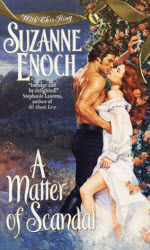
rake scandal

 Why is Clint Eastwood pushing her into that rose bush?

Well, that was Enoch’s best effort: very funny, great chemistry, a romp; and once again, it was lacking something I can’t quite put my finger on. Do the leads need to talk to each other more? Talk to each other differently? Is there only sexual chemistry and no intellectual connection and therefore although that part works, it doesn’t go deeper? Is it something about the intimacy? Blargh!

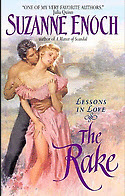
I discovered another book in the series, The Rake, but it’s $7.59 on Amazon, so this won’t be happening any time soon:

rake rake

Pity.

Also by Suzanne Enoch
The Rake (Tristan/Georgiana)
England’s Perfect Hero (Robert/Lucinda)
The Devil Wears Kilts  (Ranulf/Charlotte)

Links to my other reviews can be found on my complete reading list of books sorted by author or Author Commentary & The Tallies Shameful.