Category Archives: book review

The Affairs by Moonlight Trilogy: A Lady Never Lies, A Gentleman Never Tells, & A Duke Never Yields by Juliana Gray

Who else loves to see an autocratic hero brought down a peg? My newfound delight in Juliana Gray continues with the historical romance trilogy Affairs by Moonlight, including A Lady Never Lies, A Gentleman Never Tells, and A Duke Never Yields. If you read them in order, you have two books to wait before the aforementioned peg lowering and they are a really enjoyable ride.

The Set Up: It’s 1890. Three aristocratic/aristocrat adjacent English men rent a villa in Tuscany to escape Society, explore their individual interests, and study. Three aristocratic/aristocrat adjacent English women rent the same villa in Tuscany to escape Society, explore their individual interests, and study. Neither group had anticipated the other, nor are they pleased. They divide the house down the middle and everyone fails to stay in their prescribed area thus allowing hijinks to be fruitful and multiply.

A Lady Never Lies – Finn and Alexandra

The Duke of Olympia’s acknowledged bastard son and all around smart guy, Phineas Burke is retreating to Italy to work on his automobile in anticipation of a race in Rome later in the year. Society darling, and respectable widow, Lady Alexandra Morley is pretending to be taking a year to better herself, but in reality has fled London in hopes of sorting out her finances. Their story was engaging and blissfully free of complex machinations. There’s a villain, of course, and it takes Alexandra a while to come around, but Finn is lovely and that rarest of romance novel heroes, a redhead.

Extra appreciation to Gray for a story incorporating early automobiles. I’ve read a couple of books set in this era and they are always fun.

A Gentleman Never Tells – Roland and Lilibet

This was the first book I read from Affairs by Moonlight before going back to get A Lady Never Lies from my library and following it immediately with A Duke Never Yields. In A Gentleman Never Tells, the hero is a charming, espionage-y good guy masquerading as a wastrel caught in the trap of his own seeming indolence. If I had a romance novel nickel…

Roland and Lilibet fell in love six years ago, but he was forced to abandon the relationship. Lilibet was convinced to marry another man and did her best to love him. She has fled to Italy with her son to hide from her husband. Mr. Lilibet is an absolute bastard. So much so, in fact, that the rate at which matters escalate and their intensity when he enters the story is a bit of a shock when juxtaposed with the rather fun little maguffin. (Said horrendous individual will be the hero of the next book in Gray’s current series. Talk about given yourself a writing challenge.)  Roland’s heart practically Pepe-Le-Pews itself out of his chest around Lilibet. She has spent years finding what honour she can in her life, but has reached an impasse. Roland’s devotion crosses into “Really?” with some details, but their delight in each other is very sweet.

Gray’s heroes, particularly this one, say things like “Blast!”, “Dash it all,” and, “Right ho!”. My father, whom I always described as somewhat Edwardian, used these expressions his whole life. He used less savoury language as well, but even then he sounded formal.

A Duke Never Yields – Wallingford and Abigail

This was my favourite of three books, in spite of magic realism elements that were both a bit much and unnecessary. Interestingly, this subplot was minor enough in the first books that I didn’t really clue into what was being implied until I got to book three. There are ghosts and a curse. Sure.

The Duke of Wallingford is tall, autocratic, and “magnificently disagreeable”.  Free-spirited Abigail has selected him as her first lover. He fits very nicely into her year-long scheme of adventure and exploration. Abigail has vowed never to marry and voluntarily removed herself from Society so that she can do fun things like bet on horse races and travel. Wallingford is a perfect fit, except that he engineered the non-fraternization policy for the castle. What Abigail does not know is that he is a self-shaming slut and attempting to be a self-reforming rake as well. The goal of his year off is to make something of himself as a person and to stop putting the make on every woman he sees. Abigail simply sees an experienced man who will meet her needs, but once her emotions become involved, she sees that his previous behaviour shows a pattern that will be dangerous to her emotional well-being. There are a lot of *cough* busy heroes in romance. This is the second novel, the first being Any Duchess Will Do, wherein the hero realises that his conduct has been repellent. But it’s fun. No really, it’s fun. Abigail ties him in knots.

The reading order for the Affairs by Moonlight series isn’t crucial as the plots are contemporaneous rather than sequential, although A Duke Never Yields will be best read last. Juliana Gray is a really good writer whom I will continue to look for. I cannot imagine how complicated it was to interweave three stories so successfully, completely, and without unnecessary repetition. Reading the books so close together one can really see how the scenes are balanced. Well done.

Also by Juliana Gray:


A Princess in Hiding Trilogy
How to Tame Your Duke
How to Master Your Marquis
How to School Your Scoundrel 
The Duke of Olympia Meets His Match (novella)


Links to my other reviews can be found on my complete reading list of books sorted by author or Author Commentary & The Tallies Shameful.
A Princess in Hiding Series: How to Tame Your Duke & How to Master Your Marquis by Juliana Gray

New author! Juliana Gray is a very strong historical romance writer with a wonderful turn of phrase, a gift for simile, and great smolder. It is such an unexpected pleasure when a book randomly selected from the romance spinner at one’s library results in a new novelist to enjoy. I went back the next day, and the next, to get more of her books. Gray will be going on my woefully short good authors list and may well end up as an autobuy.

The “A Princess in Hiding” trilogy features three German aristocrats, Emilie, Stefanie, and Luisa, who have fled political unrest in their home country to arrive in London and the bosom of an uncle who has the least British-sounding aristocratic title in all of romance: the Duke of Olympia. A conniving old son of a bitch thoroughly experienced in shenanigans, he trains each woman and then sends her into hiding as a young man and, coincidentally, the story of what happens to each of them takes about 350 pages to tell.

How to Tame Your Duke – Ashland and Emilie

The Duke of Olympia arranges for Princess Emilie to be hired by the Duke of Ashland as a tutor for his teenaged son, the Marquess. Aristocracy is very thick on the ground in this series. In the wilds of Yorkshire, Emilie succeeds in her efforts to appear to be a bearded male despite my extremely serious misgivings about how convincing a fake beard would be up close on a day-to-day basis in 1889. Ashland  is big, battle-scarred, and several other Gothic things, but basically a very nice, very intense man. His Duchess decamped 12 years ago, so it is just he and his son in his palace on the moors which, sadly, is not also in the style of a Moorish palace. Emilie and Ashland fall in love, not while she is pretending to be a man, but while she is pretending to be a prostitute which is not quite as squicky as it sounds. All the truths come out, except the one about who is trying to harm the princesses, and this particular one weds her prince Duke.

I liked the characters in How to Train Your Duke, I even liked the young Marquess. Gray did not dwell overmuch in the machinations and subterfuge for which I was grateful. Emilie was a strong woman and determined not to be treated as the kind of pawn women often were in her situation. She takes what she wants.

How to Master Your Marquis – Hatherfield and Stefanie

Princess Stefanie ends up hiding in the home of a renowned criminal defense barrister (that’s going to come in handy later) who just happens to be the close friend of a man so good-looking that she refers to him as “The Archangel” in her head. James Lambton, Marquis of Hatherfield, is a glorious, beautiful, and charming man. Estranged from his parents, he spends a great deal of time at his friend’s home. His presence increases when he meets Stefanie and realises IMMEDIATELY that she is a woman dressed as a man and that she requires protection. I thought it a bit much that Ashland didn’t figure Emilie out sooner, so kudos to Gray on the logic of this twist. Unfortunately for Hatherfield, his friend’s house also contains one Lady Charlotte who is determined, and in league with Hatherfield’s parents, to land the Marquis. In a historically unrealistic, but modern applause worthy move, Hatherfield exploits the horror at his clearly inappropriate infatuation with the law clerk and lets everyone think he is gay and therefore relieve the marital pressure.

I was charmed by both of the main characters in How to Master Your Marquis; however, there was a plotting element involving sexual abuse that I did not like as it took me out of the fantasy realm these novels dwell in. It was not an exploitative or a particularly large element, but its very presence diminished the book for me. I have zero tolerance for subplots like these in romance. Caveat reader.

The last book in the trilogy, How to School Your Scoundrel, comes out in June and I will be looking for it at my library. In the meantime, I am reading another Gray trilogy, Affairs by Moonlight, and the titular rogue of How to School Your Scoundrel appears as the utter bastard of a villain in one of the books. It will be interesting to see how well Gray can reform such a reprehensible individual.

Great Details:

  1. The men are referred to almost exclusively by their titles, i.e. Ashland and Hatherfield, or their last names.
  2. Aristocrats have servants, lots of servants. It’s an uncomfortable period detail to those of us not enamored of inherited privilege, but an accurate one.
  3. Hatherfield is a rower. This explains his beautiful physique and provides a rare thing in romance: justifiable muscles.
  4. Stefanie and Emilie slept in the same bed growing up. What an excellent period detail.
  5. How to Master Your Marquis has a simultaneous flash forward plot that Gray dovetails extremely well with the present story line.

Also by Juliana Gray:

The Affairs by Moonlight Trilogy
A Lady Never Lies
A Gentleman Never Tells
A Duke Never Yields – most recommended of the three

A Princess in Hiding Series
How to Tame Your Duke
How to Master Your Marquis 
How to School Your Scoundrel 
The Duke of Olympia Meets His Match (novella)

Links to my other reviews can be found on my complete reading list of books sorted by author or Author Commentary & The Tallies Shameful.

Spindle Cove Series: A Week to Be Wicked by Tessa Dare

Road trip!

I first read A Week to Be Wicked about two years ago when I started devouring every historical romance I could get my hands on. It is a wonderful romp and an entertaining read. It hits on all of Tessa Dare’s best aspects as a writer:

  1. Smolder. Really, really, good smolder. Lisa Kleypas level smolder.
  2. Funny of the laugh out loud variety. Witty, too.
  3. Sincere emotion successfully balanced against the aforementioned humour.
  4. At least one hysterical turn of phrase describing a man’s specific firmness.
  5. Sincerely besotted heroes falling for wallflowers.
  6. Likeable, emphatically capable heroines.
  7. A strain on your willing suspension of disbelief which will almost always be worth it.               (Let us not speak of that time it wasn’t.)

Minerva Highwood and her family are living in remote Spindle Cove (coincidentally the name of this series) as her sister recovers from an illness. The ignored middle child, Minerva is bespectacled and bookish as opposed to her beautiful inside and out sister, Diana, and her precocious younger sibling, Charlotte. Sadly for Minerva, she is not quite ignored enough by her ambitious mother who never loses an opportunity to find Min inadequate in comparison with just about anyone. Minerva is a scientist at a time when such things were nigh on impossible for a woman, but the isolation of Spindle Cove affords her the opportunity to indulge her passion for geology. Minerva has found what the reader recognizes as evidence of prehistoric fauna and has been asked to present her findings to the Royal Geological Society in Edinburgh. There are only two problems a. they don’t know she’s a woman and b. getting there. Spindle Cove affords but one possible escort. One person whose magical combination of maleness and a lack of scruples will suit her purpose.

Colin Sandhurst, Lord Payne, is a well-intentioned, disillusioned rake. He is gorgeous, loquacious, and his best laid plans always go awry. Minerva approaches him with a promise of the money he will need to leave Spindle Cove and lounge in London until his inheritance kicks in. Being a rogue, Colin has some conditions for his company, the most interesting of which is that Minerva must sleep in his bed as he is an insomniac and prone to nightmares when he does get to sleep. A warm female body close to hand soothes him.

Feigning an elopement, Colin and Minerva head for Scotland and, as is the case with fictional road trips, whatever can go wrong, does, and the love-hate attraction they have always felt for each other chooses a side. A Regency romance with a vacillating grasp on reality, A Week to Be Wicked is tremendously entertaining and maintains a genuine sweetness despite the spiraling chain of events.

A complete summary of Tessa Dare’s catalogue, with recommendations, can be found here.

Links to my other reviews can be found on my complete reading list of books sorted by author or Author Commentary & The Tallies Shameful.

The Scandalous, Dissolute, No-Good Mr. Wright by Tessa Dare

The Scandalous, Dissolute, No-Good Mr. Wright is a gem. A delightful Regency romance pared down to its bare bones, this quick read is a perfect of example of what a novella can be and why I love them. There are no machinations, diversions, or distractions. Tessa Dare provides a witty, bright, engaging love story focused entirely on the winning main characters.

Owing to a pubescent scandal, Eliza Cade has been sentenced to wait to enter society until her older sisters are married. Hers is an adventurous spirit and Eliza is clamoring against the wait for her life to begin. Nonetheless, at the age of eighteen, she manages to encounter the scandalous, dissolute, no-good Mr. Harry Wright at a party when he has tucked himself away in a side room waiting for an assignation to begin. Harry takes to Eliza instantly and it is clear they are well matched, but she is too young and he too worldly for anything to come of their undeniable appeal for each other.

The novella proceeds to bounce through their subsequent encounters, some separated by a year or more, as Eliza matures and Harry tries to manage, and eventually succumbs to, his attraction to her. It is never once inappropriate or discomfiting. Rather, it progresses from “I recognize myself in you” and “you are such fun to talk to” towards deeper, mature feelings. The story is entertaining, consistently funny, and absolutely charming, plus it’s only $.99 for your e-reader.

A complete summary of Tessa Dare’s catalogue, with recommendations, can be found here.

Links to my other reviews can be found on my complete reading list of books sorted by author or Author Commentary & The Tallies Shameful.


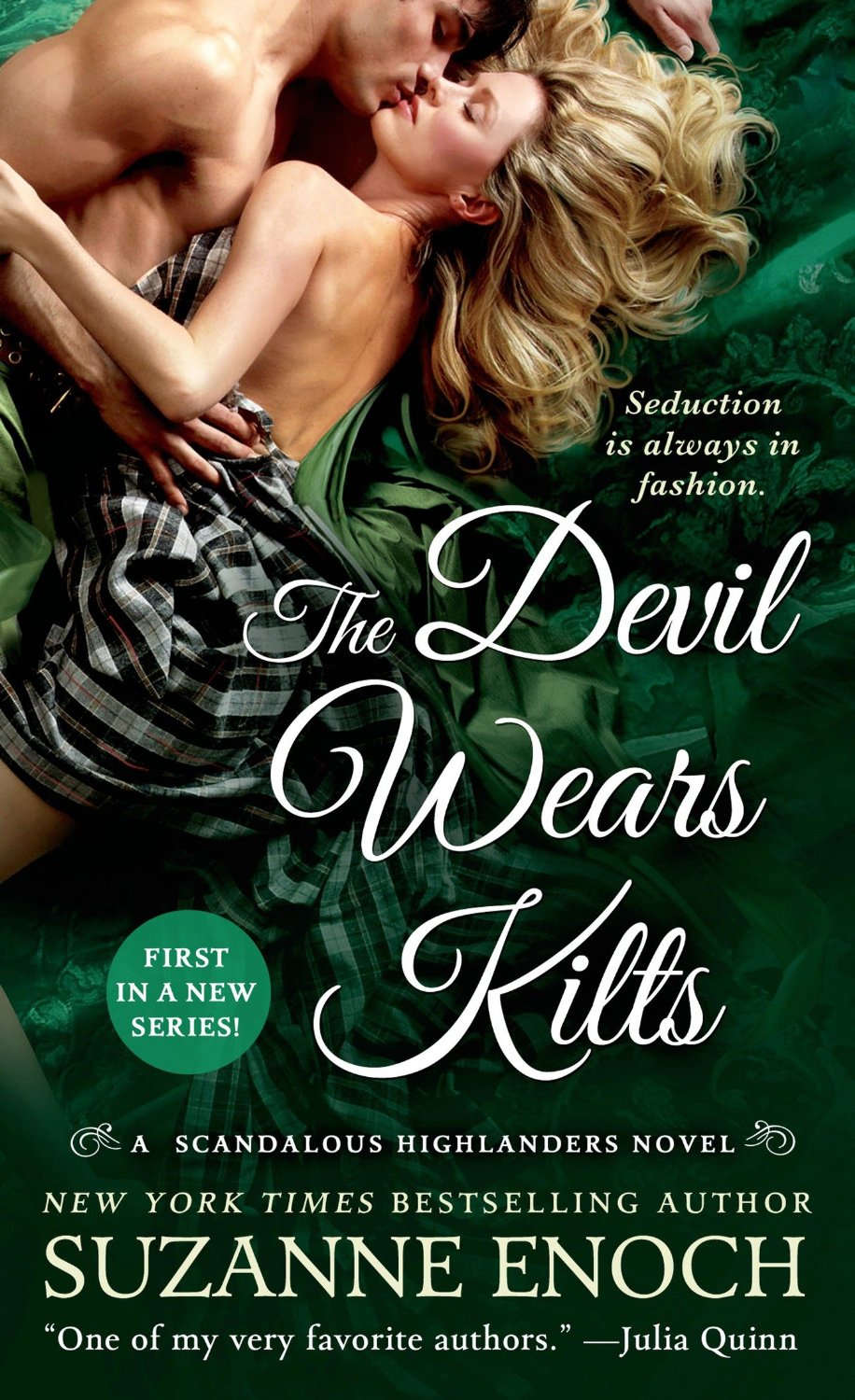
The Scandalous Highlanders Series: The Devil Wears Kilts by Suzanne Enoch

enochThere is an entire historical romance sub-genre based around Scottish Highland lairds and the tartans that love them. You can recognize the books instantly by the swathe of kilt and bare, muscular chest on the cover. I don’t read them because I get preoccupied with how cold everyone must be in Northern Scotland. Hitting on two genre quadrants, the new Scandalous Highlanders series from historical romance novelist Suzanne Enoch features members of a Scottish Highland family looking for love in Regency London. It’s kind of brilliant cross-marketing, really. The men are enormous, testosterrific, and entrenched in a kind of noble feudalism; the women are bright and steely Bennett-Dashwood-Elliots.

Rowena MacLawry of Glengask has fled her Highland home in hopes of having a London season. Her brother Ranulf, the Marquis, tracks her down at the home of their mother’s friend, Lady Hest. The Hests have two daughters, the older of whom, Charlotte, is our heroine. Ranulf and Charlotte clash in the standard “He’s a philistine!”, “She’s a busybody!” manner yet somehow manage to overcome their differences, indulge in sexual liaisons, and become betrothed. All this despite internecine clan warfare, English obnoxiousness, real estate purchases, morning rides, and a stable fire trying to distract them. The days are just packed.

The Devil Wears Kilts was fine, better than most and less than some. Suzanne Enoch is the tiptop of my romance B List. I read a lot of her work, but I avoid paying for it. I’d say I won’t bother to read more in this series, but who are we kidding? It will come to the library and I will bring it home with me. The books will be mostly enjoyable, but never quite enough somehow to lift them to the next level. I have inserted links to other Enoch books below and recommend the titles in bold.

With this Ring Series (fell swoop review)
Reforming a Rake
Meet Me at Midnight
A Matter of Scandal

Lessons in Love Series (fell swoop review)
The Rake
England’s Perfect Hero

Links to my other reviews can be found on my complete reading list of books sorted by author or Author Commentary & The Tallies Shameful.

Compromising Miss Tisdale by Jessica Jefferson

As Compromising Miss Tisdale is Jessica Jefferson’s only entry on Amazon, I am guessing she is a new author just getting started. Congratulations to her on an excellent first novel. Her website lists three upcoming publications which will feature the eponymous Miss Tisdale’s sisters. They are introduced in this first effort and sound like they will be fun.

The novel starts well with Ambrosia Tisdale beginning her fourth season in/on the market for a husband. There is nothing wrong with her other than a desire to marry someone who will please her family and, this is the hitch, for love. It’s a tall order. Duncan, Lord Bristol, is one of those younger sons who have found himself possessed of a title when his brother unexpectedly shuffled off this mortal coil. Duncan has just returned from a family imposed exile when the story opens. Ambrosia is instantly drawn to him even though she thinks he is all wrong for her. Duncan is attracted to Ambrosia, but also needs her excellent reputation and sizable dowry to help restore his family’s reputation and coffers. Duncan decides it would be most efficient to simply compromise Ambrosia. It’s dueling tropes with the reformation of a rake versus a marriage of convenience. They have great chemistry and make sense as a couple.

Compromising Miss Tisdale is a promising debut and overall the writing is very good and creates the appropriate historical illusion; unfortunately, it gets interrupted by distracting word choices, grammatical issues, and editing errors. I would like to offer Ms. Jefferson some advice: You need to either fire your current editor and/or hire one. If you are self-publishing, I imagine there comes a point when you can’t look at your manuscript for one more second. Find someone knowledgeable and honest who can review your work for you. Your novels will be the better for it.

I have some notes:

Continue reading

L’Amour et Chocolat Series: The Chocolate Heart by Laura Florand

To borrow from a previous review:

The Chocolate Heart is book five in Laura Florand’s Amour et Chocolat series. The conceit of each novel is that an American woman is thrown into close proximity with a French chocolatier/pastry god. They fall in love quickly, get busy, and are engaged in short order. Florand provides consistently enjoyable escapism with romantic locations. The Chocolate Heart is not best of the series, that’s The Chocolate Touch, but The Chocolate Heart was certainly an absorbing and mostly entertaining read.

Summer Corey has been told all her life that she is spoiled and ungrateful. Her parents see her as property to be picked up and dropped as they see fit. The latest gambit in their cycle of attention and neglect is to give her a 4 star hotel in Paris as a Christmas gift. Their goal is to lure her back from the South Pacific island where she has been living and working as a teacher in blissful self-imposed exile. Summer must stay in Paris for three months to gain another expensive gift that she actually wants, a communications satellite something-or-other, for the island residents. She hates Paris, the hotel business, and dessert.

Luc Leroi is the charming perfectionist, and practically perfect in every way, head pastry chef at the hotel Summer has been given. He is driven and has worked relentlessly to reach the top of his profession and stay there. He’s only 30, but since he started when he was 10, it seems reasonable. He is always gorgeous and most of the time he manages to be charming, but Summer completely flummoxes him.

The Chocolate Heart has the most challenging of any of the American woman/French culinary deity combinations in these books. Summer is sympathetic, but not always likeable, and Luc is a victim of his own self-restraint. They are two wounded people hiding behind false fronts and suffering from painful miscommunication. Elements that had been successful in the preceding books reached an intensity that left me uncomfortable. Luc is so busy being in control that he becomes almost clinical and Summer is so vulnerable that it feels like she is being used. It’s not romantic, so much as really unhealthy. Florand seems to realise this, too, as the book has a lengthy “several years later” epilogue to let the reader know that Luc and Summer are in a better, healthier place.

I do not recommend The Chocolate Heart, except maybe to visit favourite characters from other books in the group. This is the complete series for those who want to know with (order of preference):

  1. The Chocolate ThiefPretty good, it took me from 99 cents on Kindle to the complete series. (5)
  2. The Chocolate KissA very good fairy tale that made me forgive the metaphor. (2)
  3. The Chocolate RoseExcellent passion, it needed just a little more love story. (3)
  4. The Chocolate TouchMy favourite of the group, it was really sweet and intense. (1)
  5. The Chocolate Heart – The weakest of the group. (6)
  6. The Chocolate Temptation – Steamy, not quite as good, but still very readable. (4)

A complete summary of Laura Florand’s catalogue, with recommendations, can be found here.

Links to my other reviews can be found on my complete reading list of books sorted by author or Author Commentary & The Tallies Shameful.

Nothing to Commend Her by Jo Barrett

If Pride and Prejudice is the ultimate You Are Everything I Never Knew I Always Wanted romance, Daphne du Maurier’s Rebecca is the perfect illustration of what the romancerati refer to as The Big Misunderstanding. If at some point during their courtship or honeymoon, Maxim de Winter had managed to blurt out, “My wife was a vain, inconstant shrew and I loathed her, you little fool”, everyone would have been spared a lot of agita. Nothing to Commend Her has two Maxims and two The Second Mrs. de Winters. Both keeping secrets, both refusing to have basic conversations or ask simple questions that would clear everything up.

I wrote the preceding paragraph before I finished Nothing to Commend Her. I was taking a break from rolling my eyes and groaning. I often get review ideas while reading the book, such as a romance review template, and this time I planned one around the following elements:

  1. I got this book for free on Amazon.
  2. Jo Barrett is a new author because they often give books away to appeal to new readers. This was how I found this gem from Caroline Linden.
  3. As Barrett is a new author, I would write a constructive criticism review of her book with helpful hints for Ms. Barrett and her editor. I did that before with Shana Galen and Anya Wylde.
  4. I was going to be nice about it.

Then it turned out that Jo Barrett has published over thirty romances, both historical and contemporary, and now I can’t really see the use in pointing things out. She’s clearly making a living, so I’m just going to do this:

Continue reading

The Wicked Wallflower by Maya Rodale

Author Maya Rodale, who has previously inspired me to write a lengthy defense of romance novels, is currently balancing two series. The contemporary group (Billionaire Bad Boys) features a character who is writing her first historical romance. The Wicked Wallflower, from the historical group, is that romance. I purchased The Bad Boy Billionaire’s Wicked Arrangement for the low, low price of 99 cents on my Kindle thinking it was a novella when it was actually just an installment in the novel. It made for interesting reading as I kept projecting that story onto to this one.

In The Wicked Wallflower, Emma and her friends have become famous wallflowers. Despite that seeming oxymoron, the members of a gentleman’s club, White’s (it’s always White’s in a Regency romance), have labeled them “The Ladies Least Likely”. Lady Emma Avery is the least likely to misbehave and that is fine with her. What is not acceptable is that she and Benedict have been in love  for three years, but owing to financial considerations, they are not married or even engaged. In a tipsy lapse of judgment, Emma’s friends decide to end her suffering and write a false betrothal announcement for Emma and the most eligible man in town: Blake, Duke of Ashbrooke. Contretemps lead to the declaration being published in the newspaper.

Surprised, but seeing an opportunity, Blake decides to play along with the ruse as he needs someone just like Emma, or “Emily” as he calls her, to improve his reputation. In between his carousing and debauchery, the gorgeous Duke is working on an invention for which he needs funding. An obscene amount really, £50,000, for a calculating machine/primitive computer along the lines of what Charles Babbage proposed in the early part of the 19th century. (I don’t know stuff like that off the top of my head, Rodale explained it in an end note).  Conveniently, Blake has an Aunt Croesus who holds an annual competition to be made her sole heir. Blake convinces Emma to crash the contest with him thus throwing them into constant contact. The rake and the wallflower embark on an engagement of convenience.

The book was fine and passed the time pleasantly enough, but it didn’t have quite a enough energy or snap for me. More importantly, I was distracted by some of the pseudo-historical details, or lack thereof. If one wants a historical document, there’s always Jane Austen, but in romances published now a fine balance has to be struck between combining modern mores and viewpoints with the verisimilitude that’s required. The Wicked Wallflower took me out of its artificial reality too many times. There were lots of little details that irked, such as Blake and Emma traveling unchaperoned in a carriage; bare hands that I’m pretty sure would have been wearing gloves (it was a ball);  Emma’s mother planning a wedding to take place within a week despite a need to settle the marriage contract (mentioned in passing) and either calling the banns (three weeks in a row in church), or to get a special license (not mentioned). They can’t just get married. It’s not Las Vegas. There was anachronistic language usage as well, both “totally” and “epic” made appearances. I’ll skip the virgin to adventurous acts in the blink of an eye factor. Admittedly, I am using Wikipedia as my source of information,

cavill wikipedia cavill wikipedia

but the complaints are still valid and details like this are what separate the historical romance A list from the B list. They are also, within this genre, common knowledge. Also admittedly, if the writing had a little more smolder and crackle, none of it would have mattered.

Links to my other reviews can be found on my complete reading list of books sorted by author or Author Commentary & The Tallies Shameful.

Castles Ever After Series: Romancing the Duke by Tessa Dare

[stunned silence followed by vociferous string of profanity-laden expostulations]

That was a change of pace. Well-written. It seems historical romance author Tessa Dare is going in a new direction, one more whimsiquirkilicious than I had anticipated. I have never given my Kindle the side-eye before. And I did, in fact, resist the temptation to throw it across the room. That counts as a victory. And that was certainly the most expletives I have ever let loose while reading a love story. A lot of new things today, it seems.

[cleansing breaths]
[re-reading most of the book]

“I believe there are two ways of writing novels. One is making a sort of musical comedy without music and ignoring real life altogether; the other is going deep down into life and not caring a damn,” said P.G. Wodehouse, giving a surprisingly apt posthumous description of Romancing the Duke.

Delightful historical romance author Tessa Dare has abandoned the ladies of Spindle Cove and embarked on a new series called “Castles Ever After”. As the name suggests, this new novel has a fairy tale undertone/overtone, not to mention many clever references to classics of the romance genre. Dare writes incredibly consistent and enjoyable stories, but of all the authors whose work I buy automatically, Dare is the one who most often requires a willing suspension of disbelief. Romancing the Duke broke mine, Dare BROKE IT, with this playful and quirky novel.

Doubt not that Tessa Dare’s tongue was firmly planted in her cheek: Isolde Ophelia Goodnight’s father not only saddled her with a tragedy-in-waiting name, he left her penniless and alone. Summoned to Gostley Castle in hopes of claiming a bequest from an anonymous benefactor, she instead encounters a derelict estate and its equally derelict ducal inhabitant, Ransom, Duke of Rothbury, who will serve as the tortured hero for the purposes of the story. He’s as big, brooding, and gorgeous as one looks for in such characters. Ransom is just sitting around waiting for the redemptive power of love to bring him back into the world. It’s a good start.

The ermine was a bad sign. Izzy has a pet ermine which, in her defense, was a gift from a fan of her father’s serialized medieval fairy tale. She brings it with her to the castle and they both stay when she discovers that the estate has been bequeathed to her. This comes as quite a shock to Ransom as he did not know the castle had been either a) up for sale or b) sold. His recent blindness has left him a little behind in his correspondence. Things should have proceeded apace from there, but the hijinks, DEAR LORD, the hijinks that ensued.

I had not anticipated costume play or live action role-playing in a Regency romance. I daresay few have. I daresay I’m not even sure it was a Regency romance. It was more of a historically-indeterminate homage to a Gothic novel: the truculent hero; the crumbling castle; the bright-eyed and bushy-tailed destitute heroine; things that go bump in the night; sexual tension; aggressive carnivorous pets; plot elements that are picked up and dropped; inexplicable character shifts; and the almost successful interplay of the love story and whimsy. It was all so cute, I cringed. I wanted a love story, not a Duke getting his LARP on.

I’m not sure who exactly this novel was written for. The short answer is, “Not me.” I get it. It’s not you, Romancing the Duke, it’s me. I was expecting a heartfelt love story with some of Dare’s trademark caprice and smolder, but instead the novel is a romp with an emphatic lack of connection to reality instead of the veneer-of-plausible-deniability connection to reality I look for in romances. It was not what I expected and it was not, like Ransom’s feelings for Izzy, everything I never knew I always wanted.

My partner-in-romance, Malin, loved the book. Check out her review for a different take on Romancing the Duke.

A complete summary of Tessa Dare’s catalogue, with recommendations, can be found here.

Links to my other reviews can be found on my complete reading list of books sorted by author or Author Commentary & The Tallies Shameful.