Category Archives: book review

The Brothers Sinister Series: The Governess Affair and The Duchess War by Courtney Milan

As The Governess Affair and The Duchess War are Victorian romances by Courtney Milan, you can simply assume that, after providing the standard review content, I am going to encourage you to read them and virtually everything else she has published. Thematically, her stories focus on the questions of identity: Who are you? Who does society say you are? Who do you want to be? Romance tropes are flipped or shaken and Milan crafts lovely and heartfelt stories. Moreover, they contain social commentary and an unusually honest view of  the era they depict, as well as of modern mores. Courtney Milan is amazing like that. She is the best romance writer currently publishing and quickly becoming one of the all-time greats in the genre.

The Governess Affair

Setting up the Brothers Sinister series, The Governess Affair is about the coming together of Serena Barton and Hugo Marshall. She was assaulted by her former, and his current, employer, the Duke of Clermont. Serena is staging a sit in on a bench outside of the Duke’s London residence insisting on reparations in the form of financial support for herself and the Duke’s unborn child. Tasked with removing this inconvenience is the Duke’s man of business, Hugo Marshall. They quickly discover that in any other circumstance, they would be rushing to a vicar. Because of the complications of Hugo’s employment and Serena’s pregnancy, their union faces stumbling blocks before it can begin. Serena has already decided who she wants to be and what she is willing to do to become that person. Hugo takes a little longer, but gets to where he needs to be as well.

Story threads beyond Serena and Hugh’s sweet relationship are created in The Governess Affair. What is a triumph for the protagonists has repercussions for both Oliver, their son, and his brother, Robert, the next Duke of Clermont. He just happens to be the hero of the next book in the series.

The Duchess War

Not only has Minerva Lane been told who she is, she has participated in her own belittlement. A lioness terrified of her yearning to roar, her tightly laced corset is the perfect metaphor for the compression of her spirit. When she encounters Robert Blaisdale, Duke of Clermont, at a social event, he witnesses her frustration and gets a glimpse of the formidable woman she hides. Thrown together repeatedly by their political interests and Robert’s fascination, he and Minnie find their way towards each other as much as they do into themselves. He is a Duke with no use for the peerage, she is a woman fighting for security on her own terms, and neither can resist the challenge the other one represents. The limitations imposed on and accepted by Milan’s characters are front and center for Robert and Minnie. They both want so much and are so afraid, often very reasonably, to reach and fail that they both have to find ways to stand up and together.

Both of The Governess Affair and The Duchess War are fantastic and I encourage you to read them and virtually everything else Courtney Milan has published. Minnie’s best friend, Lydia, is featured in the wonderful novella, A Kiss for Midwinter, that follows immediately on the heels of the latter novel. The Duchess War is a great romance, A Kiss for Midwinter is a classic of the genre and one of my top five romances of all time.

A complete summary of Courtney Milan’s catalogue, with recommendations, can be found here.

Links to my other reviews can be found on my complete reading list of books sorted by author or Author Commentary & The Tallies Shameful.
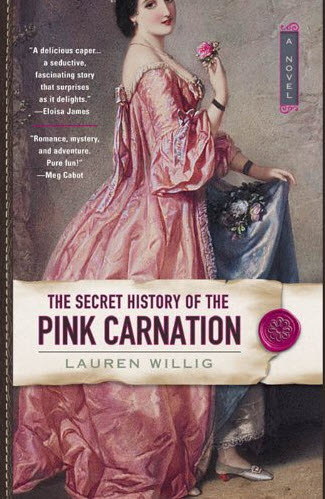
 

The Secret History Pink Carnation by Lauren Willig

carnation

The Secret History Pink Carnation is the first book of eleven (so far) in Lauren Willig’s Georgian historical romance series of the same name. Each novel has a framing device featuring a PhD student combing through nineteenth century documents for her thesis research on aristocratic spies and the relation of what she finds as a romantic adventure story. Willig’s writing is light and clever and The Secret History Pink Carnation had a kind of breezy musical comedy tone. It bounced along as a charmingly written and pleasant romp with just a little peril for the protagonists to keep things interesting.

Amy is a displaced French aristocrat who escaped with her English mother to Shropshire on the eve of the Revolution. Her father lost his head to Mme. Guillotine and her brother, Edouard, claimed his safety by becoming a toady to the new regime. Amy has had schemes and stratagems for restoring the old order to France for years, so when her brother invites her to return to Paris, she feels that she will at last have her chance to make good on all her espionage practice. On her way to France, she meets up with Napoleon’s Egyptologist Richard Selwick. Feigning indifference to politics, he uses his position at Court to glean information and carry out deeds of daring do a la Scarlet Pimpernel and thus thumb his nose at the French government.

Amy and Richard spark and spar instantly in delightful bits of comedy. He finds himself irresistibly drawn to Amy even as he desperately tries to keep her safe, defuse her impetuous machinations, and get to the business of foiling Napoleon’s plot to invade England. Things move along nicely with enough twists, jeopardy, and romance to keep things interesting.

The framing device sets up a love story as well that is tracked through the other Pink Carnation books as that relationship develops. Even as the spy stories move farther afield geographically and chronologically, the present day heroine’s life moves forward just a few months. Such is my devotion to romantic subplots that I took three Pink Carnation books out of the library and while I didn’t read beyond the first one, I did go ahead and peruse the present day chapters of the other two books to check on that love story’s progress. I’m reasonably certain those two crazy kids will be able to work things out in the long run.

The Secret History Pink Carnation was very entertaining, well-researched, and a great choice if you like a bit of farce in your romance. It was not, as my romance spirit guide, Malin, warned me, my style as it was both just a bit too devil-may-care on the political elements and insufficient on the romance for my tastes. The key part of that last sentence is “for my tastes”. I like to focus on the love story in any romance I read so subplots are often wasted on me. Spies, in particular, leave me cold. I also have no use for political intrigue. Nor murder mysteries. Supernatural elements annoy me. Road trips are fine. Is someone writing these down? Honestly, there is no pleasing me.

Also by Lauren Willig – The Seduction of the Crimson Rose

Links to my other reviews can be found on my complete reading list of books sorted by author or Author Commentary & The Tallies Shameful.

Written on Your Skin by Meredith Duran

He had made jokes for himself, expecting no one else to catch them,
and indeed no one else had.” (103) Yep.

While as well-written as all of Duran’s Victorian romances, Written on Your Skin never really captured my interest and wasn’t my cup of tea, although it did have some great moments. To find out if it might be your cup of tea, please read on.

Phin is a spy working for Her Majesty’s government in Hong Kong. Poisoned at a party, he finds help in the surprising form of Mina Masters. A beautiful flibbertigibbet to whom he is attracted against his better judgement, she surprises him by saving his life and helping him escape. Four years later, Phin’s inheritance of an earldom has allowed him to leave the service and he is flailing against himself and his past with a controlled, narcotic enhanced stupor. Mina re-enters his world when she calls in the debt owed for his life. Together, they are trying to track down her missing mother, but Mina is a complicated woman hiding behind as many masks as he is. Phin, for his part, is also trying to keep Mina safe by limiting her participation and, very much against her wishes, her appearances in public.

Trust is the through-line in Duran’s work and Written on Your Skin is no different. Both Phin and Mina have life experiences that have driven them to create false fronts for the world. He simply doesn’t know what to do with himself or how to act naturally around his old friends, in particular the louche set he used to run with. Mina has learned to play dumb, coquette, bohemian, or whatever it takes to protect herself and control her circumstances. Each has fought battles to get where they are. Magnetically drawn to each other, they have to break through all of their posturing and self-protection. How do they trust each other? Can they trust themselves?

The quality of the writing is consistent with the rest of Duran’s books, I just don’t really enjoy a lot of MacGuffin-y machinations. I’m not sure if the book had too many, or if it just felt that way because I was never really that engrossed by the story. It’s probably the latter.

Also by Meredith Duran:

Rules for Reckless Series (not entirely interconnected, more of a theme)
That Scandalous Summer – very good
Your Wicked Heart – delightful novella
Fool Me Twice – excellent
Lady Be Good – nothing special
Luck Be a Lady

Not Rules for the Reckless Series
Bound by Your Touch – excellent
Written on Your Skin – not my style, but very good

Links to my other reviews can be found on my complete reading list of books sorted by author or Author Commentary & The Tallies Shameful.

Longbourn by Jo Baker

Longbourn by Jo Baker is proof that new work based in an homage can be so much more than the wish-fulfillment and bizarre tangents of fan fiction. A lot of literature provides alternate perspectives of a known works and Baker took Pride and Prejudice, a novel known so well by so many, and used it as a starting point for an interesting and compelling new story. The Bennets and their love lives are the MacGuffin to hang the narrative upon, but what Baker shows the reader goes well beyond the original story. Lizzie and Jane make good matches, Lydia makes an imprudent one, but while their worst potential fate is to be a beholden maiden aunt or living in genteel poverty, what of the lives of their servants and the working poor who surround them and indeed live at Longbourn with them?

Sarah was orphaned at a young age and soon taken in at Longbourn manor where she trained as a servant, slowly taking on heavier and more complex duties. Now twenty, she has worked with the Hills and for the Bennets for most of her life. Her counterpart, Polly, has followed the same road, starting in service at six (!), she is now twelve and has the foibles of a child her age. James Smith has just been brought into the home as a footman. Sarah is fascinated by him immediately, but mostly as a mystery to be solved. He is hardworking and considerate, but aloof as well. He keeps his head down and, especially regarding Sarah, his eyes forward. He had been “on the tramp” before securing this position and wants nothing to do with anything but the basic comforts of life he has long been denied. The inner battle between the desire to belong and be safe versus asserting one’s true self is central to the book. Both James and Sarah, and everyone else of their class, have lives of little choice and precarious security, even when they reach for new experiences.

Writing about the 19th century below stairs gives Baker the chance for a more varied take on the comedy of manners Austen wrote. Familiar Pride and Prejudice characters are given back stories and complications that feel reasonable.  When shown from the servants’ perspective some characters become more sympathetic, some less so. Wickham in particular is given greater depth and none of it good. Mr. Darcy appears briefly in the story as a man of such exalted personage that his presence is like a god descending from Olympus and one comparably unconcerned with the mere mortals around him. The chasm between his life of Sarah’s could not be much wider and I loved seeing him through her eyes.

The historical detail of Longbourn is what made it most enjoyable for me, although the realistic recounting of James’ military service was harrowing as well. I read a lot of books about people falling in love set against variably dubious historical backdrops and I can be pretentiously captious about whatever detail the author decides to include. Here the historical elements are crucial because without them you cannot understand who the characters are. Their jobs are a large portion of their identity, the system that holds them in place was designed that way. A warm bed and steady meals are considered a luxury that they should be grateful for.The limitations and injustices of the class system are ferocious and depressing, yet Sarah and James strive for their own happiness as best they can against the mundane drudgery and quiet desperation.

Links to my other reviews can be found on my complete reading list of books sorted by author or Author Commentary & The Tallies Shameful.

Dreaming of You by Lisa Kleypas

I keep mentioning Dreaming of You in other reviews and it is on my overall recommendations list, so it seemed time to reread it and include it here. A classic of the genre originally published in 1994, Dreaming of You is part of the historical romance canon, if such a thing exists. It’s splendid, slightly dated, and Derek Craven is one of the greatest men in the genre. Complicated, brilliant, and intense, he is the supreme up-from-the-gutter hero. He would and did do almost anything he needed to survive and prosper. His heroine is pretty spectacular as well. The reader meets her when thugs are attacking Derek and she shoots one of them in the face.

Seemingly shy and demure, Sara Fielding writes about the underbelly of Victorian London. Her novel about a prostitute named Matilda was a great success and helps earn her the access she needs for her work on the gambling dens that straddle the worlds of the poor and the elite. Saving Derek’s life gains her permission to visit his luxurious gaming establishment for research as long as she stays out of his way. She doesn’t. She is brave, kind, and quietly relentless in both her literary pursuits and in encouraging Derek to allow himself to share his life with her. In coming together, neither one in any way compromises who they are, rather they are able to come more fully into themselves and fit together.

Dreaming of You has everything: a tortured hero; the reformation of a rake; opposites attracting; a wallflower who becomes a victim of circumstance; self-made characters defying society to enter its upper echelons; and an absolute bitch of a villain. Kleypas is able to balance it, ALL OF IT, because of the sincere love story and her, as always, exceptional smolder. I don’t care if elements are dated, I adore the love story and cannot endorse the novel highly enough.

Dreaming of You has a follow-up novella called Against the Odds which is mostly about Derek and Sara’s daughter, but let’s be honest, one only reads it for a chance to revisit two favourite characters. It does not disappoint.

A complete summary of Lisa Kleypas’s catalogue, with recommendations, can be found here.

Links to my other reviews can be found on my complete reading list of books sorted by author or Author Commentary & The Tallies Shameful.


Bound By Your Touch by Meredith Duran

This book is great. You should read it. Details below.

Featuring a delicious rake who needs to get his act together and a bright spinster who needs to set herself free, Meredith Duran’s Bound by Your Touch is a Victorian romance with an Egyptology maguffin and themes of disentangling oneself from unhealthy relationships and a thinking person’s feminism which emphasizes the importance of giving women responsibility for their choices as a component of true equality. All of this is supported by clever writing, appealing leads, and a believable romance.

Lydia Boyce is her family’s designated grown up. She has two sisters, one of whom is an endless pill, and an absentee father. Devoted to his pursuits in archeology, he has convinced Lydia that her role as his representative and protector is more important than her own personal and emotional interests. When a counterfeit item ostensibly from her father is delivered to the rake in question, Viscount Sanborne, hijinks ensue that lead to many interesting places in terms of both story and for the characters’ emotional growth.

Romance novels are full of constrained and plain women who are overlooked by those around them. What I liked about Lydia is that although she is aware of her so-called failings when compared to her more demure and pretty counterparts, she nonetheless does not try to change herself into something she is not. Moreover, and I loved this detail, what Lydia does not and cannot know is that she is sexually attractive to the men around her. It is not a woman’s responsibility to be appealing, but it is nice to have a fiercely intelligent heroine who is unaware of the effect she has on men.

Sanborne is likewise complicated. He is a charming and gorgeous, but also a drifting, gormless scapegrace who has been coasting along with a very fast set buoyed by his own unassailability and enmity for his father. He needs to grow up and find a way to deal with his demons. Lydia is a seemingly odd match for him, but like most people, Sanborne has unsuspected depths he finally allows himself to look into as he becomes the partner she needs.

Meredith Duran is a fantastic writer who successfully balances entertaining, sincere romance with genuine and complicated characters. Her books are great. You should read them.

Also by Meredith Duran:

Rules for Reckless Series (not entirely interconnected, more of a theme)
That Scandalous Summer – very good
Your Wicked Heart – delightful novella
Fool Me Twice – excellent
Lady Be Good – nothing special
Luck Be a Lady

Not Rules for the Reckless Series
Bound by Your Touch – excellent
Written on Your Skin – not my style, but very good

Links to my other reviews can be found on my complete reading list of books sorted by author or Author Commentary & The Tallies Shameful.

A Princess in Hiding Series: How to School Your Scoundrel by Juliana Gray

The last novel in Juliana Gray’s “A Princess in Hiding” Victorian romance series, How to School Your Scoundrel features a challenging hero and a remarkably self-possessed and capable heroine. Luisa is the eldest and last hidden princess. Like her sisters Emilie and Stefanie, she fled her country after her father, the Crown Prince, was murdered in a coup. Luisa’s husband was killed as well. Secreted away by a first-rate manipulator and conniving bastard, their uncle, the sisters were trained to masquerade as men and then sent to work in disguise for conveniently marriageable protectors. Particularly deft with plotting, Juliana Gray has cleverly intersected and overlapped Emile, Stefanie, and Luisa’s stories. With her sisters safe, it is time to learn how Luisa will be returned to power in her homeland and just happen to find a suitable Consort along the way. Her position as the secretary for the Earl of Somerton is a good start. The villain of book two in Gray’s  “Affairs by Moonlight” series, A Gentleman Never Tells, Somerton is an almost entirely irredeemable character. To become a decent human being, Somerton’s heart will need to grow three sizes and the leaden lump of his soul be alchemized into gold. Gray manages two sizes and some silver.

The challenge of Somerton’s redemption is that so much of his behaviour is that of a classic bully. Profoundly resentful of his wife Elizabeth’s lack of affection for him and the serene mien she is able to nonetheless affect, he is torn between seeking to control her and not knowing how to let go. Elizabeth’s side of the marriage was shown in A Gentleman Never Tells. It was compelling and heartbreaking. The reader may be seeing the other side of the coin in How to School Your Scoundrel, but Somerton is still a jealous, manipulative, overbearing son of a bitch. The suggestion that he would change in a new relationship was not enough for me. There is a moment late in the book when Luisa and Elizabeth are alone and Luisa tells her that she never gave Somerton a fair shake: “Yes, he can be brutal. But he also has the capacity for great devotion. And you never knew. You never gave him a chance, did you? You never opened your heart to him.” I see, so the stalking and paranoia are his wife’s fault, are they? If it was just that Somerton was heartbroken at his wife’s lack of feeling for him, it would be sympathetic; however, he is jealous and obsessed with her imagined infidelity. He has her followed, investigated, and isolated. He rejects their child. Elizabeth did her best to live honourably in an untenable situation while her husband hounded her by day and whored by night. Part of the point of marrying into ruling a country is that he will be strong and betimes ruthless which he certainly is, but the novel did not have time to transform him into a reasonable human being as well.

Another issue I had with the story was whether or not I wanted to read a book about a dictator, whatever the suggestion of benevolence in counterpoint to the dastardly revolutionaries, being returned to power, especially when the novels are set in 1889 and said autocrats are leaders of a German principality. I err on the side of democracy and just because the country was being turned into a different kind of dictatorship did not suggest to me that what the citizens needed was a return to the status quo.

How to School Your Scoundrel was well-written and Gray almost pulled off a huge character transformation. I’m sure Somerton’s brute with a heart of gold will appeal to some readers, but I am not one of them. Still, you should give Gray a try. She has six books out and this is the only one I wouldn’t recommend. I particularly liked Stefanie’s book, How to Master Your Marquis from this series and  A Duke Never Yields from the “Affairs by Moonlight” trilogy which has a lighter tone over all.

Also by Juliana Gray:

The Affairs by Moonlight Trilogy
A Lady Never Lies
A Gentleman Never Tells
A Duke Never Yields – most recommended of the three

A Princess in Hiding Series
How to Tame Your Duke
How to Master Your Marquis – most recommended of the three
How to School Your Scoundrel – see above
The Duke of Olympia Meets His Match (novella)

Links to my other reviews can be found on my complete reading list of books sorted by author or Author Commentary & The Tallies Shameful.

London’s Greatest Lovers Series: Passions of a Wicked Earl by Lorraine Heath

Spoiler: The dog dies.

It sets a certain tone when a historical romance opens with the hero going at it with his mistress. The series is called “London’s Greatest Lovers”, after all. Like the heroes of the other two books in the trilogy, Pleasures of a Notorious Gentleman and Waking Up with the Duke, as well as a couple of other Lorraine Heath heroes, the gentleman in question has an enchanted phallus and hard-earned prowess in slipping it to women. The kind of mad skillz that render the heroine’s shyness and inexperience moot and has prostitutes refusing payment. Lorraine Heath is old school.

In the biggest of Big Misunderstandings, the Earl of Westcliffe separated from his wife, Claire, on their wedding night when he discovered her in bed with his brother, Stephen. NOTHING HAPPENED! and it was a ruse to delay the consummation devoutly to be avoided, but Westcliffe took it very, very badly, beat the stuffing out of his brother, and exiled his wife.

Claire had just turned 17 and Westcliffe was 25 when they married. I don’t think delaying to relationship for a few years was a consideration in de-squicking the plot, but I am grateful for it nonetheless. Claire and Westcliffe had been contractually betrothed to each other virtually since her birth. Westcliffe really needed Claire’s dowry and her abusive father wanted her out of the house ASAP. The groom is an intense and overbearing man who made no effort to get to know his (child) bride. Claire was terrified, but the wedding night bait and switch was all Stephen’s idea. Close friends from childhood, he and Claire were young, drunk, and stupid. Getting caught in bed together was the best delaying tactic the champagne could come up with.

Three years later, Claire has decided it’s time to be married in truth as well as in exile. She has been living in isolation at Westcliffe’s familial seat lovingly restoring and running the place, because if there is one thing sheltered and inexperienced 17 year olds are good at, it’s interior design and/or estate management. Claire shows up on Westcliffe’s doorstep, he treats her in a humiliating fashion that nonetheless arouses her, and she makes her case. Claire would like to give her sister a London Season to save her from marrying an old coot. Westcliffe consents. Helped significantly by the aforementioned canine demise, their marriage of convenience transforms into one of genuine affection. A bunch of unnecessary machinations and a head-shaving interrupt the merry denouement, but the happily ever after is eventually achieved.

I have one more Lorraine Heath novel on hold through my library and then I will have read a large portion of her catalogue. Her writing is entertaining and she can give good smolder, but there is nothing that elevates her books from the B-list to the A-list; moreover, she often has elements that are too much of a throwback for books published within the last ten years and they disrupt my really very willing suspension of disbelief.

Also by Lorraine Heath:

Continue reading

Written in My Own Heart’s Blood by Diana Gabaldon

Written in My Own Heart’s Blood, book eight in Diana Gabaldon historical epic Outlander series,  picks up exactly where the last book, An Echo in the Bone, left off. It could be read as a standalone novel, but why would you want to do that? Gabaldon belongs to that rarefied group of authors who create an entire world and tell a story that takes thousands of pages to unfold. Such authors’ works need to be devoured and savoured in their entirety to achieve their full effect.

Written in My Own Heart’s Blood  was a particularly enjoyable entry in the series and (mostly) moved along quickly. The story is rich in detail and often harrowing. I made many interesting happy and unhappy noises while reading. If you are already reading the novels, you won’t need a plot summary, although Gabaldon is remarkably adept at thumbnail sketches of where things stand, and if you haven’t read the books, you really should go back and start at book one. You will either love it or give up quickly. Despite my disclaimer, here is a brief recap of Written in My Own Heart’s Blood: Claire and Jamie Fraser and their extended family are living in Philadelphia at the beginning of the American Revolutionary War. They are drawn into the fight and participate in historical events. In Scotland, their daughter and son-in-law, Bree and Roger, are dealing with complications in their own lives.

The Outlander books are wonderfully entertaining and fascinating works of historical fiction. Gabaldon excels at drawing vivid characters and at incorporating what must be years of research into her characters’ lives. I revel in all of the historical details, including the genuine political events of the time, and, particularly, the practical considerations of their daily existences and Claire’s work as a physician. There is so much I love about this series, not least of which is that, by this point, the main character is a 60 year old woman. There may be eight point of view characters, but these books are Claire’s story and I love every kind, no-nonsense, resolute inch of her character. Her husband, Jamie, who will “ruin you for all other fictional men”, is by her side and an ideal partner for Claire.

Series book lists after the jump:

Continue reading

London’s Greatest Lovers Series: Pleasures of a Notorious Gentleman by Lorraine Heath

It’s 1858, Mercy Dawson and her bastard son have been brought to the family home of Stephen Lyons. Appalled by her conduct, her father abandons her there. Thinking Stephen dead, Mercy is hoping that in bringing his son to his aristocratic family, they will let her stay on as nanny. She just wants to be with her child, but quickly learns that Stephen is very much alive and in rough shape. Pleasures of a Notorious Gentleman follows the development of their relationship and the marriage of convenience that ensues. Everyone is lying, so it’s a little complicated.

Stephen and Mercy each spent two years in the Crimean War. He was a commissioned officer and she was a nurse. They first met when he was wounded early in his tour and they formed a friendship. Wounded again, Stephen returned to the ward, but this time when he woke up his memory was blank. He has blocked out every second of his wartime experience. It is a blessing and a curse. Mercy remembers everything about her time struggling against horrifying conditions and despair, including the woman who had Stephen’s child and abandoned him to her. It’s a lovely plot and character detail that she remembers too much, he remembers too little, and they are both traumatized.

I enjoyed a great deal of this historical romance. Mercy’s strength and profound love for her adopted child make her instantly likeable. Stephen was a rake of the “I love’em and leave’em, but they know the rules going in” type before the war. He joined the army to give himself a purpose in life and acquitted himself honourably, but is still lost because of his memory issues.  Pleasures of a Notorious Gentleman kept me interested and entertained, but it did start to drag in the last third. Like all of Lorraine Heath’s romances, most of it was a better than average and the relationship felt sincere. Heath is still on my B-list and I doubt that will change; however, I wanted to address this:

There was the true tragedy of his affliction. On the street, he might run into someone who had saved his life — and Stephen would ignore him because he wouldn’t recognize him. He should buy him a drink. Hell, he should buy him a woman. And instead, he would casually stroll by as though the man were nothing.”

“HE SHOULD BUY HIM A WOMAN”?

Ms. Heath, you have got to be joking. In a book written by a woman for women, historical romance or not, you insult your readership by writing about them as something that should be bought as a thank you gesture. “I can’t think what to give him as a present. Should it be a shot of whiskey, perhaps funds for his family, or maybe a person he can exploit to satisfy his urges? Oh, that’s perfect. I’ll buy him a woman!” Jesus H. Christ, I found that offensive. The romance genre is about a woman’s right to self-determination, except, apparently, for those ones over there who are just whores. How is that different from the men who attacked Mercy when she was working as a nurse? Especially after the narrative repeatedly mentions that Stephen loves and respects women.  Is it different because of financially motivated consent? Women who are “no better than they should be” really bother me in these books. Even in a wish-fulfillment genre, I reject the happy hooker trope. I can live with the mistresses, but I really don’t want to encounter the male fantasy of prostitutes eager for sex or as inconsequential receptacles in fiction for women.

Also by Lorraine Heath:

Continue reading