The review is in verse for which I sincerely apologise. I was bored. Let’s pretend it never happened.

All Kissing Books, All the Time
The review is in verse for which I sincerely apologise. I was bored. Let’s pretend it never happened.
All of the books in the Chicago Stars contemporary romance series are built around the world of professional athletes and the women who want to climb them like trees. It’s a rarefied bubble that allows for the same kind of lifestyle fantasy as the aristocratic and wealthy world of historical romance. Almost every story also features an older couple getting a second chance at love.
Susan Elizabeth Phillips is a good writer with a successful formula and a long career. She’s clever and witty, but more than one of these books suffers from tropes that are outdated and/or offensive. Since Natural Born Charmer is the most recent of the series, it is the one I would recommend. I did try Call Me Irresistible and The Great Escape from her more recent collection. The former never captured my attention and the latter had a love scene involving the literal use of a licorice whip. Yowch.
It Had to Be You – 1994
The Suffragette Scandal is an instant classic and a master work of romantic fiction.
In a genre that wallows in cultural necrophilia, you have to love characters fighting actively against the aristocracy and existing power structures. Or at least I do. Apparently, so does author Courtney Milan because she is doing it again in a novel that is easily one of the best historical romances ever written and one that simultaneously subverts and embraces the genre. Never afraid to beat romance tropes about the head and shoulders, The Suffragette Scandal, like The Countess Conspiracy before it, takes feminism and themes of identity and wraps a love story around them.
In 1877 Cambridgeshire, Frederica Marshall, Free to her friends, runs a newspaper that is, by, for, and about women and the issues they face, much like the romance genre. A radical who has chosen her battles carefully, she is the target of derision and efforts to silence her. Into Free’s life walks Edward Clark. He approaches her with a warning that someone is trying to sabotage her and an offer to help stop him. He makes it clear that he is not doing so out of altruism, he claims to be incapable of it, but because the enemy of his enemy is his friend. Already aware of the challenge Edward mentions, she decides to trust him even when he says she shouldn’t. Free knows better than Edward. She knows better full stop.
Free’s current problem comes in the form of Lord James Delacey, a man whose overtures she had the temerity to reject. It would seem farcical that a man should react so extremely to rejection, if we didn’t know that it is sometimes so sadly true. A woman standing up when virtually the whole world is telling her to sit down, Free makes a convenient public target for Delacey’s ire:“That’s precisely it. You said no, so that is what I am giving you. No newspaper, no voice, no reputation, no independence.”
Spending her life lighting candles against the darkness, Free is a magnificent character. Sanguine and undaunted, she hides none of her intelligence and knows she should not have to. She is not naive, she knows what she faces, but she has decided who she will be and acts accordingly. Her choices have a price she is willing to pay and she finds strength in small victories and in laying the groundwork for the victories to come, even the ones she knows she will never see. Her swain is one of those alluring rogues one encounters in romance. Edward has a disaffected view of the world and of himself, but he is also heartbreaking, appealing, and understandable. As a younger man, he tried to stand up and was forced down so violently that he tells himself he has withdrawn from considerations of right and wrong. Free makes him see that “maybe pessimism was as much a lie as optimism” and in each other they find a suitable partner to stand against the world with.
I cannot possibly do The Suffragette Scandal justice. It is everything a romance novel can be when giving full rein to the genre’s central tenet of a woman’s right to self-determination and in conjunction with Milan’s undoubtedly masterful skills as a writer. It’s a glorious homage to the brave and quiet warriors of the world insisting on what is right. It’s romantic. It’s funny and moving and entertaining. It’s on sale now and you should buy it.
Reviewer’s Note: As a captious reader (I maintain a list), I want to give kudos to Milan for the little details, too, such as the fact that Free’s long hair is held up by nineteen pins instead of the usual two, and, although Free is “small but mighty”, Edward acknowledges that their height difference makes kissing somewhat awkward.
A complete summary of Courtney Milan’s catalogue, with recommendations, can be found here.
Links to my other reviews can be found on my complete reading list of books sorted by author or Author Commentary & The Tallies Shameful.
Natural Born Charmer is a contemporary romance of the “you are everything I never knew I always wanted” variety with subplots of familial healing thrown in. Given the number of people with fractured or messed up families, I’m not surprised to see this element featured in several of the contemporary romances I’ve read. In addition to the main couple, there is a subplot featuring the hero’s parents who are also messed up and trying to find their way to stability. Natural Born Charmer has the slightly heightened reality common to romances, it’s sweet without being treacly and cacklingly funny.
Dean Robillard is gorgeous, rich, incredibly well-dressed, and gorgeous some more; to wit, “You look like an ad for gay porn.” (I’m still laughing.) A professional football player, his golden life looks perfect from the outside, but his broken relationship with his mother, his dissatisfaction, and his current road trip say otherwise. All that changes when he sees a woman in a headless beaver costume stomping down a side road. Blue Bailey (Hush, it’s a totally cool name.) is a feisty mess. A peripatetic artist, she moved from Seattle to Denver just in time to be dumped by the boyfriend she moved there to join. Alone, jobless, and broke, her car has just died and she is stuck. Claiming to be gay to make her feel comfortable, Dean offers to drive Blue first to her apartment, then to Nashville, and eventually to rural Tennessee where he is going to check on the farmhouse he is having renovated. She never leaves.
Blue and Dean are both deliciously sardonic and sarcastic. I found myself throwing my head back and laughing in the way they always describe in these books, but you don’t really believe is true until it happens to you. They also have abandonment issues and not necessarily healthy coping mechanisms, but eventually manage to figure things out. While their personal relationships are improved, they are not perfect, and there is a nice examination of what happens when children are let down by their parents, even if it is for a really good reason.
A great example of the genre, Natural Born Charmer is a very well executed and sweet read. I have already taken out three more Susan Phillips novels from my library to start working through her back catalogue…
I have now reviewed almost every other book in Phillip’s Chicago Stars series as well, although I don’t really recommend them, but I do get tremendously angry with one of the heroines.
Links to my other reviews can be found on my list of books by author.
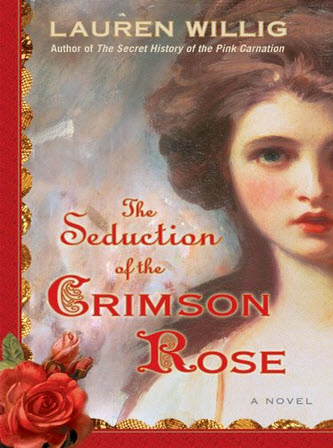
Lauren Willig’s Pink Carnation floral espionage series continues with book four of eleven, The Seduction of the Crimson Rose, and features droll characters bantering their way through espionage and falling in love. It’s a turn of the 19th century The Thin Man with all of the wit and irreverence one would expect of a Georgian Nick and Nora. As with the first novel, The Secret History Pink Carnation, the adventure is framed by a PhD candidate, Eloise, conducting research on aristocratic spies of the period and falling for the owner of the archives that make up the bulk of her source material. Their story moves quietly and slowly through the books while the historical portion resolves itself in each installment. Nefarious plots are thwarted and the assorted Pimpernels are drawn back into the fray when a new ruckus erupts as Eloise’s dissertation work continues.
Mary Alsworthy, great beauty and advantageous marriage seeker, has just been jilted for her own sister. Dusting herself off and masking her mortification, she is still hoping to trade her looks and sophistication for a nice title, inherited privilege and, fingers crossed, shiny baubles. Ruthlessly practical and not wanting to take money from her erstwhile fiance/brother-in-law, she agrees to work for Sebastian, Lord Vaughn, on behalf of The Pink Carnation seeking information about The Black Tulip. Mary’s work will help finance a London Season and her husband hunt. Lest one be put off by her mercenary intent, there is a marvelous fight between Mary and Vaughn about the role that choice plays in their respective lives. Mary is simply trying to find security in her life through the avenues available to her.
Romance novel Sebastians are frequently delightful and this one is no exception. He is older, wiser, and more world-weary than Mary, but capable of genuine feeling somewhere under all that wry, detached elan. Simultaneously resolute and a bit dandified, he is a magnificent urbane bastard that Mary finds irresistible. She lobs back his acerbic remarks in kind and they both give in to their attraction. He enjoys her beauty, but he adores her mind. Hijinks and not insignificant complications ensue, but everything turned out alright in the end. I think. I was reading for the love story, so I didn’t really pay close attention to the other elements.
Writing for those of us who love to recognize a reference, Willig is an extremely clever, well read, and deft author. Written with a wonderfully light touch, the books are mostly chaste with badinage standing in for sensuality. Much as a I love a little licentiousness in my reading, it’s a fair trade for such an entertainingly written story. While I prefer the romance to be more front and center, I would recommend The Seduction of the Crimson Rose to readers looking for intelligent and witty escapism.
Links to my other reviews can be found on my complete reading list of books sorted by author or Author Commentary & The Tallies Shameful.

As The Governess Affair and The Duchess War are Victorian romances by Courtney Milan, you can simply assume that, after providing the standard review content, I am going to encourage you to read them and virtually everything else she has published. Thematically, her stories focus on the questions of identity: Who are you? Who does society say you are? Who do you want to be? Romance tropes are flipped or shaken and Milan crafts lovely and heartfelt stories. Moreover, they contain social commentary and an unusually honest view of the era they depict, as well as of modern mores. Courtney Milan is amazing like that. She is the best romance writer currently publishing and quickly becoming one of the all-time greats in the genre.
The Governess Affair
Setting up the Brothers Sinister series, The Governess Affair is about the coming together of Serena Barton and Hugo Marshall. She was assaulted by her former, and his current, employer, the Duke of Clermont. Serena is staging a sit in on a bench outside of the Duke’s London residence insisting on reparations in the form of financial support for herself and the Duke’s unborn child. Tasked with removing this inconvenience is the Duke’s man of business, Hugo Marshall. They quickly discover that in any other circumstance, they would be rushing to a vicar. Because of the complications of Hugo’s employment and Serena’s pregnancy, their union faces stumbling blocks before it can begin. Serena has already decided who she wants to be and what she is willing to do to become that person. Hugo takes a little longer, but gets to where he needs to be as well.
Story threads beyond Serena and Hugh’s sweet relationship are created in The Governess Affair. What is a triumph for the protagonists has repercussions for both Oliver, their son, and his brother, Robert, the next Duke of Clermont. He just happens to be the hero of the next book in the series.
The Duchess War
Not only has Minerva Lane been told who she is, she has participated in her own belittlement. A lioness terrified of her yearning to roar, her tightly laced corset is the perfect metaphor for the compression of her spirit. When she encounters Robert Blaisdale, Duke of Clermont, at a social event, he witnesses her frustration and gets a glimpse of the formidable woman she hides. Thrown together repeatedly by their political interests and Robert’s fascination, he and Minnie find their way towards each other as much as they do into themselves. He is a Duke with no use for the peerage, she is a woman fighting for security on her own terms, and neither can resist the challenge the other one represents. The limitations imposed on and accepted by Milan’s characters are front and center for Robert and Minnie. They both want so much and are so afraid, often very reasonably, to reach and fail that they both have to find ways to stand up and together.
Both of The Governess Affair and The Duchess War are fantastic and I encourage you to read them and virtually everything else Courtney Milan has published. Minnie’s best friend, Lydia, is featured in the wonderful novella, A Kiss for Midwinter, that follows immediately on the heels of the latter novel. The Duchess War is a great romance, A Kiss for Midwinter is a classic of the genre and one of my top five romances of all time.
A complete summary of Courtney Milan’s catalogue, with recommendations, can be found here.
Links to my other reviews can be found on my complete reading list of books sorted by author or Author Commentary & The Tallies Shameful.
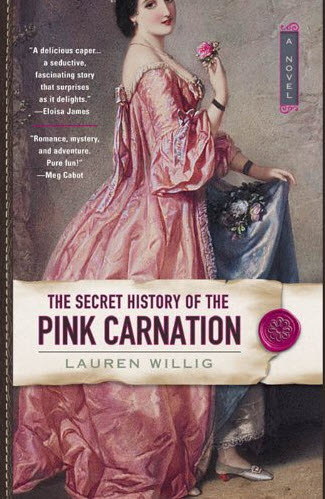
The Secret History Pink Carnation is the first book of eleven (so far) in Lauren Willig’s Georgian historical romance series of the same name. Each novel has a framing device featuring a PhD student combing through nineteenth century documents for her thesis research on aristocratic spies and the relation of what she finds as a romantic adventure story. Willig’s writing is light and clever and The Secret History Pink Carnation had a kind of breezy musical comedy tone. It bounced along as a charmingly written and pleasant romp with just a little peril for the protagonists to keep things interesting.
Amy is a displaced French aristocrat who escaped with her English mother to Shropshire on the eve of the Revolution. Her father lost his head to Mme. Guillotine and her brother, Edouard, claimed his safety by becoming a toady to the new regime. Amy has had schemes and stratagems for restoring the old order to France for years, so when her brother invites her to return to Paris, she feels that she will at last have her chance to make good on all her espionage practice. On her way to France, she meets up with Napoleon’s Egyptologist Richard Selwick. Feigning indifference to politics, he uses his position at Court to glean information and carry out deeds of daring do a la Scarlet Pimpernel and thus thumb his nose at the French government.
Amy and Richard spark and spar instantly in delightful bits of comedy. He finds himself irresistibly drawn to Amy even as he desperately tries to keep her safe, defuse her impetuous machinations, and get to the business of foiling Napoleon’s plot to invade England. Things move along nicely with enough twists, jeopardy, and romance to keep things interesting.
The framing device sets up a love story as well that is tracked through the other Pink Carnation books as that relationship develops. Even as the spy stories move farther afield geographically and chronologically, the present day heroine’s life moves forward just a few months. Such is my devotion to romantic subplots that I took three Pink Carnation books out of the library and while I didn’t read beyond the first one, I did go ahead and peruse the present day chapters of the other two books to check on that love story’s progress. I’m reasonably certain those two crazy kids will be able to work things out in the long run.
The Secret History Pink Carnation was very entertaining, well-researched, and a great choice if you like a bit of farce in your romance. It was not, as my romance spirit guide, Malin, warned me, my style as it was both just a bit too devil-may-care on the political elements and insufficient on the romance for my tastes. The key part of that last sentence is “for my tastes”. I like to focus on the love story in any romance I read so subplots are often wasted on me. Spies, in particular, leave me cold. I also have no use for political intrigue. Nor murder mysteries. Supernatural elements annoy me. Road trips are fine. Is someone writing these down? Honestly, there is no pleasing me.
Also by Lauren Willig – The Seduction of the Crimson Rose
Links to my other reviews can be found on my complete reading list of books sorted by author or Author Commentary & The Tallies Shameful.
 Mrs. Julien Presents